Table of Contents >> Show >> Hide
- The Misunderstanding: Everyone Thought Parker and Stone Were Atheists
- What Happens in “Go God Go”?
- Why the Episode Is Theological, Even When It Mocks Theology
- The Richard Dawkins Parody: Brutal, Messy, and Very South Park
- The Wii Plot Is Not a DistractionIt Is the Secret Ingredient
- What “Go God Go XII” Adds to the Argument
- How This Fits Into South Park’s Long History With Religion
- Why Fans Still Debate the Episode
- The Real Target: Certainty Without Humility
- Why the Episode Still Feels Relevant Today
- Experiences Related to the Topic: Watching “Go God Go” After Everyone Assumes They Know Your Beliefs
- Conclusion
Note: This article is based on verified episode details, creator commentary, and reputable entertainment and religion-media reporting. It is fully rewritten for original publication and contains no copied source text.
For a show famous for turning sacred cows into hamburger, South Park has always had a surprisingly complicated relationship with religion. Trey Parker and Matt Stone have mocked Catholics, Mormons, Scientologists, televangelists, cult leaders, miracle chasers, and just about anyone who brings a clipboard to your front door. So, naturally, plenty of viewers assumed the two creators were atheists. After all, when your cartoon has already put Jesus on cable television and sent Satan to a costume party, people tend to make theological guesses.
But that assumption helped inspire one of the show’s sharpest belief-system takedowns: the Season 10 two-parter “Go God Go” and “Go God Go XII.” The episodes do not simply make fun of atheism. They make fun of the human habit of turning any worldviewreligious, anti-religious, scientific, political, or fandom-basedinto a tribal identity war. In classic South Park fashion, the message arrives wrapped in time travel, Richard Dawkins, classroom evolution debates, and Eric Cartman’s unbearable need to play the Nintendo Wii.
The Misunderstanding: Everyone Thought Parker and Stone Were Atheists
The idea behind “Go God Go” came partly from public confusion over Parker and Stone’s own beliefs. Because South Park had spent years skewering organized religion, many fans and commentators assumed the creators must be firm members of the atheist club. The reality was more slippery. Parker and Stone have often resisted being filed under any simple label. Their comedy is not built around defending one ideology. It is built around attacking smugness, hypocrisy, certainty, and anyone who seems too pleased with himself.
That distinction matters. “Go God Go” was not written because Parker and Stone suddenly wanted to become Sunday school teachers. It was written because they noticed that atheists, especially the louder public voices of the mid-2000s, could be just as self-righteous as the religious figures the show had already lampooned. In other words, South Park did not switch teams. It widened the target list.
The timing was perfect. Richard Dawkins’ The God Delusion had become a major cultural talking point in 2006, and “New Atheism” was everywhere in debates about science, education, politics, and religion. The public conversation was not quiet, polite, or wearing socks with sandals. It was loud, combative, and ready-made for South Park.
What Happens in “Go God Go”?
“Go God Go” first aired on November 1, 2006, as the twelfth episode of South Park Season 10. On the surface, it begins as two unrelated stories. At South Park Elementary, Ms. Garrison is forced to teach evolution and reacts with furious resistance. Meanwhile, Cartman is obsessed with the upcoming release of the Nintendo Wii. Because waiting three weeks is apparently a human rights violation, Cartman decides to freeze himself so he can wake up on launch day.
Only Cartman could turn impatience into a science-fiction disaster. His homemade cryogenic plan goes wrong, and he wakes up more than 500 years in the future. Instead of finding a shiny new Wii, he finds a world where religion has disappeared and atheist factions are at war. The future is not a peaceful paradise of reason. It is a battlefield where groups with nearly identical beliefs are still killing each other over labels, language, and the “great question.”
Back in the present, Richard Dawkins appears as a guest teacher and becomes romantically involved with Ms. Garrison. Their relationship becomes the absurd engine that reshapes the future. Dawkins, who is portrayed less as a scientist than as a pompous anti-religious crusader, helps create the Godless world Cartman later stumbles into. But the joke is not that science is bad. The joke is that people can turn even reason into a costume and then fight over who wears it correctly.
Why the Episode Is Theological, Even When It Mocks Theology
Calling “Go God Go” a theological episode may sound strange because the story spends so much time ridiculing atheism. But theology is not just about sermons, saints, and stained glass. It is about ultimate questions: What do people believe? How do beliefs shape behavior? What happens when certainty becomes identity? Can a society remove religion and still keep all the same tribal instincts?
That is where the episode becomes smarter than its dirtiest jokes. The future atheist factions in “Go God Go XII” have no God, no church, and no traditional religion. Yet they still behave religiously. They chant. They divide into sects. They treat their group names as sacred. They turn Richard Dawkins into a nearly mythic founding figure. The vocabulary changes, but the pattern remains familiar.
This is one of Parker and Stone’s favorite comedic moves: separate belief from behavior. They are less interested in whether a doctrine is true than in whether believers become unbearable about it. In “Go God Go,” the problem is not atheism itself. The problem is dogmatism wearing a lab coat and shouting, “Science damn you!”
The Richard Dawkins Parody: Brutal, Messy, and Very South Park
Richard Dawkins was not chosen randomly. By 2006, he had become one of the most visible public critics of religion. His arguments against belief in God were widely discussed, praised, challenged, and mocked. For South Park, he represented a perfect satirical figure: brilliant, famous, controversial, and associated with a style of argument that many critics found condescending.
The show does not offer a careful academic rebuttal to Dawkins. That would be a different program, probably on PBS, probably with fewer talking otters. Instead, South Park caricatures the tone of militant certainty. Dawkins is shown as someone whose rationalism becomes its own form of arrogance. Ms. Garrison, after converting to atheism, does not become wiser or kinder. She simply changes which side she is obnoxious on.
That detail is important. The episode suggests that a belief system does not automatically improve a person. A cruel person can become religious and remain cruel. A smug person can become atheist and remain smug. A selfish person can travel 500 years into the future and still only care about a video game console. Yes, Cartman is the control group in this grand theological experiment, and the results are not encouraging.
The Wii Plot Is Not a DistractionIt Is the Secret Ingredient
One reason “Go God Go” works is that it refuses to become a lecture. Parker and Stone reportedly found the atheism material difficult because it risked becoming preachy. The Cartman-and-Wii storyline saves the episode from floating away into abstract debate. It gives the plot a ridiculous emotional engine. Cartman does not care about God, evolution, Dawkins, or the future of civilization. He cares about getting his hands on Nintendo’s newest console.
That childish obsession makes the episode funnier and more human. While adults argue about the origin of life, Cartman is conducting the dumbest possible experiment in delayed gratification. The result is a brilliant contrast: the grandest questions in philosophy sit next to the smallest tantrum in consumer culture. It is theology versus toy fever, and somehow both sides lose.
The timing also made the joke land harder. The Nintendo Wii launched in North America later that month, and excitement around the console was enormous. Cartman’s impatience exaggerated a real cultural mood. Anyone who remembers the Wii launch remembers the strange panic around finding one in stores. It was the closest many suburban families came to a mythic quest, except the sword was a motion controller and the dragon was a sold-out Best Buy shelf.
What “Go God Go XII” Adds to the Argument
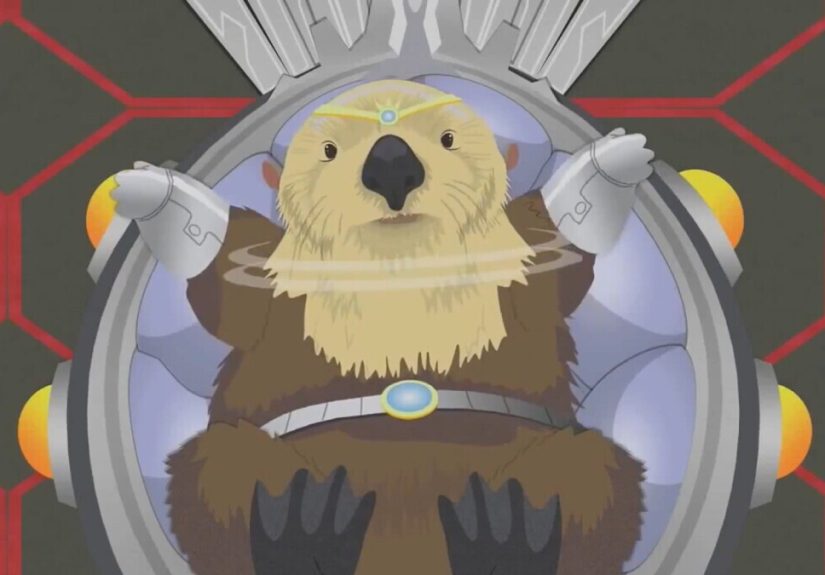
The second episode, “Go God Go XII,” aired on November 8, 2006, and expands the future-war satire. Cartman discovers three major atheist factions: the United Atheist Alliance, the United Atheist League, and the Allied Atheist Alliance, which includes highly evolved sea otters. Their conflict is absurd because their differences are ridiculously small. Their violence is not caused by belief in God. It is caused by the same old human machinery: pride, identity, control, and the need to be absolutely right.
The genius of the episode is that it does not argue that religion is good because atheists can be bad. That would be too simple. Instead, it argues that removing religion does not automatically remove the human instincts that often make religion dangerous. People can still form tribes. People can still worship leaders. People can still turn words into weapons. People can still be complete maniacs about cafeteria tables.
Near the end, the future changes after Cartman disrupts the relationship between Dawkins and Garrison. The atheist war disappears, but the world is not magically perfect. The larger joke remains: humans will always find something to fight about. If it is not religion, it may be politics. If it is not politics, it may be science. If it is not science, it may be which superhero movie “ruined cinema.” Civilization is resourceful that way.
How This Fits Into South Park’s Long History With Religion
“Go God Go” makes more sense when viewed alongside other religion-themed South Park episodes. “All About Mormons” turns Mormon history into a singalong explanation while still portraying the Mormon family as unusually kind. “Trapped in the Closet” attacks Scientology with unusually direct factual parody. “Red Hot Catholic Love” skewers Catholic scandal and institutional denial. “Bloody Mary” mocks miracle culture. Even “The Passion of the Jew” turns a blockbuster religious film into a story about guilt, fandom, and mob behavior.
Across these episodes, Parker and Stone are rarely saying, “This group is wrong, and that group is right.” Their recurring point is sharper: people become ridiculous when they stop questioning themselves. Faith can become ridiculous. Skepticism can become ridiculous. Politics can become ridiculous. Celebrity worship can become ridiculous. The moment a group treats doubt as betrayal, South Park starts warming up the flamethrower.
Why Fans Still Debate the Episode
Fans continue to discuss “Go God Go” because it is not easy to reduce to one clean message. Religious viewers may see it as a rare episode that criticizes atheist arrogance. Atheist viewers may see it as a messy but useful warning against turning skepticism into superiority. Comedy fans may simply enjoy Cartman being punished by the universe for not waiting three weeks. All of these readings can exist at once.
The episode also arrived during a cultural moment when debates about evolution, classroom science, intelligent design, and religion in public life were especially intense in the United States. That gives the story extra texture. Ms. Garrison’s resistance to evolution is absurd, but the atheist future is also absurd. The episode refuses to let either side feel fully comfortable. That is often when South Park is at its best: not balanced in a polite way, but offensive in every direction until nobody gets to sit smugly in the balcony.
The Real Target: Certainty Without Humility
The most useful way to read “Go God Go” is as a satire of certainty without humility. Parker and Stone are not asking viewers to abandon belief, science, religion, or skepticism. They are asking viewers to notice what happens when any idea becomes an excuse to stop listening. The episode’s future atheists do not fight because they lack information. They fight because they are convinced their faction owns the final answer.
That is why the line “no one single answer is ever the answer” captures the spirit of the two-parter. It sounds almost gentle by South Park standards, which means it is practically a stained-glass window. The show is not endorsing mushy relativism. It is mocking the fantasy that one slogan, one system, one book, one ideology, or one angry celebrity intellectual can solve the messy business of being human.
Why the Episode Still Feels Relevant Today
Nearly two decades later, “Go God Go” still feels current because online culture has made ideological team sports even louder. People do not merely disagree anymore; they brand themselves by disagreement. Every platform has factions, sacred phrases, forbidden phrases, purity tests, and miniature holy wars. The labels have changed, but the behavior is very familiar.
That is why the atheist factions in the episode are funny beyond the specific Dawkins-era context. They resemble any group that begins with a reasonable idea and ends with people screaming over the exact wording of the club name. The joke applies to internet fandoms, political subcultures, wellness movements, tech evangelists, anti-tech evangelists, and probably at least three group chats you regret joining.
“Go God Go” also reminds viewers that satire does not have to choose a comforting side. Parker and Stone’s comedy often frustrates people because it resists becoming propaganda. It can make a valid point in the least diplomatic way possible. It can also bury that point under bodily fluids, screaming, and sea otters. That mix is not accidental. It is the show’s method: make the audience laugh first, then make them wonder why the joke hit a nerve.
Experiences Related to the Topic: Watching “Go God Go” After Everyone Assumes They Know Your Beliefs
One of the most relatable parts of the story behind “Go God Go” is not the theology, the time travel, or even Cartman’s Wii addiction. It is the experience of being misread. Parker and Stone were placed into a box by audiences who thought they understood them: if you mock religion, you must be atheist; if you mock atheism, you must be religious; if you mock everyone, you must be impossible at dinner parties. That last one may be partly true, but the larger point stands.
Many people know what it feels like to have others assign them a belief system based on one opinion. Criticize a church scandal, and someone assumes you hate religion. Defend a religious person from lazy mockery, and someone assumes you are preaching. Question a scientific claim, and someone thinks you reject science. Support science, and someone thinks you have no room for mystery, meaning, or spirituality. Human beings love shortcuts, and labels are the cheapest shortcuts in the store.
That is why “Go God Go” can feel oddly personal. Beneath the absurdity is a familiar social experience: the pressure to join a team. Penn Jillette’s disappointment, as reported in discussions around the episode’s creation, is funny because it sounds like fandom language. It is not just “What do you believe?” It is “Why are you not on our side?” The episode turns that pressure into a cartoon future where everyone has chosen sides so completely that they have forgotten what the argument was supposed to be about.
Viewers who revisit the episode today may notice that Cartman is almost spiritually pure in his selfishness. He does not pretend to care about truth. He does not posture about morality. He wants a Wii. That makes him awful, but also strangely clarifying. Around him, adults and future civilizations dress up their desires in noble language: science, truth, peace, progress. Cartman just wants what he wants. The contrast makes everyone else look a little more ridiculous.
There is also an experience many longtime South Park fans recognize: laughing at a joke, then realizing the joke is partly aimed at you. A religious viewer may laugh at Dawkins being pompous, then remember how easily religious communities can become tribal. An atheist viewer may laugh at Ms. Garrison’s creationist ignorance, then wince at the future factions chanting like zealots. A gamer may laugh at Cartman’s impatience, then remember refreshing a checkout page for a console, phone, graphics card, or concert ticket like it contained the secret to eternal life.
That layered discomfort is why the episode has lasted. It is not the cleanest South Park story, and some of its jokes are deliberately crude even by the show’s standards. But it captures something durable about belief: humans rarely stop at ideas. We build identities around them. We form groups. We invent enemies. We create slogans. Then we act shocked when the next group does exactly the same thing with different words.
In the end, the experience of “Go God Go” is the experience of being reminded that certainty can be intoxicating. Whether someone is holding a holy book, a science book, or a Wii remote, the temptation is the same: to believe that one object, one answer, or one side will finally make everything simple. Parker and Stone’s answer is rude, funny, and strangely wise: beware of anyone who says the argument is over. Also, maybe do not freeze yourself in the mountains because Nintendo has a release schedule.
Conclusion
“Go God Go” and “Go God Go XII” remain standout South Park episodes because they turn a misunderstanding about Trey Parker and Matt Stone’s beliefs into a bigger satire about certainty, tribalism, and the human need to belong to the winning side. The episodes are theological not because they defend religion, but because they ask what replaces religion when humans still crave dogma. By pairing Richard Dawkins, evolution debates, atheist sectarian warfare, and Cartman’s desperate quest for a Nintendo Wii, Parker and Stone created a story that is ridiculous on the surface and surprisingly sharp underneath.