Table of Contents >> Show >> Hide
- Why Fall and Winter Matter So Much
- 1. Remove Fallen Fruit, Overripe Produce, and Fermenting Plant Matter
- 2. Tighten Up Trash, Recycling, Compost, and Outdoor Food Habits
- 3. Remove Shelter and Clutter That Make Great Wasp Real Estate
- 4. Seal Entry Points and Fix Repeat Nesting Hotspots Before Spring
- 5. Reduce Honeydew and Pest Pressure, Then Make a Spring Scouting Plan
- What Not to Do
- A Smarter Garden Is Usually a Less Wasp-Friendly Garden
- Common Garden Experiences and What They Teach You
If wasps turned your garden into a minor airspace dispute this year, fall is your chance to get the last word. The trick is not waiting until next summer, when colonies are large, workers are cranky, and every sugary sip outdoors suddenly feels like a public event. The best time to reduce next year’s wasp pressure is right now, while you can still see where they fed, where they nested, and what made your yard such a tempting hangout.
Here’s the encouraging part: social wasps do not simply clock back into the same colony next spring. Old colonies die off, and only mated queens survive winter. That means your job now is not to “fight an army.” It is to make your garden, shed, porch, beds, fruit trees, and nearby structures less appealing to those queens before they go house-hunting in spring. In plain English: remove the buffet, reduce the shelter, and shut down the best real estate.
Also worth saying: not every wasp is a villain in a tiny flight jacket. Many species help control garden pests by hunting caterpillars, flies, and other insects. So this is not a scorched-earth guide. It is a smart prevention plan for keeping nuisance wasps away from the places where you garden, harvest, relax, and eat lunch without accidentally sharing your sandwich with something striped and opinionated.
Why Fall and Winter Matter So Much
Most gardeners focus on wasps when they are already everywhere. That is understandable, but not ideal. By late summer and early fall, yellowjacket colonies can be large, food competition is high, and workers become more noticeable around fruit, trash, drinks, and outdoor meals. By then, you are managing a crowd. Right now, you can prevent next year’s crowd by targeting the conditions that invite queens to settle in.
Think of this season as your wasp-prevention offseason. The clues are visible: fallen fruit under trees, sticky aphid honeydew on leaves, open gaps under siding, old burrows near beds, rotting wood by the fence, and recycling bins that smell like a picnic gone wrong. Fix those now, and spring queens have fewer reasons to stay.
1. Remove Fallen Fruit, Overripe Produce, and Fermenting Plant Matter
If you do one thing this week, make it this one. Wasps love sugary food sources, and gardens produce plenty of them without trying. Fallen apples, split tomatoes, cracked figs, overripe pears, dropped grapes, and half-rotten peaches are basically little neon signs that say, “Free snacks this way.”
Yellowjackets and other nuisance wasps are strongly attracted to sweet liquids and fruit juices, especially later in the season. That means every piece of fruit on the ground is not just messy. It is advertising. And if you have fruit trees, berry patches, or vegetables that tend to split and soften, your yard can become a reliable feeding station.
What to do now
- Pick up fallen fruit at least every day or two during harvest season.
- Harvest ripe produce promptly instead of letting it linger on the plant “for one more day.”
- Remove damaged or split produce from beds and containers.
- Rake up decaying fruit and plant debris near seating areas, paths, patios, and play spaces.
- Check under shrubs and groundcovers where dropped fruit likes to hide and become an unnoticed wasp café.
This matters even more if you garden near a deck, outdoor dining area, or children’s play zone. Wasps do not care that your garden table is “for humans only.” If the buffet is nearby, they will commute.
2. Tighten Up Trash, Recycling, Compost, and Outdoor Food Habits
Gardeners sometimes focus so hard on flowers and vegetables that they forget the less glamorous attractants. Wasps are not picky food critics. In addition to sweet foods, many species also seek protein and scavenge from garbage, recycling, picnic debris, pet food, and spilled drinks. So even if your flower beds are pristine, your trash can may still be throwing an after-party.
This is where prevention gets gloriously boring and incredibly effective. A tightly covered bin does not look dramatic on Instagram, but it does remove a major reason wasps keep visiting. The same goes for rinsing cans and bottles, cleaning sticky residue from recycling bins, and not leaving pet food outdoors longer than needed.
What to do now
- Keep garbage containers tightly closed.
- Rinse soda cans, juice bottles, and food containers before putting them in recycling.
- Wash trash and recycling bins regularly, especially lids and handles.
- Clean up outdoor eating areas after every meal, including crumbs, meat drippings, and sweet drink spills.
- Do not leave pet food or sugary hummingbird-feeder leaks near patios or garden seating.
- Manage compost carefully; do not let fruit scraps sit exposed near the garden surface.
If you are wondering whether this really matters, the answer is yes. Many “wasp problems” are not nest problems at all. They are food-source problems. Remove the easy meals, and a lot of wasp traffic disappears with them.
3. Remove Shelter and Clutter That Make Great Wasp Real Estate
Queens need protected places to spend winter and suitable spots to start fresh nests in spring. That is why yards with wood piles, old stumps, rotting logs, brushy corners, dense shrubs, neglected sheds, and tucked-away cavities often see repeat wasp activity year after year. It is not that they are reusing the old nest. It is that your yard keeps offering premium zip codes.
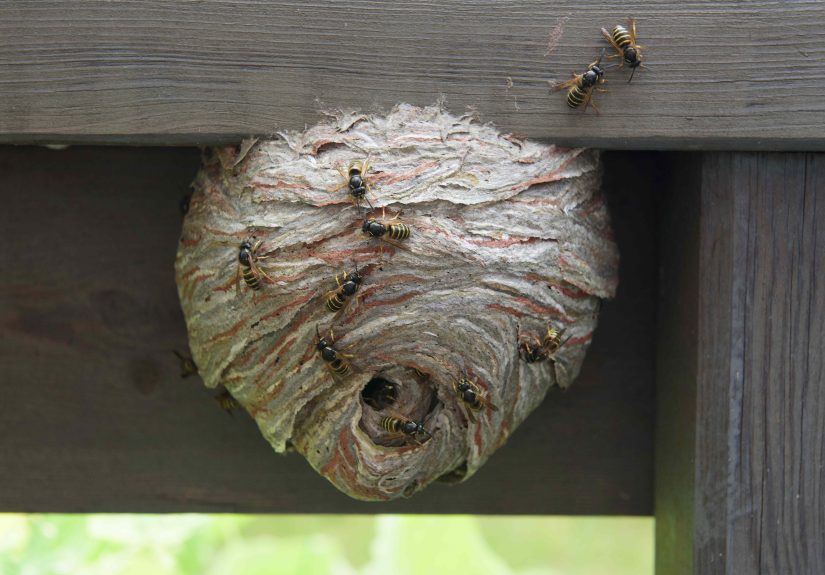
Paper wasps often favor sheltered places such as eaves, porch ceilings, barns, light fixtures, grills, mailboxes, and similar protected spots. Yellowjackets may choose underground cavities, voids around landscaping timbers, hollow logs, wall spaces, and other concealed sites. Overwintering queens also hide under bark, in wood piles, attics, chimneys, under siding, and similar quiet locations.
So yes, that picturesque stack of firewood leaning against the shed may also be a queen-friendly winter condo. Rustic charm has limits.
What to do now
- Move firewood stacks away from the house, porch, and garden seating areas.
- Remove old stumps, rotting logs, and decaying landscape wood when practical.
- Thin overly dense shrubs near entryways, patios, and play areas.
- Clear out clutter in sheds, under decks, around raised beds, and behind garden structures.
- Inspect grills, porch lights, birdhouses, trellises, and unused garden décor for early nest starts or hidden cavities.
You do not need to make your yard look like an empty parking lot. You just want fewer secluded, sheltered, undisturbed spots near the places where people spend time.
4. Seal Entry Points and Fix Repeat Nesting Hotspots Before Spring
This is one of the smartest long-term moves you can make. Wasps and hornets often return to the same type of location even though they do not reuse the old nest itself. If a queen successfully found a gap in siding, a vent without good screening, a cozy soffit space, or a quiet cavity under an eave once, another queen may judge that site worthy next year too.
That means prevention is partly a repair project. Screens, caulk, hardware cloth, siding repairs, and sealed access points can dramatically cut down on nesting in structures near the garden. Ground-level cavities matter too. Some yellowjackets nest in old rodent burrows or similar holes, so bare spots and abandoned burrows deserve attention.
What to do now
- Inspect soffits, eaves, fascia, vents, and attic openings.
- Repair or replace torn screens on vents, windows, and doors.
- Seal cracks around pipes, ducts, siding gaps, and trim.
- Check under porches, around landscape timbers, and near retaining walls for openings.
- Fill abandoned rodent burrows where appropriate and reduce bare, open nesting spots.
- Use mulch or encourage thicker turf in problem areas where ground nests have appeared before.
One important caution: if you suspect an active nest is inside a wall void, do not simply block the entrance immediately. That can force wasps into other exit routes, including interior spaces. Active nests in wall voids, roofs, or high-traffic areas are often best handled by a licensed pest professional. After the nest is inactive or professionally treated, then seal the access point so the site is less likely to be chosen again.
5. Reduce Honeydew and Pest Pressure, Then Make a Spring Scouting Plan
This final step is the one many gardeners miss. Wasps are not only attracted to fruit and soda-like sweetness. They are also drawn to honeydew, the sticky sugary waste produced by sap-feeding pests such as aphids and scale insects. If your trees, shrubs, roses, or ornamentals are coated in sticky residue, wasps may treat those plants like a snack bar.
On top of that, many wasps hunt other insects to feed their young. In moderation, that can be helpful. But heavy prey pressure can also keep wasps active around your garden. A healthier, better-managed landscape tends to be less appealing as a constant feeding zone.
What to do now
- Inspect plants for aphids, scale, and sticky honeydew.
- Prune or clean up badly infested growth where appropriate.
- Wash honeydew from leaves, patio furniture, railings, and nearby surfaces when practical.
- Manage plant pests early and sensibly next season so wasps have fewer sweet residues and prey concentrations.
- Make a note now of any problem sites so you can scout them in early spring.
That last point matters more than it sounds. In spring, queens start small nests before workers emerge. Catching activity early is far easier than dealing with a mature colony in August. Make a simple list now: under the deck, left shed vent, pear tree corner, mailbox post, porch light, fence line by the compost. When temperatures warm up next year, check those areas first.
What Not to Do
Prevention works best when it is paired with a little restraint. A few popular “solutions” are more likely to earn you panic, stings, or both.
Do not assume old nests are the whole problem
Old social-wasp nests are typically not reused the following year. Removing them can be tidy and satisfying, but the bigger job is changing the site conditions that made that location attractive in the first place.
Do not use gasoline, a hose blast, or other dramatic DIY heroics
These folk remedies are unreliable and can be dangerous. Wasps defend their nests fast, and badly timed nest attacks can end with multiple stings and a story you did not want to live through.
Do not try to eliminate every wasp in sight
Many wasps are beneficial predators and some are fairly nonaggressive when away from the nest. The goal is to reduce nuisance nesting and food attraction near people, not to wage war on every insect wearing yellow.
A Smarter Garden Is Usually a Less Wasp-Friendly Garden
If you zoom out, the best wasp prevention plan is really a good garden-maintenance plan wearing a pest-control hat. Harvest on time. Pick up what falls. Keep trash closed. Thin clutter. Repair gaps. Watch for aphids. Clean sticky surfaces. Scout problem spots before queens get comfortable. None of that is flashy, but it works because it matches how wasps actually behave.
And that is the real secret: next year’s wasp problem is often built this year, one overlooked detail at a time. A rotting pear under the tree. A vent with no screen. A gap under siding. An old burrow by the raised bed. A wood pile tucked against the shed. Fix enough of those now, and your garden becomes a much less attractive address.
In other words, you do not need a magic spray, a fake paper decoy, or a motivational speech for insects. You need fewer snacks, fewer shelters, and fewer easy entrances. The queens can go apartment hunting somewhere else.
Common Garden Experiences and What They Teach You
One of the most common experiences gardeners report is that the wasp problem seems to “appear out of nowhere” in late summer. In reality, it usually built slowly. Early in the season, a small nest can go unnoticed under an eave, inside a light fixture, behind siding, or down in a hidden ground cavity. Nobody pays much attention because traffic is light. Then August rolls around, fruit starts dropping, outdoor meals happen more often, and suddenly it feels like the garden has been placed under active surveillance by tiny security drones.
Another familiar pattern happens around fruit trees. A gardener may think the issue is the tree itself, when the real problem is the fruit on the ground. Once apples, pears, peaches, or grapes begin splitting, fermenting, or dropping, wasps start visiting the ground first, then the low-hanging fruit, then anything else sugary nearby. People often notice the wasps near a chair, a hose bib, or the back steps and assume the nest must be there. Sometimes it is. Just as often, the food source is the main attraction.
Many gardeners also learn the hard way that “just one little gap” in a structure is more than enough. A loose screen over a vent, an opening near a soffit, a gap where a pipe enters the wall, or a hollow post cap can become prime nesting space. Then the next season feels strangely familiar. That is why repeat problem areas matter so much. Wasps may not reuse the same nest, but they absolutely appreciate good architecture.
There is also the experience of discovering that the prettiest, most relaxed corners of a yard can double as excellent insect shelter. Dense shrubs by a patio create privacy for people, but they can also create protected routes and cavities for nest-building. A decorative wood pile by the fence looks charming until you remember that queens like protected overwintering spots too. Garden maintenance and pest prevention are more connected than they first appear.
Then there is the emotional side of it, which is very real. Once someone gets stung near the garden, every buzzing insect starts to feel personal. That is understandable, but it can lead to overcorrecting and treating every wasp as a disaster. In practice, the best outcomes usually come from calm observation. Where are they feeding? Where are they flying in and out? Is the issue a nest, a food source, or both? Gardeners who pause and diagnose usually solve the problem faster than gardeners who go straight to battle mode with a spray can and a dream.
The biggest lesson from all these experiences is simple: prevention feels small when you are doing it, but huge when you skip it. Picking up fruit, washing bins, sealing vents, moving wood piles, noting old burrows, and checking spring hotspots are not thrilling chores. But they are exactly the kind of steady, practical steps that turn next year’s garden from “why are there so many wasps?” into “huh, I barely noticed them.” And honestly, that is the kind of quiet gardening success worth aiming for.