Table of Contents >> Show >> Hide
- Why Talking Underwater Sounds Like a Secret Whale Meeting
- The Classic Underwater Conversation: A Dramatic Reconstruction
- Why We Still Try to Talk Underwater Anyway
- The Role of Body Language Below the Surface
- Why This Tiny Moment Feels So Awesome
- Childhood, Swimming Pools, and the Language of Summer
- Underwater Hearing and the Science of Muffled Words
- Safety Note: Fun Is Great, But Water Still Deserves Respect
- How to Get Better at Understanding Your Friend Underwater
- Why This Belongs on a List of 1000 Awesome Things
- Extra Experiences: The Joy of Misunderstood Underwater Conversations
- Conclusion
There are many great mysteries in life. Why does one missing sock always disappear into another dimension? Why does toast land butter-side down with suspicious consistency? And, perhaps most importantly, why does your best friend suddenly believe they can deliver a full TED Talk while both of you are underwater?
Welcome to one of life’s oddly perfect little moments: trying to understand what your friend’s saying when you’re underwater. It is not efficient. It is not elegant. It is definitely not a language recognized by any official academic institution. But somehow, in the bubbly blue silence of a pool, lake, ocean, or hotel hot tub, two people can look at each other, puff out a few distorted sounds, wave their hands like confused sea captains, and walk away convinced they held a meaningful conversation.
This tiny human ritual, celebrated in the spirit of 1000 Awesome Things, deserves more attention than it gets. It combines science, friendship, comedy, body language, childhood memories, and the universal desire to say something extremely important at the worst possible time. Like, “Look at that!” Or, “I found your goggles!” Or, “I think I swallowed half the pool.”
So let’s dive ingoggles optionaland explore why underwater communication is so hilariously difficult, why sound behaves strangely below the surface, and why this simple moment remains one of those small, ridiculous joys that makes life feel lighter.
Why Talking Underwater Sounds Like a Secret Whale Meeting
On land, speaking feels easy because air is doing a lot of behind-the-scenes work. Your vocal cords vibrate, sound waves travel through the air, your friend’s ears receive those vibrations, and their brain turns them into words. It is a beautiful system, until you add water and everything becomes “blurb-glorp-mmph?”
Sound actually travels faster in water than in air. In seawater, it can move more than four times faster than it does through air. That sounds like underwater talking should be clearer, right? Wrong. This is where physics strolls in wearing flippers and ruins the party.
Human ears are designed for air. When your ear canal fills with water, sound does not reach your eardrum in the usual way. Instead, much of what you hear underwater comes through bone conduction and vibration. That means your brain is receiving sound, but it is not receiving the crisp, neatly packaged version it expects. The result is less “clear conversation” and more “someone put a walkie-talkie in a washing machine.”
The Water Is Fast, But Your Ears Are Confused
Underwater sound moves quickly because water is denser than air. Its particles are packed closer together, so vibrations can transfer efficiently. In the ocean, sound can travel long distances, especially low-frequency sound. That is one reason marine animals such as whales and dolphins rely heavily on sound to communicate, navigate, and understand their environment.
But people are not dolphins, despite what your friend may believe after doing one decent cannonball. Our ears evolved for conversations in air, not for decoding bubble-filled pool speeches. Underwater, it also becomes harder to tell where a sound is coming from because sound reaches both ears with less of the timing difference our brains normally use for direction. Your friend could be two feet away or halfway across the pool yelling about a pool noodle, and your brain may simply shrug.
That is part of the magic. You are both technically communicating, but your senses are playing a prank on you.
The Classic Underwater Conversation: A Dramatic Reconstruction
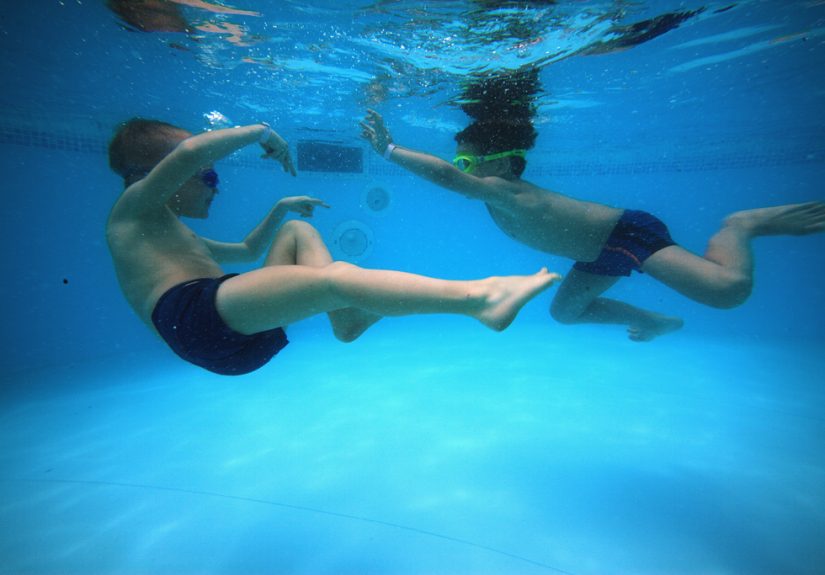
Every underwater conversation follows a familiar pattern. First, someone gets an idea. This idea is almost never important enough to justify underwater communication, but in the moment it feels urgent. They tap your shoulder. You turn around. Their cheeks are puffed. Their hair is floating like seaweed in a shampoo commercial gone wrong.
Then they speak.
“Mmmmph-brrrb-ooof?”
You stare.
They repeat it, louder, because naturally the problem must be volume, not the entire aquatic environment.
“MMMMMPH-BRRRB-OOOF!”
You nod confidently, because friendship sometimes means pretending you understand. Then you both surface, gasping and laughing, and discover they were saying, “Do you want to race?” while you thought they said, “There’s a snake.”
This is the exact point where underwater friendship becomes comedy gold. The misunderstanding is the feature, not the bug.
Why We Still Try to Talk Underwater Anyway
Humans are stubborn social creatures. Put us anywhereelevators, airplanes, dentist chairs, quiet librariesand eventually we will try to communicate. Underwater is no different. The moment speaking becomes difficult, it also becomes irresistible.
Part of the fun is the challenge. Can you decode your friend’s message before you run out of breath? Can you read their eyebrows through goggles? Can you tell whether they are saying “Marco Polo,” “my toe hurts,” or “I found a penny”? It becomes a game of lip-reading, charades, guesswork, and emergency bubble translation.
That effort makes the moment feel strangely satisfying. When you finally understand what your friend means, even if the message is just “look at my handstand,” it feels like cracking an ancient code. You are no longer a swimmer. You are a deep-sea linguist. A chlorine-soaked detective. A master of the mystical language of bubbles.
The Role of Body Language Below the Surface
Because speech fails so spectacularly underwater, body language takes over. Eyes get wider. Fingers point more dramatically. Eyebrows become punctuation. A shrug can mean “I don’t know,” “I dropped it,” or “this was a terrible idea.”
Professional divers rely on clear hand signals for safety. Common scuba diving signals can communicate essential ideas such as “OK,” “go up,” “go down,” “stop,” “problem,” or “low on air.” Before a dive, trained divers often review signals with their buddies so everyone understands the plan. That kind of communication is practical, precise, and potentially life-saving.
Pool communication between friends is usually less polished. Instead of a clean “OK” signal, you may get a frantic combination of pointing, nodding, jazz hands, and bubbles. Still, the basic principle is the same: when words fail, the body gets promoted to spokesperson.
Underwater Charades: The Unofficial Sport
Trying to understand your friend underwater is basically charades with a time limit. You are holding your breath, your friend is acting out something that may or may not involve a diving ring, and both of you are floating just enough to make every gesture look dramatic.
The best part is that the stakes are usually delightfully low. Nobody is negotiating a business contract down there. Most underwater messages are wonderfully simple:
- “Watch this flip.”
- “I found the toy.”
- “Let’s race.”
- “Your goggles are crooked.”
- “There is definitely a leaf touching my foot and I hate it.”
Yet each one feels urgent. That urgency, paired with the total lack of clarity, is what makes the moment so funny.
Why This Tiny Moment Feels So Awesome
The charm of “trying to understand what your friend’s saying when you’re underwater” is that it captures a rare kind of playfulness. It is silly, physical, and immediate. You cannot multitask underwater. You cannot check your phone. You cannot overthink a text message. You are simply there, suspended in blue, trying to decode your friend’s bubbly nonsense before both of you need air.
That kind of attention feels refreshing. In a world full of notifications, underwater communication is beautifully analog. No typing indicators. No autocorrect. No “seen at 2:14 PM.” Just eye contact, bubbles, and hope.
It also brings people closer. Shared confusion is underrated. When you and a friend surface laughing because one of you misunderstood “race to the wall” as “brace for a fall,” you have created a tiny private memory. It may not be profound, but it is sticky. Years later, the memory can pop back up with the smell of sunscreen or the sound of splashing water.
Childhood, Swimming Pools, and the Language of Summer
For many people, underwater talking belongs to childhood. It lives in the same mental scrapbook as wrinkled fingers, sun-warmed towels, diving sticks, inflatable rafts, and the proud moment when you finally touched the bottom of the deep end.
Children are natural underwater communicators because they are fearless inventors of nonsense. They do not care that their words are impossible to understand. They will still deliver an entire speech underwater with the confidence of a mayor addressing the town. And somehow, other kids understand enough to keep the game going.
That is why this awesome thing feels nostalgic. It reminds us of a time when communication did not have to be perfect to be successful. A look, a gesture, a bubble, and a laugh were enough.
Underwater Hearing and the Science of Muffled Words
There is a practical explanation for why your friend sounds so strange underwater. Speech depends on a wide range of frequencies, and our brains are used to interpreting those frequencies through air. Water changes how sound energy moves and how it enters the ear. The outer ear canal fills with water, the eardrum receives sound differently, and the skull can carry vibrations in a way that makes voices feel internal, muffled, or directionless.
That is why underwater sounds can seem both loud and unclear at the same time. You may hear a nearby splash, thump, or shout, but the details of speech get blurred. Consonants suffer especially badly. On land, the difference between “race,” “face,” and “base” is obvious. Underwater, those words may all become “brrrff.”
This also explains why people naturally exaggerate. They open their eyes wider, make bigger mouth shapes, point harder, and repeat themselves with more bubbles. The body knows the message is not getting through, so it starts adding subtitles.
Safety Note: Fun Is Great, But Water Still Deserves Respect
As funny as underwater talking is, water safety matters. Holding your breath for too long, roughhousing, swimming while exhausted, or ignoring pool rules can turn a playful moment risky. The best version of this awesome thing happens in safe conditions, with people who are comfortable in the water and paying attention to each other.
Healthy swimming habits also matter. Public health guidance often emphasizes not swallowing pool water, staying out of the water when sick with diarrhea, showering before swimming, and helping keep recreational water cleaner for everyone. Your underwater conversation may be hilarious, but nobody wants the plot twist to be “accidental mouthful of mystery water.”
Ear care is worth remembering too. Water trapped in the ear canal can contribute to swimmer’s ear, a painful outer ear infection. Drying ears gently after swimming and avoiding aggressive cleaning with cotton swabs can help protect the ear canal. In other words: enjoy the underwater nonsense, then take care of your ears like the loyal little sound-catchers they are.
How to Get Better at Understanding Your Friend Underwater
You may never become fluent in Bubble-ish, but you can improve. First, keep messages short. “Race?” works better than “Would you be interested in competing in a casual freestyle event from this side of the pool to the other?” Second, use gestures. Point, nod, thumbs up, thumbs down, and simple hand signals can do more than a full sentence.
Third, make eye contact. Underwater communication depends heavily on visual clues, especially facial expressions and mouth shapes. Fourth, surface when needed. There is no shame in popping up and saying, “What?” In fact, that is the official anthem of underwater friendship.
Finally, embrace the misunderstanding. Half the joy comes from getting it wrong. If your friend says “look at the fish” and you hear “lick the dish,” congratulations. You have created a memory.
Why This Belongs on a List of 1000 Awesome Things
The best awesome things are often small. They are not expensive, rare, or complicated. They are little sparks of joy hiding in ordinary life: the first sip of cold water when you are thirsty, the perfect parking spot, a warm towel, or a friend making a ridiculous face underwater while trying to communicate something very important about a pool toy.
Trying to understand your friend underwater belongs on that list because it is a pure, unserious moment of connection. It asks nothing from you except attention, breath, and a willingness to look ridiculous. It turns a normal swim into a tiny adventure. It reminds us that friendship is not only built through deep conversations. Sometimes it is built through muffled nonsense and shared laughter.
Extra Experiences: The Joy of Misunderstood Underwater Conversations
One of the funniest things about underwater communication is how quickly everyone becomes overconfident. You can spend five seconds below the surface and suddenly believe you have developed a complete new language. You point at the diving ring, your friend nods, you kick toward the bottom, and for one glorious moment it feels like teamwork. Then you surface and realize your friend thought you were pointing at your foot. Somehow, both of you still feel successful.
There is a special kind of friendship that grows in swimming pools. It is not polished or formal. It is made of splash fights, borrowed goggles, shouted dares, and underwater “conversations” that would make no sense to anyone else. When you are underwater, your friend’s face becomes funnier. Their cheeks puff out. Their hair floats upward. Their words become bubble soup. Even a serious message looks ridiculous, which is why underwater arguments never really work. It is hard to stay dramatic when both people look like surprised goldfish.
Some of the best pool memories start with someone trying to say something underwater and failing completely. Maybe they are warning you that your goggles slipped. Maybe they are asking whether you want to race. Maybe they are announcing that they just performed the greatest underwater handstand in neighborhood history and would appreciate applause. Whatever the message, the delivery is always part speech, part mime, part aquarium soundtrack.
At the beach, the experience changes slightly. Waves add chaos. Salt water adds drama. Your friend may be only a few feet away, but one rolling wave can turn their message into a full ocean remix. You catch one word, miss the rest, and respond with a confident thumbs up even though you have no idea what you just agreed to. This is how people accidentally join sandcastle competitions, swim races, or snack runs.
Lakes add their own mysterious atmosphere. The water is darker, the bottom is suspicious, and every brush against your leg feels like a creature from a low-budget monster movie. Underwater communication in a lake often involves fewer words and more urgent pointing. Your friend says something muffled, you see their eyes widen, and suddenly you are both swimming toward the dock like Olympic athletes with unresolved emotional issues.
Hotel pools may be the funniest setting of all. Everyone is relaxed, nobody is taking anything too seriously, and there is always one person who believes the pool is their personal stage. Underwater talking becomes part of the entertainment. Someone invents a challenge. Someone mishears the rules. Someone surfaces laughing so hard they inhale a tiny amount of pool water and immediately regrets every decision that led to that moment.
The beauty of these experiences is that they do not need to be perfect. In fact, they are better when they are imperfect. The missed words, wrong guesses, goofy expressions, and dramatic bubbles are the whole point. Trying to understand your friend underwater is a reminder that communication is more than language. It is effort. It is attention. It is the willingness to meet someone halfway, even if halfway happens to be three feet below the surface and full of chlorine.
And when you finally understand each otherwhen the gesture clicks, the message lands, and both of you surface laughingit feels like a tiny victory. Not a life-changing victory, maybe. But the kind that makes a summer afternoon brighter. The kind that turns a normal swim into a story. The kind that proves awesome things are often hiding in plain sight, just below the surface.
Conclusion
Trying to understand what your friend’s saying when you’re underwater is one of those small, absurd pleasures that makes being human feel wonderfully unserious. It mixes science with silliness, friendship with confusion, and sound waves with a heroic amount of bubbles. Water may distort speech, confuse our ears, and turn simple sentences into mysterious aquatic poetry, but that is exactly why the moment works.
It is funny because it fails. It is memorable because you both keep trying. And it is awesome because, for a few seconds, the world gets quieter, your friend gets blurrier, and communication becomes a ridiculous little adventure. Whether you are in a backyard pool, a lake, the ocean, or a hotel pool with suspiciously strong chlorine, the underwater conversation remains a classic: confusing, hilarious, and strangely beautiful.