Table of Contents >> Show >> Hide
- Why Visby Is the Perfect Setting
- What Makes a Creperie Feel Modern Here
- Why Crêpes and Galettes Fit Scandinavia So Well
- The Role of Fika and Slow Pleasure
- Design, Mood, and the Scandinavian Talent for Restraint
- What the Experience Says About Travel Now
- Final Thoughts: Butter, Stone, and Time Travel
- Extended Experience: 500 More Words from the Cobblestones
Some cities flirt with history. Visby, Sweden, practically moves in with it. Inside this walled town on the island of Gotland, the past is not tucked safely behind museum glass. It spills into the streets, clings to the stone, and peeks around corners in the form of ruined churches, narrow lanes, and old merchant houses that seem to have absolutely no intention of becoming less photogenic with age. And yet, in the middle of all that medieval drama, there is something delightfully modern about sitting down for a crêpe.
That contrast is what makes the idea of a modern-day creperie in a medieval Scandinavian city so irresistible. It is not just about food. It is about atmosphere, adaptation, and the small miracle of how cities survive by letting old bones hold new habits. In Visby, one of the best-preserved medieval cities in northern Europe, a creperie feels both surprising and completely right. The stone walls say thirteenth century. The plate in front of you says lunch. The room says stay a while. And your schedule, if you have any wisdom at all, says cancel the rest.
Why Visby Is the Perfect Setting
To understand why this pairing works, you have to start with the city itself. Visby is not a generic old town with a few cobblestones and a gift shop pretending to be ancient. It is a place with serious historical credentials. The town rose from a Viking-era settlement into a major Hanseatic trading center, and its thirteenth-century ramparts still loop around the old core like they were built by people who believed strongly in walls, commerce, and making a statement. Visby has long been called the city of roses and ruins, which sounds like the title of an indie film, but it is actually an accurate description. In summer, climbing roses soften the stone. Ruined churches punctuate the skyline. The Baltic light does the rest.
That layered backdrop matters because a meal is never only about what is on the plate. In a place like Visby, the city becomes part of the flavor. A savory galette eaten after a walk along the wall feels more grounded than the same dish might feel in an airport food court. A sweet crêpe after wandering through medieval alleys feels less like dessert and more like emotional support. The town gives the meal context, and the meal gives the town a human scale. History stops being abstract the minute you sit down inside it.
What Makes a Creperie Feel Modern Here
The genius of a modern creperie in a city like Visby lies in how relaxed it is. Medieval settings can sometimes encourage businesses to lean too hard into costume-drama theatrics, as if every table should come with a goblet and a lute player named Bjorn. A good modern creperie resists that temptation. It lets the architecture do the historical heavy lifting while the menu, lighting, and hospitality bring the place into the present.
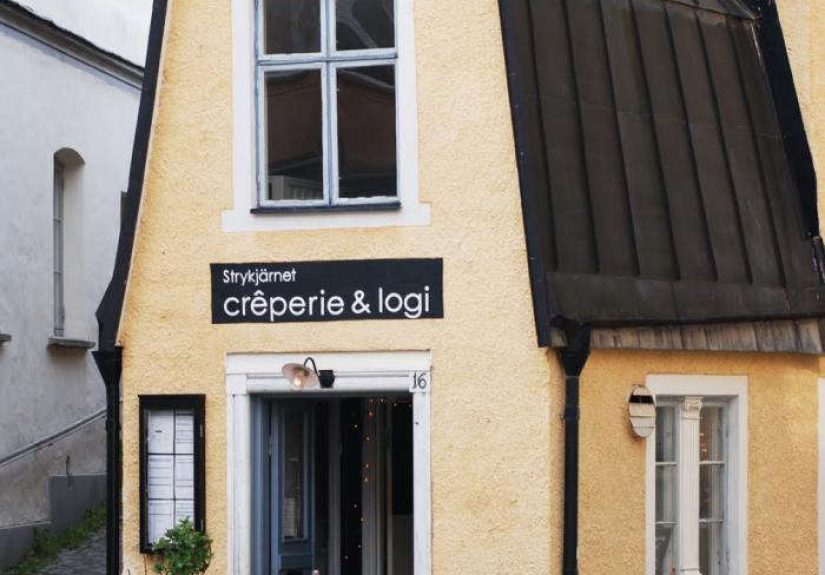
One real example that captures this idea is Crêperie & Logi in Visby’s old town, often associated with the distinctive Strykjärnet building. Coverage of the space has described it as being in the medieval inner city, in a neighborhood dating back to the twelfth century, with interiors inspired by Gotland’s sea and stark landscape. That mix is exactly the point. You do not have to fake medieval charm when you already have it. You can be crisp, minimal, warm, and contemporary inside a centuries-old setting and somehow make the whole thing feel even older in the best possible way.
Modernity here is not loud. It shows up in the confidence of the concept. It shows up in the menu design, the clean plating, the casual pace, and the sense that nobody is trying too hard. Scandinavian hospitality often works that way. The room is comfortable rather than theatrical. The details are thoughtful rather than crowded. You feel taken care of without being trapped inside a performance. In other words, it is the opposite of eating in a theme park tavern while wondering whether the chicken was seasoned during the Middle Ages.
Why Crêpes and Galettes Fit Scandinavia So Well
At first glance, French crêpes in a Swedish medieval town might sound like culinary jet lag. Look closer, though, and the pairing makes all kinds of sense. Crêpes and galettes are simple, versatile, and highly adaptable. Their charm comes from what they can carry: cheese, ham, mushrooms, berries, cream, herbs, smoked fish, seasonal vegetables, and all the little local ingredients that make regional dining memorable. In that way, the format is almost tailor-made for a Scandinavian setting.
There is also a historical logic to it. Crêpes are commonly linked to Brittany, where buckwheat galettes became a practical and beloved staple. That matters because buckwheat, rye, dairy, preserved fish, forest berries, and seasonal produce all sit comfortably within northern food traditions as well. A galette is French in origin, yes, but it is generous enough to welcome local identity. In Visby, that means a French idea can absorb a Gotlandic accent without sounding confused.
That is exactly what makes a place like Visby Crêperie & Logi so appealing. It has been described as serving galettes and crêpes based on French cuisine but with an exclusive Gotlandic touch. That little phrase does a lot of work. It suggests that the restaurant is not copying Brittany line for line like a student trying not to get caught. It is translating the form into local language. The result is less “French import” and more “Baltic conversation.”
The Local Twist Matters
Gotland has its own food identity, and a strong one. The island is known for ingredients and specialties that feel inseparable from place: seafood, foraged flavors, berries, rye bread traditions, and the famous saffranspannkaka, a saffron pancake traditionally served with whipped cream and dewberry jam. That last detail is especially fun because it proves the island already understands the emotional power of a pancake-shaped treat. A creperie is not an alien idea here. It is a cousin with better French pronunciation.
Modern Scandinavian dining also tends to value seasonality, local sourcing, and ingredients that connect land and sea. That makes a creperie menu especially flexible. A savory galette can hold smoked fish one season, mushrooms and cheese the next, and some sort of buttery, herb-scented miracle whenever the kitchen feels ambitious. A sweet crêpe can swing from restrained and elegant to fully committed dessert chaos. There is room for both good taste and actual good taste, which is the best kind of double meaning.
The Role of Fika and Slow Pleasure
No discussion of a Scandinavian creperie would feel complete without mentioning fika, Sweden’s beloved ritual of pausing for coffee and a treat. Fika is more than a caffeine break. It is a social rhythm, a small daily insistence that life should include conversation, stillness, and something delicious on a plate. In Visby, where café culture already fits naturally among old streets and garden courtyards, a creperie slips easily into that tradition.
The beauty of fika is that it rejects urgency. You do not inhale your coffee while power-walking across a parking lot. You sit. You chat. You observe. You pretend your inbox cannot find you. A modern creperie in a medieval city extends that same philosophy into lunch or an early dinner. The format encourages lingering. You order one thing, then maybe another. You talk about the architecture as if you are deeply qualified to evaluate thirteenth-century masonry. You split a sweet crêpe because that sounds modest, then immediately regret sharing.
That slower pace is part of the article’s core appeal. In a world obsessed with speed, a creperie inside old stone streets feels quietly rebellious. It asks you to enjoy the city instead of merely collecting it. It turns travel from a checklist into an afternoon.
Design, Mood, and the Scandinavian Talent for Restraint
A modern-day creperie in Visby works not only because of the food, but because of the mood. Scandinavian interiors tend to favor restraint, texture, and natural materials over fuss. That design language pairs beautifully with medieval architecture because both rely on authenticity. Stone walls do not need help being stone walls. Timber beams do not need a motivational speech. All a smart restaurateur has to do is create warmth around them.
That can mean muted colors, soft lighting, clean lines, simple tableware, and details that echo the local landscape rather than compete with it. A sheepskin draped over a chair in a cool climate does not feel staged; it feels sensible and inviting. A room inspired by Gotland’s sea, limestone, and spare beauty feels more lasting than a room stuffed with faux-historic clutter. The real achievement is making the place feel intimate rather than precious.
And that is where the “modern-day” part truly earns its spot in the title. Modern here does not mean futuristic. It means edited. It means choosing comfort over spectacle, clarity over gimmicks, and genuine atmosphere over decorative shouting. A city with this much history does not need a restaurant to yell. It needs a restaurant to listen.
What the Experience Says About Travel Now
Travelers increasingly want places that feel rooted, not interchangeable. They want meals that could only make full sense where they are being eaten. A burger in a medieval Scandinavian city may be perfectly serviceable, but it does not necessarily tell you much about the place. A thoughtfully run creperie, by contrast, can become a bridge between traditions. It lets a visitor experience local ingredients, local tempo, local design, and local geography through a format that still feels easy to approach.
That accessibility matters. Not every visitor is ready to dive face-first into the most traditional item on the regional menu. A creperie offers an on-ramp. You may arrive for something familiar, then notice the local jam, the island cheese, the smoked fish, the herb combinations, the coffee ritual, the rhythm of the room. Before long, the place has taught you something without ever turning into a lecture.
In that sense, the modern-day creperie becomes a model for the best kind of travel experience. It respects the past without fossilizing it. It welcomes outside influence without losing local identity. It is cosmopolitan without becoming generic. And it proves that one of the nicest ways to encounter a medieval city is not always through a cathedral or museum, but through lunch.
Final Thoughts: Butter, Stone, and Time Travel
A modern-day creperie in a medieval Scandinavian city works because it captures a rare balance. It feels old and new, local and borrowed, stylish and relaxed, all at once. In Visby, that balance becomes especially vivid. The city’s walls, ruins, and Hanseatic history provide gravity. The creperie supplies ease. Together, they create the kind of experience travelers remember with embarrassing intensity and then try, unsuccessfully, to recreate at home with a nonstick pan and unrealistic optimism.
The real lesson is that living cities survive by mixing continuity with reinvention. Medieval stone alone is not enough. Neither is trend-driven dining. But combine a deeply rooted place with a format that invites warmth, conversation, and local flavor, and suddenly you have something better than a meal. You have a scene. You have a mood. You have one of those rare travel moments that feels cinematic while you are in it and even better once it becomes memory.
And if that memory involves a crisp-edged galette, a good cup of coffee, a breeze off the Baltic, and a stroll through rose-lined lanes afterward, well, that is not just lunch. That is history behaving beautifully.
Extended Experience: 500 More Words from the Cobblestones
Imagine arriving just after noon, when the old town seems to glow rather than merely shine. The stone underfoot is uneven in the polite medieval way, meaning it has been charming people for centuries while plotting against flimsy shoes. You pass church ruins, a low wall warmed by the sun, and a lane so picturesque it looks suspiciously curated. Then you step into a creperie where the mood shifts from postcard to pulse. The city outside is grand and historic; the room inside is human-sized and alive. Cutlery clinks. Coffee lands on tables. Someone laughs in that easy, unperformed way that instantly makes a place feel worth staying in.
The first thing you notice is temperature. Not literal temperature, though that matters too in Scandinavia. It is the emotional temperature. Medieval cities can sometimes feel awe-inspiring but slightly distant, as if they are waiting for you to admire them from the correct historical angle. A creperie changes that. It gives the city a living room. Suddenly the old town is not only something to study or photograph. It is somewhere to eat, rest, and become temporarily ordinary inside. That may be the most luxurious travel experience of all.
You order a savory galette because restraint seems wise. It arrives looking understated, which is how very good food often enters the conversation. Then the flavors unfold: something nutty from the batter, something creamy from the cheese, something bright from greens or herbs, and maybe a smoky, salty note that makes you remember you are on a Baltic island. The ingredients do not need to show off. They just need to know where they are. In a city with this much character, confidence is more appealing than drama.
Then comes the sweet course, because obviously it does. Perhaps it is simple: butter, sugar, lemon, and the kind of balance that makes you wonder why dessert menus everywhere are trying so hard. Or perhaps it leans into local fruit and cream, giving the meal a faint echo of Gotland’s own saffron-pancake traditions. Either way, the effect is the same. The room softens. Time widens. You remember that travel is not a race to consume landmarks but a chance to let places rearrange your pace.
Outside again, the city feels different after the meal. The walls seem less remote. The alleyways feel less like scenery and more like part of a lived-in pattern. A restaurant can do that when it is good enough: it can convert a destination into a memory with texture. You no longer think only about Visby as a UNESCO site or a medieval trading city. You think about the way lunch sounded, smelled, and lingered. You think about coffee steam against old windows, the scrape of chairs on ancient floors, the breeze waiting outside, and the very modern satisfaction of being exactly where you are.
That is why the idea of a modern-day creperie in a medieval Scandinavian city lands so well. It captures the best version of contemporary travel: respectful of history, hungry for beauty, and smart enough to understand that sometimes the soul of a place reveals itself not in the biggest monument, but in the warmest room nearby.