Table of Contents >> Show >> Hide
- Why Old Inductors Looked So Good
- What Inductors Actually Do, Minus the Textbook Headache
- The Great Shrinking: Why Inductors Started Looking Boring
- Why Coil Beauty Still Matters
- The Comeback: Makers, Machines, and Modern Curiosity
- Modern Inductors Are Better, but They Also Borrow From the Past
- Where Beautiful Inductors Still Show Up
- What Engineers and Hobbyists Can Learn From the Revival
- Conclusion
- Bench Notes and Real-World Experiences With Beautiful Inductors
For a long time, inductors had an image problem. Resistors get neat color bands. Capacitors get drama. Semiconductors get fan clubs. Inductors? They usually look like quiet little lumps that showed up to the party in practical shoes and then stood near the chips. But that boring reputation falls apart the moment you look at the history of hand-wound coils. Suddenly, inductors stop being anonymous components and start looking like tiny copper sculptures with a physics degree.
That is what makes the renewed interest in beautiful inductors so exciting. What used to be treated as a nearly vanished craft is becoming visible again, thanks to hobbyists, specialized manufacturers, modern winding machines, better magnetic materials, and a fresh appreciation for high-Q coils in RF work, audio experiments, custom transformers, antennas, and precision electronics. In other words, the lost art did not disappear. It just hid under a pile of surface-mount parts and waited for makers to get curious again.
Why Old Inductors Looked So Good
Before compact ferrite and powdered-metal parts took over, many inductors were physically larger and often air-cored. Designers used winding geometry as a performance tool, not just a manufacturing step. The spacing, crossing pattern, angle, and layering of the wire all influenced capacitance, inductance, mechanical stability, and Q factor. If that sounds technical, it is. If that sounds artistic, it is also that.
Older radio and RF coils often used basket, honeycomb, universal, or other layered winding styles to reduce parasitic capacitance between turns. That mattered because a real inductor is never just an inductor. It also has resistance and stray capacitance hiding in the corners like uninvited relatives at Thanksgiving. When designers spread turns cleverly instead of stacking them like copper lasagna, they could create coils that behaved better at higher frequencies.
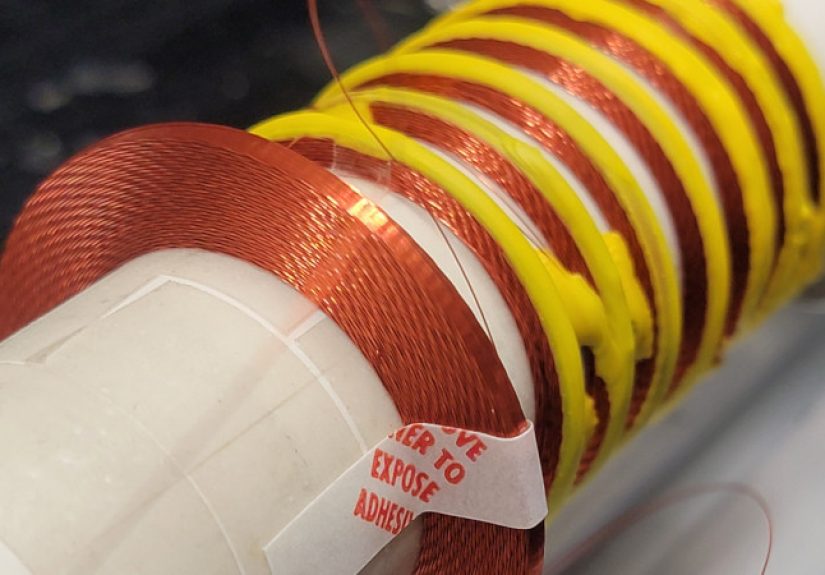
The result was performance with personality. Vintage coils often looked airy, geometric, and surprisingly elegant. They were built with deliberate wire paths, carefully chosen forms, and winding angles that made the finished part look halfway between a scientific instrument and a piece of industrial jewelry. Yes, industrial jewelry is a thing now. I am declaring it officially.
What Inductors Actually Do, Minus the Textbook Headache
An inductor stores energy in a magnetic field when current flows through it. More importantly, it resists sudden changes in current. That makes it useful in filters, oscillators, chokes, tuners, wireless power systems, switching regulators, noise suppression networks, and more. If electricity were a rowdy crowd, the inductor would be the calm bouncer at the door saying, “We are not doing abrupt current spikes in here.”
The amount of inductance depends on a few big factors: the number of turns, the shape of the coil, the spacing of the windings, and the magnetic properties of the core material. Add more turns and inductance usually rises. Change the geometry and the magnetic field changes. Swap air for ferrite or powdered metal and the whole behavior shifts again.
This is why inductors can be both brutally practical and weirdly beautiful. Their electrical personality is tied directly to their physical form. A tiny geometry change can alter the component’s performance. In a world full of black-box electronics, inductors still wear their physics on the outside.
The Great Shrinking: Why Inductors Started Looking Boring
So why did gorgeous coils fade from view? The simple answer is progress. Ferrite technology improved. Magnetic materials became more refined. Shielded constructions got better. Surface-mount packaging took over. Power electronics demanded smaller footprints, lower EMI, tighter tolerance, and faster automated assembly. Electronics stopped asking, “Is this coil handsome?” and started asking, “Can this fit beside six other parts in a space the size of a fingernail?”
Modern inductors are incredible at what they do. Toroidal and shielded designs help keep magnetic flux where it belongs. Composite and powdered materials can manage current more gracefully than older hard-saturating approaches. Engineers now think in terms of DCR, AC loss, saturation current, RMS current, self-resonant frequency, thermal rise, and EMI. None of those phrases scream “wall art,” but they absolutely scream “this product won’t melt your converter.”
And that is a fair trade. Modern inductors became less visually dramatic because they became better optimized for mass production and real-world performance. A compact molded power inductor may not stop traffic at a museum, but it will quietly help your phone charger, laptop regulator, automotive module, or industrial controller work as intended. That earns some respect.
Why Coil Beauty Still Matters
Here is the fun part: the visual beauty of classic inductors was not just decorative. Many of those winding methods existed because they solved real electrical problems. Lower inter-turn capacitance, high Q, stable form, and specialized frequency behavior gave those coils a reason to look the way they did. Their beauty was a side effect of engineering intelligence. That is usually the best kind of beauty anyway.
High-Q inductors are especially important in narrow-band circuits, tuned RF sections, oscillators, and resonant systems. A high-Q coil wastes less energy and helps produce sharper selectivity. At the same time, every real inductor has a self-resonant frequency, the point where its own stray capacitance starts fighting back and the component stops behaving like a proper inductor. That is one reason winding style matters so much in high-frequency work.
Designers who care about RF performance, low loss, or custom resonance still pay close attention to wire layout, winding tension, core choice, and parasitics. That means the old wisdom never really went obsolete. It just stopped being visible to casual observers.
The Comeback: Makers, Machines, and Modern Curiosity
The phrase “not such a lost art” fits today because a new generation is rebuilding this knowledge from the bench up. Makers are studying vintage coils, reverse-engineering winding machines, and using stepper motors, Arduino-based control, 3D-printed fixtures, and custom tension systems to reproduce winding patterns that once lived behind factory doors and company secrets.
That matters because winding is not just about getting wire onto a form. Precision feed angle, phase shift, turn spacing, tension control, and repeatability all influence the finished coil. A sloppy winding can turn a promising design into an electrical potato. A well-controlled winding can produce stable, efficient, and impressively consistent results.
Modern tools help democratize a craft that used to require expensive dedicated machines or deep institutional know-how. Today, a determined builder can experiment with layered air-core coils, universal winding styles, toroids, pickup coils, and specialized RF forms without owning a giant factory or a time machine. That is a big deal.
What Has Changed in Practice
Three things made the comeback possible. First, information is easier to share. Second, motion control is cheap. Third, engineers and hobbyists now appreciate that old methods often solved problems that still exist today. If self-capacitance, saturation, losses, and bandwidth are still real issues, then old winding ideas still have value. Physics did not get a software update.
Modern Inductors Are Better, but They Also Borrow From the Past
Modern inductor design is full of tradeoffs. Ferrite cores can offer high permeability and compact size, but they can saturate more sharply. Powdered iron and composite materials often provide softer saturation behavior and can be attractive in energy-storage applications. Closed magnetic paths help reduce stray fields. Litz wire or specialized conductor choices can help manage high-frequency losses. Shielding can reduce EMI. Every improvement comes with a little engineering negotiation.
And here is the sneaky truth: many “modern” wins still depend on the same core principle that made vintage inductors beautiful. Shape matters. Layout matters. Material matters. Stray effects matter. The old craftsmen were not being fancy for fun. They were wrestling invisible fields into useful forms. Today’s engineers are doing the same thing with better simulation, better materials, and smaller tolerances.
Even specialized shapes like conical inductors show how much geometry still matters. Their shape can limit the effects of stray capacitance and create useful broadband behavior. That sounds futuristic, but the underlying lesson is wonderfully old-school: if you want a coil to behave well, give its physical form the respect it deserves.
Where Beautiful Inductors Still Show Up
You can still find the spirit of beautiful inductors in several corners of electronics:
RF and Tuned Circuits
When engineers care about selectivity, bandwidth, and resonance, winding details become more important. That is where high-Q coils still earn their keep.
Custom Audio and Musical Projects
Inductors appear in filters, pickups, and crossover networks. In some of these projects, custom winding is part performance choice and part obsession. Honestly, that is a respectable hobby formula.
Power Electronics
Most power inductors are not trying to win beauty contests, but their internal geometry, core choice, and magnetic shielding still reflect highly refined design judgment. Inside the boring shell, there is often a lot of elegant engineering.
Vintage Restoration and Experimental Radio
Builders restoring old sets or making new circuits with classic techniques often rediscover just how clever historical winding methods were. A coil can become both replacement part and history lesson.
What Engineers and Hobbyists Can Learn From the Revival
The renewed fascination with beautiful inductors says something bigger about electronics culture. People are getting tired of treating every part like a sealed mystery cube. There is value in understanding how a component’s shape affects its behavior. There is also joy in seeing a part that reveals its function instead of hiding it.
Inductors teach that lesson brilliantly. They are physical embodiments of electromagnetic theory. You can see the conductor. You can imagine the field. You can change the geometry and observe a different result. In an era dominated by hidden silicon, that transparency feels refreshing.
It also reminds us that manufacturing knowledge is part of engineering knowledge. A coil winder’s feed angle, tensioning method, and layering strategy are not side notes. They are part of the design. When people revive that craft, they are not indulging nostalgia. They are recovering useful expertise.
Conclusion
Beautiful inductors are not just artifacts from a more romantic electronics age. They are proof that elegance and performance often grow from the same root. What looked like decorative winding was frequently a smart response to parasitic capacitance, Q factor, bandwidth, resonance, and stability. That is why the art is coming back. The underlying problems never left.
Modern electronics will continue using compact molded parts, shielded power inductors, and advanced magnetic materials, and for good reason. But the renewed interest in classic coil forms, precision winding, and hand-built magnetics shows that the craft still has life. Inductors may never become the prom kings of the BOM, but they deserve much more than background-extra status. Sometimes the quiet copper coil is the smartest, prettiest part in the whole circuit.
Bench Notes and Real-World Experiences With Beautiful Inductors
One of the most memorable things about working around coils is that inductors often feel more alive than other passive parts. A resistor almost dares you to ignore it. A capacitor gets attention when it is huge, leaky, or dramatically bad-tempered. But a hand-wound inductor invites inspection. You pick it up, turn it under a light, and immediately start asking questions. Why is the wire crossing at that angle? Why are the turns spaced like that? Why does this one look like a tiny woven basket while another looks like a miniature copper spring that went to finishing school?
That experience changes the way people think about electronics. The first time someone compares a rough, tightly packed coil with a more carefully wound one and then sees the difference in tuning behavior, noise, or consistency, the lesson sticks. It stops being abstract theory. Suddenly, stray capacitance is not some textbook phrase floating in the distance. It is the reason one coil behaves cleanly and the other acts like it drank too much espresso.
There is also something oddly satisfying about the mechanical side of the work. Winding a coil well requires patience, rhythm, and a feel for tension. Too loose and the shape shifts. Too tight and the wire can scrape, deform, or become harder to manage. Even with modern fixtures and motorized setups, there is still a hands-on quality to the process. You are not just assigning a value in software. You are making geometry behave.
People who restore old radios or build RF projects often talk about the moment they realize the old designers were far more clever than they first assumed. A vintage coil that looks charming or eccentric can turn out to be a carefully reasoned solution to a very specific electrical problem. That discovery creates respect fast. It also creates curiosity. Once you understand that the beauty is functional, you start seeing old magnetics less as relics and more as engineering arguments written in copper wire.
Even modern builders who mostly work with compact switch-mode supplies can appreciate that feeling. Open up a power design, compare different inductors, and you see the same story in a different costume: thermal tradeoffs, leakage control, current handling, saturation margins, and packaging constraints all playing tug-of-war. The outside may look molded and tidy, but the design thinking is still deeply physical.
That is probably why beautiful inductors keep pulling people back in. They reward both the eye and the mind. They are technical, tactile, and a little mysterious. They remind us that electronics is not only about code, chips, and black boxes. Sometimes it is also about copper, form, patience, and the stubborn human desire to make a component work better and look amazing while doing it.