Table of Contents >> Show >> Hide
- What Is an Employment Verification Letter?
- Why People Request Employment Verification Letters
- What an Employment Verification Letter Should Include
- What an Employment Verification Letter Should Not Include
- Employment Verification Letter vs. Other Employment Documents
- How to Write One Without Overcomplicating It
- Employment Verification Letter Sample 1: Standard Template
- Employment Verification Letter Sample 2: With Salary Information
- Employment Verification Letter Sample 3: Former Employee
- Employment Verification Letter Sample 4: Minimal Confirmation Version
- Employment Verification Letter Sample 5: Employee Request Template
- Best Practices for Employers Using Verification Templates
- Common Mistakes to Avoid
- When a Template Is Better Than Starting From Scratch
- Real-World Experiences With Employment Verification Letters
- Conclusion
- SEO Tags
Need proof that someone actually works where they say they work? Welcome to the wonderfully glamorous world of employment verification letters, where HR becomes part detective, part diplomat, and part professional keeper of company letterhead. Whether the letter is for a mortgage application, apartment rental, background screening, school paperwork, or a government benefits request, a good employment verification letter does one job very well: it confirms the facts clearly, professionally, and without turning into an accidental autobiography.
This guide breaks down what an employment verification letter is, when people use one, what details belong in it, what details definitely do not, and how to build a clean template your team can reuse without reinventing the wheel every Tuesday afternoon. You will also find several employment verification letter samples and templates you can adapt for current employees, former employees, salary verification, and simple request situations. If you have ever stared at a blank page wondering whether to include salary, supervisor details, or the employee’s shoe size, this article is here to save the day. Spoiler: definitely not the shoe size.
What Is an Employment Verification Letter?
An employment verification letter is a formal business document that confirms a person’s employment with a company. In most cases, it verifies basic facts such as the employee’s full name, job title, employment dates, and current work status. Depending on the request and the employer’s policy, the letter may also include salary or compensation information, department, work schedule, or whether the employee is full-time or part-time.
The key word here is verification. This is not a recommendation letter, a character reference, or a warm-and-fuzzy tribute to how Greg from accounting always brings excellent donuts to the break room. It is a factual document. Its purpose is to confirm information, not to praise performance.
Why People Request Employment Verification Letters
Employees and former employees request these letters for a wide range of practical reasons. In the United States, the most common use cases include:
- Applying for a mortgage, auto loan, or other credit product
- Renting an apartment or house
- Providing proof of income or job stability
- Completing background screening for a new role
- Documenting employment for a school, visa, or public assistance process
- Confirming previous work history with a prospective employer
In other words, this letter tends to show up whenever a third party wants reassurance that the employee’s job and income are real, current, and not a creative writing exercise.
What an Employment Verification Letter Should Include
A strong employment verification letter is short, specific, and easy for a lender, landlord, recruiter, or agency to review. Most effective letters include:
- Company name and business address
- Date of the letter
- Recipient name or “To Whom It May Concern”
- Employee’s full legal name
- Job title
- Employment status, such as current employee or former employee
- Start date and, if relevant, end date
- Full-time or part-time status, if needed
- Salary or compensation details, only when authorized and necessary
- Name, title, and contact information of the person issuing the letter
- Signature
The best letters are also printed on company letterhead or at least formatted like official business correspondence. That instantly makes the document look legitimate and gives the recipient a clear contact point for follow-up.
What an Employment Verification Letter Should Not Include
Here is where things get interesting. Just because someone asks for more information does not mean you should hand over the entire employee file wrapped in a bow. Employers should avoid including:
- Performance opinions unless there is a specific, authorized reason
- Medical or disability information
- Protected personal information
- Speculation about future job stability
- Confidential disciplinary details
- Salary information when the employee has not authorized release and the employer’s policy does not allow it
A smart rule of thumb is this: provide only the information needed for the stated purpose. Many employers default to confirming only name, job title, and dates of employment unless the employee signs a release or the request clearly calls for more.
Employment Verification Letter vs. Other Employment Documents
Employment Verification Letter
Confirms facts about a person’s employment.
Reference Letter
Describes the employee’s performance, strengths, and suitability. This is opinion-based and much broader.
Offer Letter or Employment Confirmation Letter
Outlines the terms of a new or upcoming role. It is not the same thing as proof of current employment.
Form I-9
This federal form is used by employers to verify identity and work authorization for new hires in the United States. It is a compliance document, not a substitute for an employment verification letter.
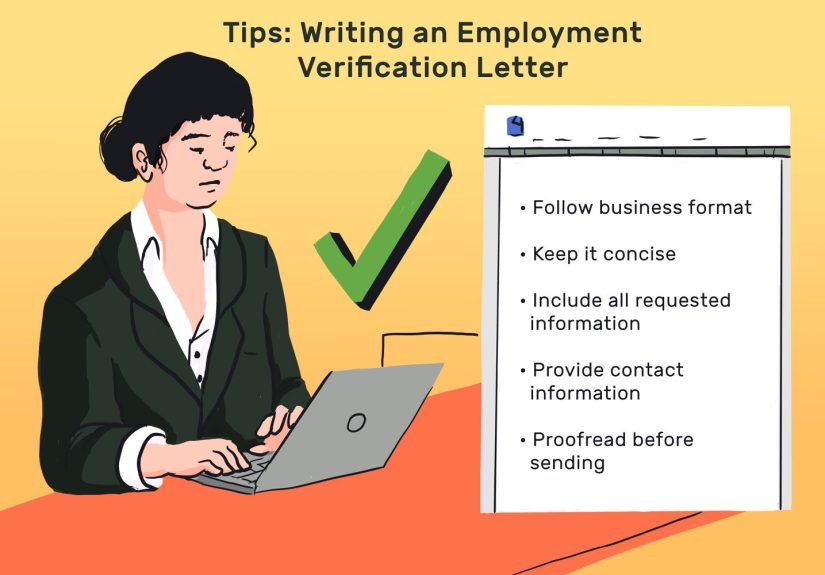
How to Write One Without Overcomplicating It
If you are drafting a letter from scratch, use a simple sequence:
- Start with company letterhead or business contact details.
- Add the date and recipient.
- Identify the employee by full name.
- State the job title and employment status.
- Provide employment dates.
- Add salary or schedule details only if needed and authorized.
- Offer contact information for follow-up.
- Sign the letter with the name and title of the HR representative, manager, or authorized employer contact.
That is it. No dramatic monologue. No five-paragraph essay. No mysterious corporate poetry. Just facts.
Employment Verification Letter Sample 1: Standard Template
Employment Verification Letter Sample 2: With Salary Information
Use this version only when salary verification is necessary and the employee has approved the release of that information.
Employment Verification Letter Sample 3: Former Employee
Employment Verification Letter Sample 4: Minimal Confirmation Version
Some employers prefer a tightly limited response. This version is clean, safe, and useful when the company policy allows only basic verification.
Employment Verification Letter Sample 5: Employee Request Template
Sometimes the employee needs a quick request template to send HR. Here is a simple one:
Best Practices for Employers Using Verification Templates
1. Create a Standard Internal Process
The easiest way to avoid chaos is to decide who handles requests, what information can be shared, what requires consent, and how letters should be delivered. When the process is clear, nobody has to play corporate hide-and-seek with HR.
2. Keep a Reusable Template Library
Save versions for common requests such as basic employment confirmation, employment plus salary, former employee verification, and employee request emails.
3. Confirm the Recipient’s Needs
A landlord may want dates and salary. A lender may want current status and income. A recruiter may only want past title and tenure. Tailor the letter to the actual purpose instead of over-sharing.
4. Use Consent When Appropriate
If the request involves salary, income, or broader employment details, written authorization is often the safest move. It protects both the employee and the employer.
5. Double-Check Accuracy
One wrong hire date can create a completely avoidable mess. Verify names, dates, titles, and compensation before signing anything.
Common Mistakes to Avoid
- Using casual language that makes the letter look unofficial
- Forgetting the signature or contact information
- Including salary without authorization
- Adding opinions instead of verified facts
- Sending the letter without proofreading dates and titles
- Ignoring company policy or state privacy considerations
- Confusing a verification letter with a recommendation letter
Another common mistake is assuming the letter alone will always be enough. In some cases, requesters may also ask for pay stubs, W-2s, or direct verification through a payroll or employment verification service. A letter is often the first stop, not always the final stop.
When a Template Is Better Than Starting From Scratch
Templates save time, improve consistency, and reduce the chance of accidental oversharing. They are especially useful for HR teams that receive frequent requests from lenders, landlords, schools, and public agencies. A good template also helps small businesses look polished and organized, even if the “HR department” is technically one person, one laptop, and a coffee mug with motivational damage.
The trick is to make your templates flexible. Leave placeholders for names, dates, recipient information, salary details, and delivery instructions. That way, the same base document can serve multiple needs without becoming a legal or administrative guessing game.
Real-World Experiences With Employment Verification Letters
In real life, employment verification letters are rarely dramatic, but they do tend to show up at dramatic moments. One employee may be applying for an apartment and discover that the property manager wants proof of current employment before the end of the day. Another may be finalizing a mortgage and suddenly learn that the lender needs updated confirmation from the employer within a very narrow timeline. That is when a clean template stops being “nice to have” and becomes the office superhero in sensible shoes.
HR professionals often say the same thing after handling a few of these requests: the biggest challenge is not writing the letter, it is deciding what should be included. A basic request can turn into a back-and-forth marathon when the recipient wants more detail than the employer is comfortable providing. For example, a simple “yes, this person works here” letter may be enough for a school or a basic records request, but a landlord may ask for salary, hours, and status. If the company has no clear policy, the person writing the letter ends up stuck between helping the employee and protecting confidential information.
Employees have their own learning curve too. Many assume HR already knows exactly what every third party wants. Usually, that is not the case. The smoothest experiences happen when the employee tells HR the purpose of the letter, the deadline, the recipient, and whether salary information is needed. That small amount of context can cut the process from several emails to one efficient response.
Small business owners often experience a different version of the same issue. They may not have formal HR software, an automated verification platform, or a full document workflow. So when a request arrives, they open a blank document and hope professionalism appears by magic. A reusable employment verification template solves that problem fast. It allows the business to respond quickly while keeping the format consistent and the facts controlled.
Another common experience involves former employees. A new employer or lender may ask for verification years after the person left. If records are disorganized, even a simple check of start and end dates can become a scavenger hunt through old payroll files and archived emails. Businesses that keep a standard process and reliable records tend to handle these requests calmly. Businesses that do not often discover that “we should really organize this” is not a great real-time strategy.
The best lesson from these everyday scenarios is simple: employment verification letters work best when they are boring. Not sloppy-boring. Efficient-boring. Clear facts, accurate dates, the right level of detail, and no extra commentary. When that happens, employees get what they need, employers stay within policy, and everyone gets to move on with their day. In the administrative universe, that counts as a beautiful ending.
Conclusion
Employment verification letters may not be the most thrilling documents in the business world, but they matter a lot when someone is trying to rent a home, secure financing, pass a background check, or prove work history. The strongest letters are factual, concise, professional, and tailored to the purpose of the request. They confirm what is needed without wandering into opinions, private data, or unnecessary details.
For employers, the smartest move is to build a repeatable template system and a clear disclosure process. For employees, the best approach is to request the letter early and specify exactly what the recipient needs. Get those two pieces right, and this humble document goes from annoying paperwork to a very useful problem-solver.