Table of Contents >> Show >> Hide
- Why This Funny Brexit Thread Blew Up
- What Brexit Actually Was, Minus the Fog Machine
- Why the “Cheese Submarine” Metaphor Worked So Well
- Behind the Laughs, the Stakes Were Real
- Why Political Humor Sometimes Explains More Than Experts Do
- The Real Secret of the Viral Brexit Thread
- Extra Section: What Living Through Brexit-by-Meme Felt Like
- Final Thoughts
Every once in a while, the internet does humanity a small but meaningful favor. It takes a giant, tangled, headache-inducing political drama and translates it into something the average sleep-deprived person can understand before their coffee gets cold. That is exactly what happened when a guy explained Brexit in a wildly funny tweet thread that turned a years-long constitutional soap opera into one ridiculous image: a submarine made of cheese.
Yes, cheese.
And honestly? It was perfect.
The reason this hilarious Brexit thread spread so fast is simple. Brexit was one of those political stories that seemed to become more confusing every time someone tried to explain it. There were deadlines, extensions, emergency votes, dramatic speeches, hard borders, soft borders, trade rules, customs unions, Article 50, and enough parliamentary chaos to make even seasoned news junkies want to lie face-down on the carpet. Then along came a joke that cut through the fog with the grace of a butter knife through warm brie.
In this article, we are looking at why that funny Brexit explanation landed so well, what the joke was really saying, and why humor became one of the best ways to process a political saga that often felt too absurd to be real. If you have ever stared at Brexit news and thought, “I know these are words, but together they mean nothing to me,” congratulations. You are exactly the target audience for this gloriously silly masterpiece.
Why This Funny Brexit Thread Blew Up
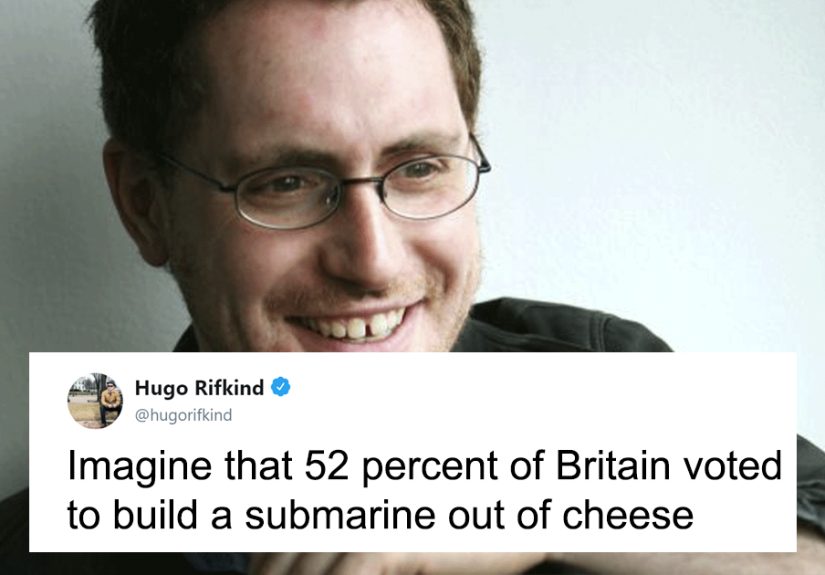
The viral thread is associated with journalist and columnist Hugo Rifkind, who turned Brexit into a wonderfully absurd metaphor. His idea, in essence, was that trying to deliver Brexit sometimes looked like trying to build a submarine out of cheese: lots of confidence, lots of slogans, lots of insistence that it absolutely could work, and then a slowly dawning realization that maybe dairy is not the ideal material for deep-sea engineering.
That image worked because it captured the emotional truth of the moment better than a hundred dry explainers. It took a political promise sold as simple and heroic and showed how messy it looked once someone actually had to make it happen. The genius was not just that it was funny. It was that it was funny and useful. Political satire rarely gets bonus points for being educational, but this thread managed it.
People shared it because they recognized the pattern. Big promises. Easy slogans. Complicated consequences. Loud certainty. Then panic, confusion, and a lot of awkward backtracking while pretending everything was still going according to plan. If that sounds familiar, welcome to modern politics, where the campaign billboard is often much sturdier than the policy behind it.
What Brexit Actually Was, Minus the Fog Machine
The Referendum That Changed Everything
Brexit refers to the United Kingdom’s decision to leave the European Union. In 2016, British voters were asked whether the U.K. should remain in or leave the EU. Leave won by a narrow but decisive margin, and that vote detonated one of the most complicated political processes in recent British history.
On paper, the idea sounded straightforward enough: leave the European Union and regain more national control over laws, borders, and trade. In practice, it was more like trying to remove a deeply rooted tree without disturbing the patio, the fence, the plumbing, the dog, or your relationship with the neighbors.
The U.K. had spent decades tied into the EU’s legal, economic, and regulatory systems. Untangling that relationship was never going to be a clean, one-snip job. It affected trade, travel, immigration, business rules, citizens’ rights, and the delicate political balance on the island of Ireland. So even though “Brexit” sounded like a neat label, the actual process came with all the elegance of carrying soup in a paper bag.
Why It Became So Confusing
One reason the Brexit debate grew so chaotic is that different people wanted completely different versions of it. Some imagined a clean break with total freedom and minimal disruption. Others wanted close ties with Europe while still technically leaving. Some saw Brexit as a sovereignty issue. Others treated it as an immigration issue, an economic issue, or a cultural revolt against elites. It was one word carrying about twelve political fantasies at once.
That is where the cheese submarine joke hits its sweet spot. It suggests that a crowd may vote enthusiastically for a grand-sounding idea without agreeing on how it would work in real life. The problem begins when someone then has to build the thing. Suddenly everyone discovers that they did not vote for the same blueprint at all. Some wanted cheddar. Some wanted Swiss. Some wanted a submarine that looked underwater but somehow stayed dry. Democracy is beautiful, but it can also occasionally resemble a group project designed by raccoons.
Theresa May’s Impossible Assignment
A huge reason the tweet thread resonated was that it captured the impossible position of then-Prime Minister Theresa May. She had to carry out the referendum result while negotiating with the EU and managing deep divisions inside British politics. That meant trying to satisfy hard-line Brexit supporters, cautious moderates, opposition critics, business leaders, nervous citizens, and European negotiators who were not exactly in the mood for improvised chaos.
Her challenge was brutal: deliver something called Brexit while proving it would not damage trade, create major border problems, or shatter the balance in Northern Ireland. That is a little like being told to renovate a house without moving the walls, changing the wiring, upsetting the plumbing, or spending any money. Oh, and your relatives are live-streaming the whole thing while shouting contradictory advice.
Why the “Cheese Submarine” Metaphor Worked So Well
It Turned Complexity Into Something Visual
Most people do not enjoy reading about customs arrangements or regulatory divergence for fun. Some do, and they are probably very organized and own impressive folders. But the average reader needs a shortcut. The tweet thread provided one by making Brexit visual. A cheese submarine is easy to imagine. It is also obviously ridiculous. The more you think about it, the funnier and sadder it becomes.
That is what strong political humor does. It does not merely mock. It compresses a mountain of frustration into one image people can carry around in their heads. You may forget the wording of a parliamentary motion, but you will not forget a soggy dairy submarine trying to survive underwater because somebody shouted, “The people have spoken!”
It Exposed Magical Thinking
The thread also nailed a deeper truth: political movements often thrive on certainty before they collide with logistics. Campaigns are fueled by emotion, identity, hope, grievance, and symbolism. Governing, by contrast, is fueled by paperwork, compromise, legal texts, and people saying annoying things like, “That may not be possible.”
Brexit became a case study in what happens when a giant symbolic promise slams into administrative reality. You can sell a dream in three words. You cannot implement it in three words. That mismatch between campaign simplicity and governing complexity is exactly why the thread felt so sharp. It laughed at the fantasy without needing a lecture.
It Made People Feel Less Alone
One underrated function of internet humor is that it reassures confused people that they are not losing their minds. When politics becomes maddeningly hard to follow, a funny thread can feel like a public service. It says, “No, no, you are not dumb. This really is bizarre.” That validation matters.
Brexit produced a lot of bewilderment, not just in Britain but around the world. So when someone finally found a way to say, “Here is why this all feels insane,” people grabbed onto it like a life raft. A very non-cheese life raft, thankfully.
Behind the Laughs, the Stakes Were Real
Of course, the reason Brexit humor had such bite is that the consequences were real. Britain formally left the European Union in early 2020, and the transition period ended at the close of that year. After that, the practical effects became harder to ignore. There were new trade frictions, more customs paperwork, tougher rules for moving goods, and major changes to freedom of movement between the U.K. and EU countries.
That is why so many jokes about Brexit had an edge to them. The comedy was not floating in empty space. It sat on top of genuine anxiety about jobs, travel, supply chains, identity, and the future of the U.K. The Northern Ireland question alone showed how one political slogan could run into years of tense, complicated negotiation.
And that tension is a big part of why the funny Brexit tweets still matter. They were not simply memes for meme’s sake. They were a coping mechanism. A way for people to process a national drama that often felt too serious to ignore and too ridiculous to absorb without laughing.
Why Political Humor Sometimes Explains More Than Experts Do
There is a reason funny political explainers spread so widely. Humor sneaks past exhaustion. By the time Brexit had dragged on through endless headlines, many people had emotionally checked out. They did not want another stern explainer. They wanted someone to translate the nonsense into human language.
That is exactly what the thread did. It stripped away the technical jargon and exposed the central contradiction: a huge political promise had been made, millions believed in it, and now the people in charge had to make that promise function in the real world. Comedy often succeeds where formal analysis fails because it gets to the emotional core first. Then the facts click into place afterward.
That does not mean jokes replace journalism. It means the best jokes can illuminate the same truth from a different angle. In the case of Brexit, a ridiculous metaphor became a better door into the topic than a pile of procedural updates ever could.
The Real Secret of the Viral Brexit Thread
The funniest part of the whole thing is that the thread was not just mocking one side, one leader, or one bad week in politics. It was capturing a broader human habit: our talent for demanding impossible outcomes and then acting surprised when reality sends us an invoice.
That is why the thread still feels relevant. Substitute another issue, another country, another slogan, and the structure still works. People love certainty. They love promises that feel bold and emotionally satisfying. They love stories with heroes and villains. What they do not love is discovering that complicated systems are, inconveniently, complicated.
Brexit became one of the most meme-able political stories of the era because it had everything: drama, identity, procedure, scandal, confusion, grandstanding, and a rotating cast of people insisting they were definitely in control while events suggested otherwise. The joke landed because the reality had already done half the work.
Extra Section: What Living Through Brexit-by-Meme Felt Like
If you were online during the height of Brexit chaos, the experience could feel strangely theatrical. You would wake up, check your phone, and find that the U.K. had reached a breakthrough, rejected a breakthrough, delayed a breakthrough, or discovered that what looked like a breakthrough was actually a corridor leading to three more arguments and a very stressed anchor on television. Every week seemed to produce a fresh “historic” moment, which is exhausting because history, ideally, should not happen three times before lunch.
For ordinary people following along, the emotional rhythm was oddly familiar. First came the confident slogan. Then came the debate shows. Then came the charts, the angry interviews, the headlines about negotiations going down to the wire, and the endless question of what would happen to trade, travel, work, residency, and border arrangements. At some point, many people stopped pretending they fully understood every detail. That was when the memes stepped in like unlicensed therapists.
The funny Brexit thread worked because it recreated the actual experience of watching the story unfold. It felt like seeing adults in suits argue passionately over a plan that had been pitched as simple, only for the plan to become more confusing the closer it got to implementation. Whether you were a politics obsessive or just someone trying to understand why the news was suddenly full of customs unions and parliamentary votes, the joke captured that weird blend of disbelief and recognition.
There was also something deeply relatable about the tone. It did not sound like a textbook. It sounded like the friend who leans across the table and says, “Okay, let me explain this in a way that does not make your brain evaporate.” That is why people shared it. Not everyone wanted a legal briefing. They wanted a human explanation with a pulse and a punch line.
And then there were the real-life experiences orbiting the joke. Travelers worried about what new rules would mean. Businesses braced for paperwork. Citizens living across borders wondered how their status, rights, and routines might shift. Families argued. Comment sections combusted. Whole political identities hardened around a single word. The thread did not erase any of that. What it did was give people a language for the absurdity. It allowed them to laugh without denying that the stakes were real.
That may be the lasting value of the whole thing. Funny Brexit tweets were never just about dunking on politicians. They were about surviving information overload. They were about making a giant geopolitical story feel graspable for five blessed minutes. And if that required imagining a submarine made of cheese heroically descending into the ocean of consequences, then honestly, that might have been the most reasonable part of the whole saga.
Final Thoughts
“Guy Explains Brexit In 12 Hilarious Tweets And It Will Crack You Up” is more than a clicky title. It points to something real about how people deal with modern politics. Sometimes the smartest explanation is not the driest one. Sometimes the best guide through a dense political maze is a joke sharp enough to cut through spin, jargon, and pretend certainty.
The Brexit thread became memorable because it turned a sprawling political mess into a metaphor no one could forget. It was funny, yes, but it also carried a truth that made the laughter stick. Big slogans are easy. Building the thing is hard. Building the thing out of cheese is harder.
And that, in one gloriously ridiculous image, is why this hilarious Brexit explanation still works.