Table of Contents >> Show >> Hide
- What Does It Mean to Find Area From Circumference?
- The Key Circle Formulas You Need
- How to Find the Area of a Circle Using Its Circumference: 12 Steps
- Step 1: Read the problem carefully
- Step 2: Write down the circumference
- Step 3: Choose your method
- Step 4: Use the circumference formula
- Step 5: Rearrange the formula to find the radius
- Step 6: Substitute the circumference
- Step 7: Write the area formula
- Step 8: Substitute the radius into the area formula
- Step 9: Try the direct formula
- Step 10: Use the correct units
- Step 11: Round your answer properly
- Step 12: Check if your answer makes sense
- Example Problem: Area From Circumference
- Another Example Using the Direct Formula
- Why the Direct Formula Works
- Common Mistakes to Avoid
- When Would You Use This in Real Life?
- Quick Reference: Area From Circumference
- Practice Problems
- Experience-Based Tips for Learning This Topic
- Conclusion
Finding the area of a circle using its circumference sounds like one of those math problems designed to make pencils tremble. You are given the distance around the circle, but the question asks for the space inside it. That feels a little like being handed the crust of a pizza and asked how much cheese used to be there. Luckily, geometry is much kinder than it first appears.
The big idea is simple: circumference helps you find the radius, and the radius helps you find the area. Once you understand that connection, the whole problem becomes a neat little math relay race. The circumference passes the baton to the radius, the radius runs to the area formula, and everyone finishes with square units and a tiny victory parade.
In this guide, you will learn the formulas, the reasoning behind them, and a practical 12-step method for solving these problems without panicking, guessing, or whispering “please be multiple choice” into your notebook.
What Does It Mean to Find Area From Circumference?
The circumference of a circle is the distance around the outside edge. If you wrapped a string around a circular table, pulled the string straight, and measured it, you would have the circumference. The area of a circle, on the other hand, is the amount of flat space inside the circle. If that table were a pancake, area would describe the buttery surface available for syrup. Very important science.
Most circle area problems give you the radius or diameter. But sometimes you only know the circumference. That is not a dead end. Since circumference, diameter, radius, and area are all connected by pi, you can move from one measurement to another using formulas.
The Key Circle Formulas You Need
Before jumping into the steps, keep these formulas close. They are the geometry version of a good set of house keys.
- Circumference using radius: C = 2πr
- Circumference using diameter: C = πd
- Area using radius: A = πr²
- Area directly from circumference: A = C² ÷ 4π
Here, C means circumference, r means radius, d means diameter, A means area, and π is pi, usually approximated as 3.14 or 3.14159. If your teacher or assignment says to use 3.14, use 3.14. If it asks for an exact answer, leave π in your answer. Math teachers enjoy precision the way cats enjoy knocking things off tables.
How to Find the Area of a Circle Using Its Circumference: 12 Steps
Step 1: Read the problem carefully
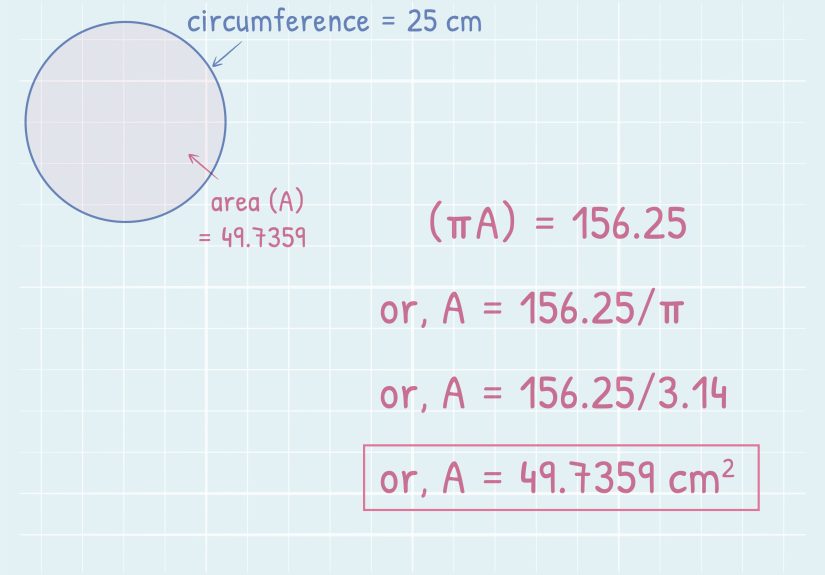
Start by identifying what you are given. Look for words like “circumference,” “distance around,” or “perimeter of the circle.” If the problem says the circumference is 25 inches, that means C = 25 inches. Do not accidentally treat it as the diameter or radius. That is how innocent numbers end up in witness protection.
Step 2: Write down the circumference
Put the given circumference on your paper. For example:
C = 25 inches
This keeps your work organized and reduces the chance of mixing up values later. In geometry, neatness is not just for people with color-coded binders. It actually helps.
Step 3: Choose your method
You have two good options. The first method is to find the radius first, then use the area formula. The second method is to use the direct formula:
A = C² ÷ 4π
Both methods work. For beginners, finding the radius first is often easier to understand. For faster solving, the direct formula is wonderfully efficient.
Step 4: Use the circumference formula
The standard circumference formula is:
C = 2πr
This formula says the circumference equals 2 times pi times the radius. Since you already know C, you can rearrange the formula to solve for r.
Step 5: Rearrange the formula to find the radius
To isolate the radius, divide both sides of the formula by 2π:
r = C ÷ 2π
This is the bridge between circumference and area. Once you know the radius, the area formula becomes easy to use.
Step 6: Substitute the circumference
Suppose the circumference is 25 inches. Substitute 25 for C:
r = 25 ÷ 2π
If you are using 3.14 for π, the calculation becomes:
r = 25 ÷ 6.28
That gives:
r ≈ 3.98 inches
Step 7: Write the area formula
Now use the area formula:
A = πr²
This means you square the radius first, then multiply by pi. The order matters. Squaring after multiplying by pi would create a very different answer and possibly a dramatic sigh from your math teacher.
Step 8: Substitute the radius into the area formula
Using the radius from the example:
A = 3.14 × 3.98²
First square the radius:
3.98² ≈ 15.84
Then multiply by pi:
A ≈ 3.14 × 15.84
A ≈ 49.74 square inches
Step 9: Try the direct formula
The faster method is:
A = C² ÷ 4π
Using C = 25 inches:
A = 25² ÷ 4π
A = 625 ÷ 12.56
A ≈ 49.76 square inches
The small difference comes from rounding. Both answers are essentially the same. The direct formula simply skips the separate radius step.
Step 10: Use the correct units
Circumference is measured in linear units, such as inches, feet, centimeters, or meters. Area is measured in square units, such as square inches, square feet, square centimeters, or square meters. If the circumference is in inches, the area will be in square inches. If the circumference is in meters, the area will be in square meters.
Step 11: Round your answer properly
Some problems ask you to round to the nearest tenth, hundredth, or whole number. If no rounding instruction is given, two decimal places is usually acceptable for decimal answers. For exact answers, leave π in the answer. For example, if C = 20π, then:
r = 20π ÷ 2π = 10
A = π × 10² = 100π square units
Step 12: Check if your answer makes sense
A quick reasonableness check can save you from sneaky mistakes. If the circumference is large, the area should also be large. If the area comes out smaller than expected, you may have forgotten to square the radius. If the unit says “inches” instead of “square inches,” fix it before the units police arrive wearing tiny geometry badges.
Example Problem: Area From Circumference
Problem: A circular garden has a circumference of 31.4 feet. What is its area?
Solution using the radius method
Start with the circumference formula:
C = 2πr
Substitute 31.4 for C:
31.4 = 2 × 3.14 × r
31.4 = 6.28r
Divide by 6.28:
r = 5 feet
Now find the area:
A = πr²
A = 3.14 × 5²
A = 3.14 × 25
A = 78.5 square feet
Answer: The area of the circular garden is 78.5 square feet.
Another Example Using the Direct Formula
Problem: A circular rug has a circumference of 18 feet. Find its area.
Use the direct formula:
A = C² ÷ 4π
Substitute 18 for C:
A = 18² ÷ 4π
A = 324 ÷ 12.56
A ≈ 25.80 square feet
Answer: The rug covers about 25.80 square feet.
Why the Direct Formula Works
The direct formula may look like it appeared out of a magician’s sleeve, but it comes from combining two familiar circle formulas. Start with:
C = 2πr
Solve for r:
r = C ÷ 2π
Now put that into the area formula:
A = πr²
So:
A = π(C ÷ 2π)²
After simplifying, you get:
A = C² ÷ 4π
That is why the formula works. It is not a separate trick; it is just the radius method wearing a faster pair of shoes.
Common Mistakes to Avoid
Confusing circumference with diameter
Circumference is the distance around the circle. Diameter is the distance across the circle through the center. They are related, but they are not the same. If a problem gives you circumference, do not plug it directly into a diameter formula unless you first divide by π.
Forgetting to square the radius
The area formula is A = πr², not A = πr. The little exponent 2 is doing important work. Forgetting it is like baking cookies without flour. Something will happen, but it will not be what you wanted.
Rounding too early
If possible, keep several decimal places until the final step. Rounding the radius too early can make your area slightly inaccurate. For the cleanest answer, use the calculator value of π or keep π in symbolic form until the end.
Using the wrong units
Area must be written in square units. If the circumference is 12 centimeters, the area is in square centimeters. This detail matters in schoolwork, construction, design, landscaping, and any situation where measurements become real materials.
When Would You Use This in Real Life?
You might use this calculation more often than you think. If you know the distance around a circular flower bed, you can estimate how much mulch covers the inside. If you measure the edge of a round table, you can calculate the tabletop area. If you are buying a circular rug, designing a patio, planning a craft project, or measuring a pizza pan, circumference can help you find area.
This is especially useful when measuring across the circle is inconvenient. Maybe the center is blocked, the object is too large, or you only have access to the outer edge. In those cases, measuring the circumference with string or a flexible tape measure can be easier than trying to find the diameter directly.
Quick Reference: Area From Circumference
Here is the simple version:
- Write down the circumference.
- Use r = C ÷ 2π to find the radius.
- Use A = πr² to find the area.
- Or use A = C² ÷ 4π for a faster solution.
- Write the answer in square units.
For example, if C = 40 centimeters:
A = 40² ÷ 4π
A = 1600 ÷ 12.56
A ≈ 127.39 square centimeters
Practice Problems
Practice 1
A circle has a circumference of 12.56 inches. Find the area.
Solution: r = 12.56 ÷ 6.28 = 2 inches. A = 3.14 × 2² = 12.56 square inches.
Practice 2
A circular pond has a circumference of 62.8 meters. Find the area.
Solution: r = 62.8 ÷ 6.28 = 10 meters. A = 3.14 × 10² = 314 square meters.
Practice 3
A round mirror has a circumference of 15.7 inches. Find the area.
Solution: r = 15.7 ÷ 6.28 = 2.5 inches. A = 3.14 × 2.5² = 19.625 square inches, or about 19.63 square inches.
Experience-Based Tips for Learning This Topic
One of the best ways to understand how to find the area of a circle using its circumference is to stop treating the formulas like random alphabet soup. Many students first meet C = 2πr and A = πr² as separate facts, memorize them five minutes before a quiz, and then wonder why the numbers are suddenly playing musical chairs. The trick is to see the relationship. Circumference tells you how far it is around the circle. Area tells you how much space is inside. The radius connects both.
In real practice, the biggest breakthrough usually comes from drawing a quick circle and labeling what you know. Even a lopsided circle is fine. Geometry does not require museum-quality artwork. Write the circumference on the outside edge, mark the unknown radius from the center to the edge, and remind yourself that the radius is the missing key. Once you find it, the area formula becomes straightforward.
Another helpful experience is using real objects. Take a cup, plate, roll of tape, or circular lid. Wrap a piece of string around it, then measure the string. That gives you the circumference. Next, calculate the radius and area. Then compare your result by measuring the diameter directly and using half of it as the radius. This hands-on method makes the formulas feel less mysterious. Suddenly, pi is not just a symbol haunting your calculator; it is the relationship between the distance around a circle and the distance across it.
It also helps to practice with friendly numbers first. Circumferences like 6.28, 12.56, 31.4, and 62.8 are easier because they divide neatly when using 3.14 for pi. After that, move on to messier numbers like 18, 25, or 47.1. Messy numbers are not harder conceptually; they just involve decimals. Think of them as the same recipe with a few crumbs on the counter.
When teaching or studying this topic, I recommend writing both methods side by side. The radius method shows the logic clearly: circumference to radius, radius to area. The direct formula method builds speed: A = C² ÷ 4π. Over time, you will probably use the direct formula for quick calculations, but the radius method will help you explain your work and avoid mistakes.
A final practical tip: always check the units before celebrating. If the problem gives a circumference in feet, the area must be in square feet. If it gives centimeters, the area must be in square centimeters. Units are not decoration. They tell readers what your answer actually means. A result of “78.5” is incomplete. A result of “78.5 square feet” is useful. That tiny phrase can be the difference between a correct solution and a math problem wearing only one shoe.
Conclusion
Finding the area of a circle using its circumference is easier once you understand the relationship between circumference, radius, and area. The circumference gives you the distance around the circle. From there, you can find the radius using r = C ÷ 2π, then calculate the area with A = πr². For a shortcut, use A = C² ÷ 4π.
The most important habits are simple: identify the circumference correctly, use the right formula, avoid rounding too early, square the radius, and label the final answer with square units. Do that, and circle problems become much less intimidating. They may still be round, but they will no longer run circles around you.
Note: This article was created for web publishing and is based on standard geometry concepts used in reputable educational math references, including circumference, radius, diameter, pi, and circle area formulas.