Table of Contents >> Show >> Hide
- What Is a Daruma Good Luck Doll?
- Why People Use a Daruma Doll
- How to Use a Daruma Good Luck Doll: 4 Steps
- Where Should You Place a Daruma Doll?
- Common Mistakes to Avoid
- What Does a Daruma Doll Mean?
- Can You Use a Daruma Doll Outside New Year’s?
- Conclusion
- Real-Life Experiences With a Daruma Good Luck Doll
- SEO Tags
If your motivation has been acting like it needs a nap, a Daruma good luck doll might be the pep talk your shelf has been missing. This round, red Japanese good luck doll is more than cute decor with dramatic eyebrows. A Daruma is traditionally used as a visual promise: you set a goal, color in one eye, keep going, and finish the second eye when you reach your target.
That simple ritual is why people love Daruma dolls. They turn a vague dream like “I should really get my life together” into something far more useful: one clear goal staring back at you from across the room. No confetti cannon required.
In this guide, you’ll learn how to use a Daruma good luck doll in four practical steps, what the doll means, where to place it, common mistakes to avoid, and how real people make the experience feel surprisingly powerful.
Note: Daruma traditions can vary a little by region, temple, and maker. Some instructions describe the first eye from the doll’s left side, while others simply say to color one eye first and the second eye later. The heart of the ritual stays the same: set a goal, complete one eye, finish the goal, then complete the other.
What Is a Daruma Good Luck Doll?
A Daruma doll is a traditional Japanese figure associated with perseverance, focus, and good fortune. It is modeled after Bodhidharma, the monk linked to Zen Buddhism. That connection helps explain the Daruma’s intense face, blank eyes, and “I am not here to play games” energy.
Its shape matters too. A Daruma is usually round, hollow, and weighted at the bottom, so it tips and springs upright again. That design is part of the appeal. The message is simple and timeless: get knocked down, get back up. In other words, the doll is basically a motivational speaker who never sends you a calendar invite.
New Daruma dolls traditionally come with blank white eyes. One eye is filled in when you choose a wish, resolution, or goal. The second eye is completed when that goal is achieved. So yes, your Daruma is adorable, but it is also quietly tracking your follow-through.
Why People Use a Daruma Doll
People use Daruma dolls because the ritual makes a goal feel concrete. Instead of keeping your intention floating around your brain like a loose balloon, the Daruma gives it a physical home. You can see it. You remember it. You feel a tiny nudge every time you walk by.
That is why Daruma dolls are often connected to New Year’s resolutions, school goals, career milestones, creative projects, athletic training, and business plans. But you do not need to wait until January 1 or a dramatic life reinvention montage. A Daruma works just as well for finishing a certification, paying off debt, launching a side hustle, or finally writing chapter one instead of “researching” chapter one for six months.
How to Use a Daruma Good Luck Doll: 4 Steps
Step 1: Choose One Specific Goal
The first step is the most important: decide exactly what your Daruma is for. One doll, one goal. That is the sweet spot.
A fuzzy goal like “be happier” sounds nice, but it is hard to measure. A better version would be “walk 30 minutes five days a week for three months,” “save $2,000 for an emergency fund,” or “submit my graduate school application by October 1.” A Daruma works best when your goal is clear enough that you will know, without any debate, whether you did it.
Before you do anything else, ask yourself these questions:
- What exactly am I trying to achieve?
- Why does it matter to me?
- How will I know when it is finished?
If you want, write the goal down on a small card and keep it near the doll. That turns the ritual into more than decoration. It becomes a commitment with a receipt.
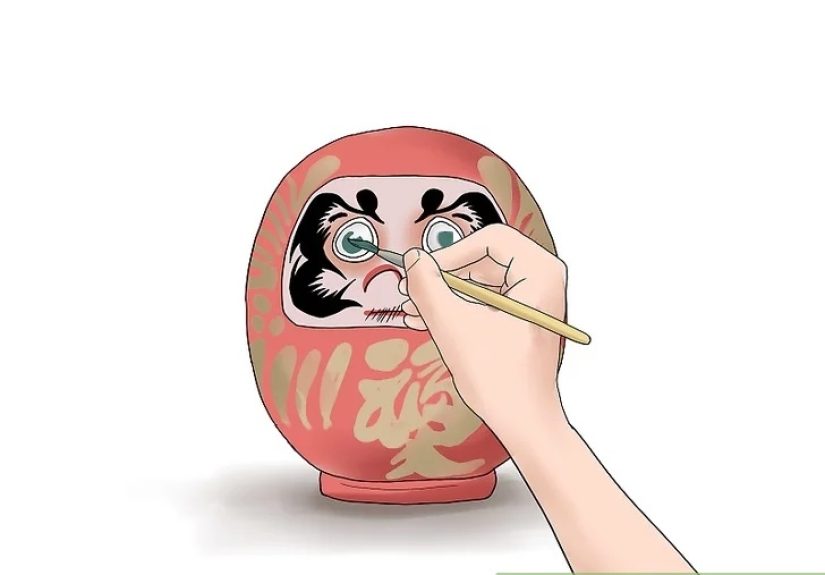
Step 2: Fill In the First Eye
Once you have your goal, fill in the first eye. Traditionally, people use black ink or a dark marker. This is the moment when your intention becomes official.
Take a breath before you do it. Do not rush. The point is not just to color an eye. The point is to mark a beginning. Many people pause to say their goal out loud, think about why it matters, or make a quiet promise to themselves. It can be simple:
“I’m using this Daruma to help me finish my portfolio by June 30.”
That is it. No fireworks, no chanting, no need to stand on a mountain at sunrise unless that is already on your schedule.
If your Daruma came with instructions from a maker or temple, follow those. If not, the widely understood custom is straightforward: one eye at the start, one eye at completion.
Step 3: Put the Daruma Where You Will See It and Take Action
Now place your Daruma somewhere visible. This part is sneakily powerful. The doll works best when it stays in your everyday environment, not hidden in a drawer with expired coupons and mystery charging cables.
Good places include:
- a desk where you work or study
- a bookshelf at eye level
- an entryway table where you pass it often
- a home office shelf
- a business counter or workspace
Seeing the one-eyed Daruma regularly acts like a visual checkpoint. It reminds you that the goal is still open. Still alive. Still expecting you to do your part.
And that is the key: a Daruma is not a shortcut. It is a symbol that supports effort. You still have to study, practice, apply, save, build, write, train, or show up. The doll is a ritual object, not a magical vending machine.
A smart move here is to pair your Daruma with a tiny action plan. For example:
- Goal: Run a 10K.
Action: Train three mornings a week. - Goal: Finish a thesis draft.
Action: Write every weekday. - Goal: Grow a small business.
Action: Contact five prospects each week.
That way, your Daruma is not just watching you dream. It is watching you move.
Step 4: Fill In the Second Eye When the Goal Is Achieved
When you complete the goal, fill in the second eye. This is the satisfying part. Your Daruma goes from “mid-mission” to “mission accomplished.”
Do not skip this step. Finishing the second eye matters because it closes the loop. It gives you a moment to acknowledge your effort, not just your outcome. You did the thing. That deserves more than a tired shrug and another email.
Some people add the completion date on the bottom of the doll or on a note nearby. Others pause for a small gratitude ritual or take a picture to mark the moment. You can keep it simple and still make it meaningful.
After the goal is completed, you have a few respectful options. Some people keep the finished Daruma as a reminder of what they accomplished. Others retire it at the end of the year. In Japan, completed Daruma dolls are often returned to temples for ceremonial burning. If that is not available where you live, the main idea is to treat it respectfully rather than tossing it around like ordinary clutter.
Where Should You Place a Daruma Doll?
If you are wondering where to place a Daruma good luck doll, choose a spot that matches the goal. That usually works better than obsessing over “perfect” placement.
Here are some easy examples:
- Work goal: place it on your desk or office shelf.
- Study goal: keep it near your books, laptop, or study lamp.
- Fitness goal: put it near your workout space or gym bag shelf.
- Financial goal: place it near your budgeting area or home office.
- Family or home goal: keep it in a shared visible room.
Try not to place it somewhere chaotic, hidden, or purely decorative if you want the ritual to do its job. A Daruma should be seen, not accidentally rediscovered while cleaning behind a toaster.
Common Mistakes to Avoid
Using a Daruma doll is simple, but a few common mistakes can make the ritual less effective.
Picking a goal that is too vague
“Improve my life” is inspiring, but slippery. Pick something specific enough to finish.
Using one Daruma for ten goals
This turns a focused tradition into a chaotic group project. One goal per doll keeps the meaning clear.
Hiding it away
If you never see it, you lose the daily reminder that makes the Daruma useful.
Expecting luck to do all the work
The Daruma supports intention and perseverance. It does not answer emails, lift weights, or finish tax forms.
Skipping the second eye
Celebrate completion. Closure is part of the ritual, and it helps you recognize progress instead of racing straight into your next stress spiral.
What Does a Daruma Doll Mean?
The meaning of a Daruma doll combines several ideas: perseverance, resilience, discipline, intention, and good fortune. Its blank eyes symbolize a goal in progress. Its weighted body symbolizes the ability to recover after setbacks. Its connection to Bodhidharma adds a layer of focus and spiritual endurance.
That combination is why the Daruma feels different from ordinary lucky charms. It is not only about wishing for good things. It is also about committing to the work required to reach them. In that sense, the Daruma is part encouragement, part accountability partner, and part stern little coach who never accepts “I got distracted” as a full defense.
Can You Use a Daruma Doll Outside New Year’s?
Absolutely. Many people first encounter Daruma dolls around New Year’s because the tradition is strongly linked with resolutions and fresh starts. But a Daruma can be started at any time of year. New semester? Great. New job? Perfect. New business, new training cycle, new chapter of life? The Daruma is not checking the calendar.
What matters more than timing is sincerity. If the goal matters to you and you are willing to work toward it, the ritual still makes sense.
Conclusion
Learning how to use a Daruma good luck doll is refreshingly simple. Choose one meaningful goal. Fill in the first eye. Keep the doll where it reminds you to act. Fill in the second eye when the goal is done. That is the whole practice, and that is the beauty of it.
A Daruma does not promise a perfect year, effortless success, or a personality makeover by Tuesday. What it does offer is something much more useful: a visible reminder to stay focused, keep going, and rise again when things wobble. And since most goals wobble at least a little, that message ages very well.
So if you want a ritual that is simple, meaningful, and surprisingly motivating, a Daruma good luck doll is a pretty charming place to start.
Real-Life Experiences With a Daruma Good Luck Doll
One reason Daruma dolls remain so memorable is that the experience of using one tends to sneak up on people. At first, it can feel like a small cultural tradition or a decorative object with a very intense face. Then a few weeks pass, and the doll starts to feel less like decor and more like a quiet witness to your effort.
Students often describe the experience as oddly grounding. Imagine setting a goal to get into dental school, pass a difficult exam, or finish a capstone project. You color one eye, place the Daruma near your notes, and suddenly the goal feels less abstract. On rough days, the doll becomes a reminder that progress does not have to be dramatic. It just has to continue. One chapter. One problem set. One application. One draft. The Daruma does not clap, but somehow it still keeps you honest.
Professionals and small business owners often connect with the ritual for a different reason: it creates focus in the middle of noise. If your days are full of meetings, invoices, calls, logistics, and general digital chaos, a Daruma can become a visual anchor. Maybe your goal is to launch a service, hit a revenue milestone, or open a new location. Every time you see that unfinished face, it nudges you back toward the thing that matters most. Not the fake urgent thing. The real thing.
People also talk about the emotional side of the experience. A Daruma is especially meaningful during long goals, the kind that take months or even years. When progress is slow, the one-eyed doll can feel like a symbol of endurance. It says, in its own round and slightly dramatic way, “We are not done yet.” That can be comforting when motivation dips or life throws a wrench into your plan.
Then there is the moment of completion. Filling in the second eye may sound small, but for many people it feels surprisingly powerful. It creates a pause that modern life rarely encourages. Instead of rushing straight into the next task, you stop and acknowledge that something was finished. You worked. You persisted. You followed through. That tiny closing ritual turns success into a memory rather than a blur.
Even if the goal changes, the Daruma experience can still be valuable. Sometimes people begin with one plan and discover along the way that the real lesson is flexibility, not stubbornness. The ritual still has meaning because it made them look closely at what they wanted, what they could sustain, and what mattered enough to keep pursuing. In that sense, the Daruma is not just about winning. It is about paying attention.
That may be why so many people keep finished Daruma dolls instead of hiding them away. A completed Daruma becomes a record of effort. It is physical proof that a person once made a promise and kept it. And honestly, that is a pretty beautiful thing for a little papier-mâché troublemaker with eyebrows like punctuation marks.