Table of Contents >> Show >> Hide
- What Is This Over-the-top Hackerspace Donation Box?
- Why a Brony Theme Actually Makes Sense
- The Maker Ingredients: Sensors, LEDs, Sound, and Airflow
- Why Interactive Donation Boxes Work Better Than Boring Jars
- The Hackerspace Lesson: Build the Culture Into the Object
- Design Takeaways for Your Own Interactive Donation Box
- Specific Example: How the Brony Box Turns a Bill Into a Show
- Why This Project Still Feels Fresh
- The Human Side of Hackerspace Fundraising
- Experiences Related to the Topic: What an Over-the-top Donation Box Teaches in Real Life
- Conclusion
Some donation boxes whisper, “Please help.” Others sit politely near the door, transparent, humble, and about as thrilling as a printer jam. Then there is the kind of donation box that lights up, plays music, throws dollar bills into a tiny indoor tornado, and somehow makes a room full of hardware nerds grin like they just found a free oscilloscope on Craigslist. That is the spirit behind the over-the-top hackerspace donation box that brings out the brony in you.
At first glance, this sounds like a joke somebody made after too much solder smoke and vending-machine coffee. A My Little Pony-themed donation box? In a hackerspace? With fans, an LED matrix, a sensor, and a dramatic response every time someone slips in a bill? Yes. Absolutely yes. And the more you think about it, the more brilliant it becomes.
This project is not only about ponies, rainbows, or the joyful absurdity of making a donation box do a victory dance. It is about the best parts of maker culture: turning a boring object into an experience, making public support feel fun, and proving that community technology does not have to wear a gray hoodie and speak only in command-line arguments.
What Is This Over-the-top Hackerspace Donation Box?
The famous project came from CRASH Space, a nonprofit hackerspace in Los Angeles known for its community of hackers, programmers, builders, artists, and hands-on tinkerers. Like many hackerspaces, CRASH Space depends on members, volunteers, outreach, classes, events, and donations to keep the lights on and the soldering irons warm. At events, the group once used a very ordinary donation jar. Functional? Sure. Inspiring? Not unless you are emotionally moved by snack-food containers.
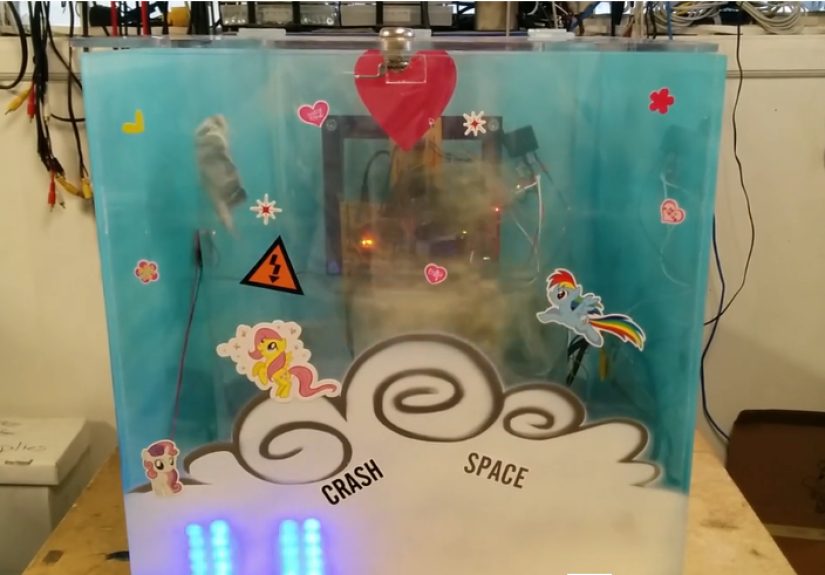
So builder Michelle Leonhart created something more worthy of a playful, inventive hackerspace: a My Little Pony-inspired donation box that rewards paper-bill donations with a miniature multimedia celebration. The box included a sensor near the donation slot, an LED matrix that could display a thank-you message, an audio trigger to play music, and fans that blasted the bills around in a clear chamber like a tiny cash cyclone. It was part donation container, part kinetic sculpture, part fandom joke, and part lesson in interaction design.
The result was a “dollar-bill vortex box” with personality. Instead of asking people to donate out of guilt, it offered them a small show. Donate a bill, and the box reacted. Not with a silent clunk, but with light, sound, airflow, and delight. That reaction turns giving from a private transaction into a shared moment. In a booth full of blinking boards and half-finished robots, the donation box became one more exhibit.
Why a Brony Theme Actually Makes Sense
The brony angle may sound random until you understand the culture around hackerspaces. Hackerspaces are rarely sterile labs. They are community workshops where people bring weird ideas, niche obsessions, inside jokes, abandoned projects, and glorious nonsense. A soldering unicorn mascot named Sparkles fits that world better than a corporate logo ever could.
The brony fandom, centered around adult fans of My Little Pony: Friendship Is Magic, became widely known for creativity, fan art, remix culture, online communities, and a cheerful rejection of old assumptions about what adults are “supposed” to like. That overlaps naturally with hacker culture, which has always enjoyed taking things apart, rebuilding them, and refusing to accept default settings. If society says a donation box should be plain, the hackerspace answer is, “What if it had a wind tunnel and friendship magic?”
That is not childish. It is strategic play. When people laugh, they pay attention. When they pay attention, they remember. When they remember, they are more likely to support the project, talk about it, and maybe come back with friends. In other words, pony stickers and rainbow energy can become a surprisingly effective public-engagement tool.
The Maker Ingredients: Sensors, LEDs, Sound, and Airflow
The core idea behind the box is simple: detect a donation, trigger a response, and make the response visible enough to feel rewarding. The hardware stack reflects classic maker-project thinking. A small microcontroller, such as an Arduino Nano-style board, can monitor a sensor, control outputs, and coordinate the sequence. A distance or proximity sensor near the slot can detect the movement of a bill. Once the donation is sensed, the controller can activate an LED matrix, play an audio file through a sound module, and switch on fans through a relay or transistor-based control circuit.
The LED matrix is the project’s smiling face. It can scroll “THANK YOU!” or show playful animations. The audio system adds theatrical timing, and the fans deliver the physical punchline: money flying around the chamber. That airflow matters because it transforms the bill from “cash dropped in a box” into “proof that something happened.” It also encourages paper money over coins, which is a clever practical detail. Coins are useful, but bills make better tiny tornadoes.
The enclosure is just as important. A clear acrylic or Plexiglas box lets people see the donation in motion, which makes the mechanism understandable and shareable. Decorative elements such as laser-cut hearts, stickers, and colorful trim turn the electronics into a character. Without the theme, the hardware might feel like a lab demo. With the theme, it becomes a story.
Why Interactive Donation Boxes Work Better Than Boring Jars
Traditional donation boxes rely on passive generosity. They sit there and hope visitors notice them. Interactive donation boxes do something more powerful: they create feedback. Humans love feedback. We press elevator buttons twice even though we know it does nothing, just because we want the world to confirm we exist. A donation box that responds says, “Yes, your action mattered.”
This is where warm-glow giving comes in. People often donate not only because a cause is worthy, but also because giving feels good. A responsive donation box amplifies that feeling. It adds humor, surprise, and social recognition without turning the donor into the star of an awkward telethon. The person drops in a bill, the box celebrates, nearby visitors look over, and suddenly generosity has a soundtrack.
For nonprofits, museums, makerspaces, and community workshops, this matters. Physical donation boxes do more than collect money; they remind visitors that the organization needs support. When the box is memorable, that reminder becomes softer and more effective. Instead of “Please fund our operating costs,” the message becomes “You can help keep this wonderful madness alive.”
The Hackerspace Lesson: Build the Culture Into the Object
The best feature of the brony donation box is not the sensor, the fan, or even the pony theme. It is that the object reflects the culture of the place that made it. CRASH Space could have bought a generic acrylic donation container and slapped a label on it. Instead, the makers built an artifact that says: we like electronics, we like jokes, we like community, and we are not afraid of sparkle.
That is an important lesson for any hackerspace or makerspace. Your tools may attract people, but your culture keeps them around. A laser cutter is useful. A 3D printer is useful. A bench full of microcontrollers is useful. But what makes a space feel alive is the sense that people are welcome to try strange ideas. A ridiculous donation box sends that signal instantly.
It also turns fundraising into a demonstration of competence. Visitors can see that the community does not just talk about making things; it makes things. Even a donation container becomes an engineering playground. The box quietly says, “Imagine what else happens here.” That is better marketing than a stack of flyers.
Design Takeaways for Your Own Interactive Donation Box
1. Make the Reward Immediate
The response should happen right after the donation. A delayed reaction weakens the connection between action and reward. Whether it is a light animation, a sound effect, a moving part, or a tiny mechanical dance, the donor should instantly understand that they caused it.
2. Keep the Mechanism Visible
Transparent materials make the box more trustworthy and more interesting. People like seeing where the money goes, and they enjoy watching the internal action. Visibility also helps visitors understand that the box is not magic, even if the theme claims otherwise.
3. Build Around a Story
A theme gives the project emotional shape. It could be ponies, robots, space cats, retro arcade games, garden gnomes, or a tiny dragon guarding the rent fund. The exact theme matters less than the fact that it feels intentional and memorable.
4. Design for Maintenance
Public projects get bumped, poked, overfed, ignored, and occasionally treated like carnival machines. A donation box needs accessible wiring, secure cash storage, reliable power, and parts that can survive repeated use. Cute is good. Cute and repairable is better.
5. Respect the Donor
A fun box should celebrate the act of giving without shaming people who do not donate. The tone should be welcoming, not demanding. Humor works best when it invites people in rather than making them feel trapped by a glittery guilt machine.
Specific Example: How the Brony Box Turns a Bill Into a Show
Picture the scene at a public maker event. A visitor walks up to the booth, notices the bright decoration, and asks, “What does this do?” Someone from the hackerspace grins, because this is exactly the question the box was built to create. The visitor slides a dollar bill into the slot. A sensor detects the bill passing through. The controller fires the sequence. The LED matrix scrolls a thank-you message. Music plays. Fans spin up. Inside the clear chamber, the bill lifts, flutters, and joins the swirling herd of previous donations.
Now the visitor is not merely a donor. They are part of the demo. Other people notice. Someone laughs. Someone records a short video. Someone asks how it works. Suddenly the donation box has done three jobs: collected money, started a conversation, and explained the hackerspace’s personality in five seconds.
That is why the project remains interesting years later. It is not because the circuit is impossibly complex. It is because the idea is complete. The theme, the mechanics, the sound, the visuals, and the fundraising goal all point in the same direction: generosity can be playful.
Why This Project Still Feels Fresh
Maker culture has changed since the first wave of viral Arduino projects, but the lesson here has not aged. If anything, it feels more relevant. People are surrounded by digital donation buttons, subscription prompts, payment links, QR codes, and online campaigns. Those tools are efficient, but they are often forgettable. A physical interactive object can cut through the noise because it has presence.
The brony donation box belongs to a category of projects that are technically modest but culturally smart. It does not need artificial intelligence, blockchain, or a voice assistant named after a weather pattern. It just needs a clear interaction loop: insert bill, trigger joy, remember the space. That is elegant design wearing a rainbow wig.
For community organizations, the takeaway is not “copy this exact pony box.” The takeaway is “build fundraising into the experience people already came to enjoy.” A hackerspace can make a donation robot. A library makerspace can make a book-loving monster that burps thank-you lights. A museum can make a transparent coin run. A school robotics club can build a small rover that carries donations to a locked container. The project should feel like the organization, not like a catalog product.
The Human Side of Hackerspace Fundraising
Hackerspaces often operate on thin budgets. Rent, tools, repairs, utilities, insurance, materials, and event costs do not pay themselves, no matter how nicely you ask the 3D printer. Fundraising is necessary, but asking for money can feel awkward in volunteer communities. Many makers would rather debug an intermittent ground fault than say, “Please donate.”
An interactive box helps by making the ask indirect. It does not pressure visitors with a speech. It gives them something to discover. It says, “Here is a fun thing we made. If you enjoy it, you can support more fun things.” That tone fits maker culture because it is generous, transparent, and a little silly.
It also respects the fact that community support is emotional. People give to places that feel alive. They give when they can imagine the impact. A donation box that looks like it was built by real members, for real events, with real jokes baked into the acrylic, makes the organization feel tangible. You are not supporting an abstract nonprofit. You are helping the people who built the pony-powered money tornado.
Experiences Related to the Topic: What an Over-the-top Donation Box Teaches in Real Life
Anyone who has spent time around a hackerspace knows that the best projects often begin with a sentence that should probably be illegal in a serious meeting: “Wouldn’t it be funny if…” That phrase is dangerous. It can produce a cardboard robot, a self-playing xylophone, a laser-cut sandwich press, or in this case, a donation box that behaves like it was raised by Saturday morning cartoons and a bench power supply.
The experience of seeing an object like this in person is different from reading a parts list. You notice the social effect first. People approach it with suspicion, amusement, and curiosity. They lean in. They look for the sensor. They ask whether it takes coins. Somebody jokes that the box has better stage presence than most conference speakers. Then someone donates a bill, and the whole thing becomes a tiny event.
That moment teaches a powerful design principle: interaction creates ownership. When visitors trigger the light, sound, and motion themselves, they feel connected to the object. They are not watching a display; they are causing a reaction. The donation becomes a button press with moral benefits. It is giving, but with better user experience.
For makers, the project is also a reminder that polish does not always mean minimalism. Many modern products try to look clean, quiet, and invisible. Hackerspace projects can go the other way. They can be loud, decorated, referential, and proudly handmade. The visible personality is not a flaw. It is the point. A pony-themed donation box does not need to apologize for being too much. Being too much is its job.
There is also a useful lesson about public durability. A project that works perfectly on a bench may behave differently at an event. Lighting is weird. People poke things. Kids press anything that looks pressable. Someone may insert a folded bill sideways with the confidence of a raccoon solving a safe. Building for the public means anticipating chaos with good wiring, strain relief, secure fasteners, easy reset access, and a cash compartment that does not require a ritual sacrifice to empty.
Finally, the box shows why humor belongs in technology. Humor lowers the barrier to entry. Not everyone wants to discuss microcontroller pinouts. But nearly everyone understands a funny machine that says thank you. Once people are laughing, they become more willing to ask technical questions. That is when outreach happens. The silly object becomes a doorway into electronics, fabrication, programming, and community participation.
In that sense, the brony donation box is more than a novelty. It is a miniature ambassador for hands-on learning. It proves that a project can be useful, educational, weird, and emotionally warm at the same time. It asks for support without becoming stiff. It celebrates fandom without turning the article into a costume contest. It makes cash fly around in a clear box, which is objectively fun unless you are a very tired accountant.
If you are planning a donation box for a hackerspace, makerspace, school club, museum, or community lab, the big lesson is simple: do not only build a container. Build a moment. Give people a reason to smile, a reason to ask questions, and a reason to remember who you are. Whether your theme is ponies, robots, rockets, or a suspiciously charismatic toaster, make the donation feel like participation. That is how a box becomes a story.
Conclusion
The over-the-top hackerspace donation box that brings out the brony in you is a perfect example of what happens when fundraising meets maker imagination. It takes a dull object and transforms it into an interactive experience with personality, humor, and technical charm. By combining sensors, LEDs, music, fans, acrylic, and a My Little Pony-inspired theme, the project turns a simple donation into a memorable act of community support.
More importantly, it proves that playful design can serve a serious purpose. Hackerspaces need funding, but they also need visibility, conversation, and emotional connection. A creative donation box can do all three. It can collect money, teach electronics, entertain visitors, and show off the culture of the space in one delightful burst of light and airflow. Not bad for a box with a pony problem.