Table of Contents >> Show >> Hide
- Why Jennifer Lawrence Playing Basketball Became Internet Gold
- Jennifer Lawrence: The Celebrity Who Makes Memes Feel Friendly
- What Makes a Great Photoshop Battle?
- The Best Types of Edits From the Jennifer Lawrence Basketball Meme
- Why the Internet Loves Awkward Celebrity Sports Moments
- Photoshop Battles Before AI Took Over the Timeline
- The Secret SEO Lesson Hidden in a Silly Basketball Meme
- When Meme Culture Is Playful Instead of Cruel
- Why This Meme Still Works Years Later
- Experiences Related to Jennifer Lawrence, Basketball, and the Photoshop Games
- Conclusion
Note: This is an original, rewritten SEO article based on publicly available entertainment coverage, social-media context, and real background information. The original image set is discussed for analysis, but the images are not reproduced here.
There are celebrity photos, and then there are celebrity photos that practically walk into the internet wearing a sign that says, “Please turn me into a meme.” Jennifer Lawrence playing basketball belongs firmly in the second category. One casual, slightly awkward, wonderfully human image of the Oscar-winning actress shooting hoops was all it took for Reddit’s Photoshop community to roll up its sleeves, crack its knuckles, and begin the digital mischief.
The result was the kind of online moment that feels both ridiculous and oddly inevitable: Jennifer Lawrence, basketball in hand, transformed into everything from a pop-culture heroine to a surreal action figure in scenarios that had very little to do with sports and absolutely everything to do with imagination. The original photo became the spark; the internet brought the gasoline, glitter, and a suspicious number of cats.
What made this particular Photoshop battle so funny was not that Jennifer Lawrence was doing anything outrageous. Quite the opposite. She was simply playing basketball. But the internet has a sixth sense for images with “meme posture,” and this one had it all: motion, facial concentration, a floating ball, open space, and the slightly theatrical body language of someone caught mid-action. In other words, it was not just a photo. It was a blank canvas wearing sneakers.
Why Jennifer Lawrence Playing Basketball Became Internet Gold
The viral image surfaced around 2016, during a period when Reddit Photoshop battles were already a beloved corner of internet culture. These battles usually begin with one unusual or visually flexible image. Someone posts it, other users edit it, and the community votes, comments, jokes, improves, and one-ups itself until the original photo has lived several dozen new lives.
Jennifer Lawrence’s basketball photo arrived with the perfect ingredients. First, the image featured a celebrity with massive public recognition. Lawrence was already famous for The Hunger Games, Silver Linings Playbook, American Hustle, and her many funny, unfiltered public appearances. Second, the photo had a physical pose that could be easily separated from the original setting and placed somewhere absurd. Third, the subject looked neither overly polished nor carefully staged. It had the charm of a candid moment, which is exactly what Photoshop humor loves.
Photoshop battles work best when the edit does not have to fight the original photo. The stronger the visual “hook,” the easier it is for creators to build a joke. In this case, Jennifer Lawrence’s raised arms, athletic stance, and focused expression could become a dramatic movie still, a video game move, a superhero landing, a circus trick, a scene from a children’s movie, or a deeply questionable basketball strategy. The internet did not need much encouragement. It saw the photo and collectively shouted, “We can make this weirder.”
Jennifer Lawrence: The Celebrity Who Makes Memes Feel Friendly
Part of the reason the Photoshop battle landed so well is Jennifer Lawrence’s public image. Born in Kentucky, Lawrence built a career that moved quickly from independent drama to blockbuster stardom. Her breakout role in Winter’s Bone earned serious critical attention, while The Hunger Games turned her into one of the most recognizable actresses of her generation. She later won the Academy Award for Best Actress for Silver Linings Playbook and became closely associated with roles that balanced intensity, vulnerability, and offbeat humor.
But her meme appeal has never been only about acting credits. Lawrence has long been treated by fans and entertainment media as unusually relatable for an A-list star. Her interviews often included self-deprecating jokes, food references, red-carpet clumsiness, and the kind of facial expressions that look like someone accidentally turned their internal monologue into a public event. That made her a natural fit for internet humor, where the most shareable celebrity moments are often the ones that puncture glamour with something recognizably human.
With the basketball photo, the joke was not “Jennifer Lawrence is bad at basketball.” The better joke was, “Jennifer Lawrence has accidentally wandered into a thousand alternate universes.” The edits were funny because they treated the image as a prop, not as a takedown. That distinction matters. A good Photoshop battle can be silly without being mean. It can laugh at the moment while still leaving the person in the photo intact.
What Makes a Great Photoshop Battle?
A great Photoshop battle is not just about technical skill. Yes, clean cutouts, good shadows, matching lighting, and believable perspective all help. But the internet rewards timing and concept first. A technically perfect edit with no joke will usually lose to a slightly rough edit with a hilarious idea. The best entries understand the original photo and then twist it just far enough to surprise people.
1. The Pose Must Suggest a Story
Jennifer Lawrence’s basketball pose worked because it already looked like the middle of a scene. She was not simply standing still; she was caught in action. A mid-action pose gives editors a beginning and an ending to invent. Is she catching something? Throwing something? Lifting something? Escaping something? Performing a ritual in a very confusing gym class? The more possibilities a pose contains, the more jokes the community can build.
2. The Background Should Be Easy to Replace
Photoshop editors love a subject that can be cut out and dropped into another world. A busy background can still work, but a clear figure with a recognizable silhouette makes editing faster and more flexible. In this case, Lawrence’s body position and the basketball gave creators clear visual anchors. The ball could become another object, the court could become another universe, and the athletic posture could be reinterpreted as anything from heroic to chaotic.
3. The Celebrity Must Be Recognizable
Recognition gives the joke instant power. A random person playing basketball might still produce funny edits, but Jennifer Lawrence adds cultural context. Viewers bring their own knowledge of Katniss Everdeen, award-show moments, celebrity interviews, and Hollywood fame. Every edit can play with that context. A basketball shot can become a Hunger Games joke. A dramatic lift can become a movie-poster gag. A serious facial expression can become the emotional climax of a fake blockbuster about recreational sports.
The Best Types of Edits From the Jennifer Lawrence Basketball Meme
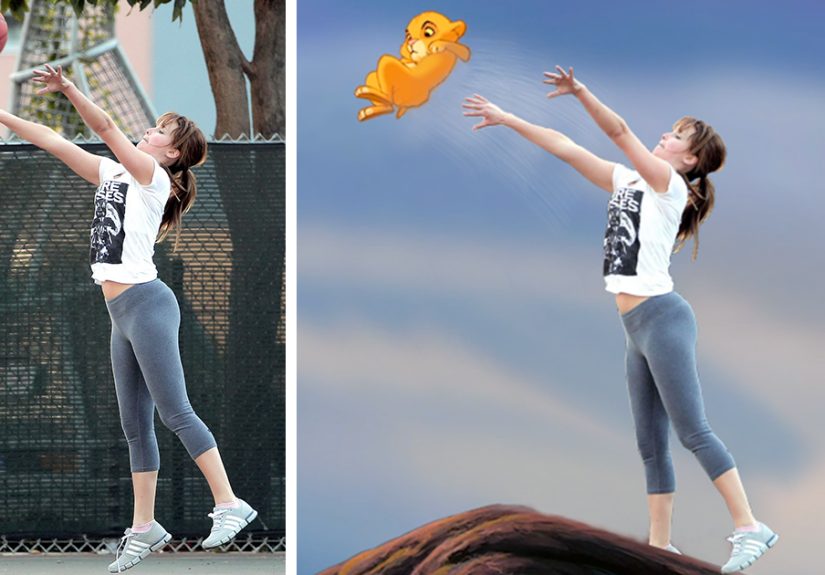
The “29 pics” that circulated around this Photoshop battle showed how many directions one image can travel once creative strangers get involved. Some edits leaned into movie references. Others turned the basketball into a different object entirely. Some placed Lawrence into animal-related chaos, fantasy scenes, video game worlds, or classic internet absurdity. One widely discussed style of edit played with a Lion King-like presentation, using the raised posture to make the moment look like a dramatic offering. Another type of edit treated her pose as if she were lifting, catching, or launching something far more surprising than a basketball.
That variety is the real entertainment. Photoshop battles are not funny because every entry is perfect. They are funny because the crowd keeps widening the joke. One person sees sports. Another sees cinema. Another sees a cat. Someone else sees a disaster movie. Then a fifth person arrives with the energy of a sleep-deprived art student and somehow turns the same photo into a Renaissance painting with sneakers.
The most memorable edits usually do one of three things. They either change the object, change the setting, or change the stakes. The basketball might become a planet, a creature, a tiny person, a piece of movie lore, or a dangerous item that absolutely should not be thrown indoors. The court might become outer space, a famous film scene, a fantasy battlefield, or a video game level. The stakes might shift from “celebrity plays basketball” to “Hollywood star saves the universe through questionable free-throw form.”
Why the Internet Loves Awkward Celebrity Sports Moments
Celebrity sports photos are especially meme-friendly because they combine two kinds of performance: athletic movement and public image. Athletes train to look powerful in motion. Actors train to control emotion, expression, and physical presence. But a casual sports photo strips away some of that control. It catches a famous person in the same weird freeze-frame that happens to everyone during a backyard game, office volleyball day, or one ill-advised attempt to impress relatives at Thanksgiving.
That is why Jennifer Lawrence playing basketball feels fun instead of scandalous. It is low-stakes. Nobody is analyzing a championship game. Nobody is claiming she should be drafted. The humor comes from seeing a global movie star in a universal human situation: trying to coordinate limbs, gravity, and a ball while a camera exists nearby. Most people have at least one photo like this. The difference is that most people’s awkward basketball pictures do not end up in a Reddit Photoshop battle seen by half the internet.
The basketball element also opens the door to physical comedy. A ball in the air can become almost anything. Arms raised toward the sky can suggest triumph, confusion, worship, panic, or a very dramatic attempt to catch lunch. Sports photography often creates strange shapes because bodies are moving fast. Freeze the right moment, and even a normal motion can look like interpretive dance performed during a fire drill.
Photoshop Battles Before AI Took Over the Timeline
The Jennifer Lawrence basketball edits also represent a particular era of internet creativity. Photoshop battles became popular because they rewarded human remixing. Users were not simply asking a machine to generate ten options. They were cutting, blending, masking, lighting, and joking by hand. The humor came from craft as much as concept.
Adobe Photoshop itself has been part of digital culture since 1990, growing from professional image-editing software into a word people casually use as a verb. Over time, the tools became more powerful, and newer AI features made image manipulation faster than ever. But classic Photoshop battles have a special flavor because they feel handmade. You can often sense the editor’s thought process: “What if Jennifer Lawrence was not playing basketball, but instead saving a baby lion from gravity?” That human leap is the joke.
Today, visual humor moves faster. Platforms like Instagram, TikTok, Reddit, X, and Facebook help images spread instantly. Memes can be generated, remixed, captioned, stitched, and re-uploaded before lunch. But speed is not always the same as charm. The best old-school Photoshop battles had a workshop quality. People improved each other’s ideas, responded to details, and built a miniature comedy festival around one image.
The Secret SEO Lesson Hidden in a Silly Basketball Meme
Believe it or not, there is a content lesson here. Viral posts like “Jennifer Lawrence Plays Basketball And The Photoshop Games Begin (29 Pics)” succeed because the title is direct, visual, and curiosity-driven. It tells readers who is involved, what happened, and why they should click. There is a celebrity name, an action, and a promise of multiple images. That is a strong formula for entertainment content.
However, the reason readers stay is not just the title. They stay because the content delivers a chain of surprises. Each edit becomes a new punchline. The reader scrolls because the next image might be funnier, stranger, or more technically impressive than the last. In SEO terms, that means strong engagement. In human terms, it means people enjoy watching strangers compete to be the funniest person in the room.
For publishers, this type of topic works best when paired with analysis, context, and careful wording. A simple image dump may get quick attention, but a fuller article can explain why the moment mattered, how Photoshop battles work, and what the trend says about celebrity culture. That makes the piece more useful for readers who arrive through search engines looking for Jennifer Lawrence memes, Photoshop battle examples, funny celebrity photos, or internet humor history.
When Meme Culture Is Playful Instead of Cruel
Not every celebrity meme is harmless. Some rely on embarrassment, body-shaming, or taking a person’s worst moment and turning it into public entertainment. The Jennifer Lawrence basketball Photoshop battle is more interesting because its humor is mostly based on transformation rather than humiliation. The image becomes a launchpad for absurd scenes, not a courtroom where the internet prosecutes someone for having knees.
That difference is worth noticing. Playful remix culture works best when the joke points outward. The humor comes from the edit, the reference, the surprise, or the impossible new scenario. Cruel meme culture points inward, targeting the person’s appearance or dignity. One creates a shared laugh; the other creates a pile-on. The Jennifer Lawrence basketball edits largely belong to the first category, which is why people can still discuss them years later with affection rather than discomfort.
Lawrence’s own public persona likely helped. She has often been associated with spontaneity and self-aware humor, so the edits felt like they fit the broader internet idea of Jennifer Lawrence: talented, famous, glamorous when necessary, but also fully capable of looking like someone who just realized the gym floor is more slippery than expected.
Why This Meme Still Works Years Later
Some memes expire quickly because they depend on a current event that loses relevance. Others survive because the basic joke is timeless. Jennifer Lawrence playing basketball falls into the second category. You do not need to remember the exact week it went viral. You do not need to know every Reddit username involved. You only need to understand the setup: famous actress, awkward sports photo, internet editors unleashed.
The image also sits at a crossroads of several evergreen interests: celebrity culture, basketball, Photoshop humor, Reddit creativity, and visual memes. Each of those topics continues to attract search interest because people enjoy seeing familiar public figures in unexpected situations. The basketball photo is not important because it changed Jennifer Lawrence’s career. It is important because it shows how the internet turns a tiny moment into a collaborative comedy project.
In that sense, the “29 pics” format is part of the appeal. A single meme can be funny, but a collection shows range. It lets readers compare ideas, pick favorites, and appreciate the creativity of the crowd. The first edit makes you laugh. The tenth edit makes you respect the madness. By the twenty-ninth, you may begin to wonder whether the internet should be given more supervision, or possibly less.
Experiences Related to Jennifer Lawrence, Basketball, and the Photoshop Games
Anyone who has ever watched a Photoshop battle unfold knows the experience is strangely addictive. You open the first image expecting a quick laugh, and then suddenly you are fifteen edits deep, judging shadow placement like a museum curator with Wi-Fi. The Jennifer Lawrence basketball battle has that exact energy. It begins with a simple question: “What can people possibly do with this?” Then the answers arrive, each one more committed to nonsense than the last.
The funniest part of this kind of experience is how quickly your brain adapts to the new reality. At first, you see Jennifer Lawrence playing basketball. A few edits later, your mind accepts that she might also be catching a cartoon lion, floating through a movie scene, battling imaginary creatures, or starring in the world’s most confusing sports commercial. The original context fades, and the edited universe takes over. That is the magic trick of a strong meme: it convinces you that absurdity was always hiding inside the photo.
There is also a familiar social experience around these posts. Someone sends the link in a group chat with a message like, “I’m sorry, but look at number seven.” Then everyone develops strong opinions. One person likes the cleanest edit. Another prefers the dumbest one. Someone else starts explaining why a particular shadow is wrong, even though nobody asked them to become the Supreme Court of Lighting Angles. Before long, the photo has become less about Jennifer Lawrence and more about shared taste in ridiculousness.
For people who create edits, the experience is even more satisfying. A Photoshop battle gives you constraints, and constraints are where creativity gets spicy. You have one subject, one pose, and one chance to make the internet snort coffee through its nose. The challenge is not just to edit well; it is to think sideways. What does this pose resemble? What story can be built around the ball? What reference will people recognize instantly? A good edit feels like solving a puzzle with a punchline.
For casual viewers, the Jennifer Lawrence basketball meme also brings a softer pleasure: seeing fame become ordinary for a moment. Celebrities are usually photographed in controlled environments, surrounded by stylists, lights, red carpets, and professional polish. A basketball photo breaks that frame. It reminds viewers that even an Oscar winner can be caught mid-motion looking like the laws of physics just filed a complaint. That relatability is not a flaw. It is the whole charm.
In a broader sense, the Photoshop games show why the internet keeps returning to visual remixing. People like to participate, even if they are only voting, laughing, or sending the best edit to a friend. The photo becomes a shared object, and the edits become a conversation. Some are clever. Some are chaotic. Some look like they were made at 2:00 a.m. by someone powered entirely by cereal and confidence. But together, they create a small, joyful archive of collective imagination.
That is why “Jennifer Lawrence Plays Basketball And The Photoshop Games Begin” remains such a memorable topic. It captures the internet at play: fast, weird, creative, and just a little too proud of itself. The basketball may have started the game, but the edits won it.
Conclusion
The Jennifer Lawrence basketball Photoshop battle is a perfect example of how internet culture can turn an ordinary celebrity photo into a collaborative comedy event. A candid sports moment became a playground for Reddit editors, entertainment sites, meme fans, and casual readers who simply wanted to see how far one image could go. The reason it worked was simple: the photo had motion, personality, and endless remix potential.
More importantly, the edits showed the best side of Photoshop humor. They were playful, inventive, and driven by pop-culture imagination rather than cruelty. Jennifer Lawrence’s recognizable persona made the meme instantly clickable, while the community’s creativity made it memorable. Years later, the image still works because it captures a universal truth of online life: give the internet a ball, a celebrity, and a slightly awkward pose, and it will build a tiny cinematic universe before dinner.