Table of Contents >> Show >> Hide
- What “Urania” Means in the KPM Universe
- Meet the Designer Energy Behind the Look: Trude Petri
- The Urania Gravy Boat, Up Close: Shape, Proportions, and Why It Works
- Authenticity: The KPM Marks You Want to See (and the Mistakes You Don’t)
- Buying a KPM Berlin Urania Gravy Boat: What Affects Price
- How to Use a Gravy Boat Like a Person Who Has It Together
- Care and Cleaning: Keeping That White Porcelain Bright
- Why Collectors and Design People Love Urania
- Experiences: Living With a KPM Berlin Urania Gravy Boat (and Why It’s Weirdly Fun)
- Conclusion
Some objects do a lot of talking without ever raising their voice. The KPM Berlin Urania gravy boat is one of them.
It doesn’t have ruffles, swoops, or a spout that looks like it’s auditioning for an opera. It shows up, sits down,
and quietly makes everything around it look more “intentional.” Even if your dinner plan was, technically,
“whatever’s in the fridge plus confidence.”
In design terms, Urania is that rare sweet spot: minimalist without being sterile, classic without feeling fussy,
and special without screaming “PLEASE ADMIRE ME.” In hosting terms, it’s the piece that convinces your guests you
definitely own matching napkins somewhere.
What “Urania” Means in the KPM Universe
KPM (Königliche Porzellan-Manufaktur Berlin) is famous for porcelain that balances craft tradition with modern design.
The Urania line is often described as a reduced, clarity-first serviceporcelain that aims for “nothing can be left out”
rather than “what else can we glue on?” That design philosophy places Urania in the orbit of early 20th-century
Modernismthink New Objectivity and the Bauhaus-era preference for clean form and functional elegance.
From Arkadia’s Ornament to Urania’s Calm
A helpful way to understand Urania is to see it as the pared-back counterpart to KPM’s Arkadia. Arkadia’s form was
developed in 1938 in connection with designer Trude Petri, and it is known for its classical structure and (in many
versions) decorative relief medallions. Urania carries that disciplined geometry forward, but without the relief
decoration, putting the focus on proportion, silhouette, and the crisp transitions between surfaces.
In other words: Arkadia is the friend who arrives in a tailored jacket with an incredible story. Urania is the friend
who arrives in a perfect white shirt and somehow makes everyone else look slightly rumpled (in a charming way, but still).
Meet the Designer Energy Behind the Look: Trude Petri
When people fall for Urania, they often fall for the design thinking behind it: a belief that elegance can be engineered
through restraint. Trude Petri is frequently credited in KPM’s modern tableware story, and her work is widely recognized
within design circlesso much so that related KPM designs appear in major museum collections.
If you love objects that look “simple” only until you try to design one yourself, you’ll recognize the trick:
the fewer the lines, the more every line has to be perfect. Urania lives in that high-stakes minimalism.
The Urania Gravy Boat, Up Close: Shape, Proportions, and Why It Works
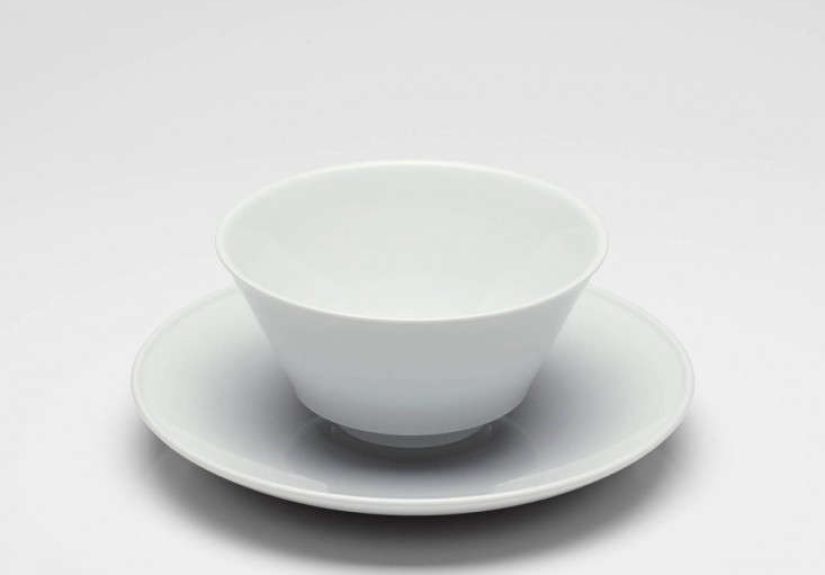
The Urania gravy boat is celebrated for its clean-lined profileno frilly curves, no ornamental flourishes, just a
confident vessel in bright white porcelain. The overall footprint is often listed around 200 mm, with a height around
80 mm, giving it a low, stable presence that looks refined on a table and feels practical in the hand.
It’s also a piece that looks good even when it’s not “working.” Empty, it reads like a small sculpture. Filled, it
turns into a functional centerpiece. And unlike some traditional gravy boats, it doesn’t visually bully the rest of
the table setting. It’s more: “I’m here if you need me.” Which, frankly, is a great vibe for gravy.
Why Minimalist Tableware Feels So Luxurious
With minimalist porcelain, there’s nowhere to hide. You notice the symmetry, the smoothness of the glaze, the precision
of the rim, and how the handle and spout integrate with the body. Urania’s appeal is that it doesn’t try to distract
you with decorationit wins you over with refinement.
The result is oddly versatile. It can sit beside rustic mashed potatoes or a precisely plated short rib, and it won’t
feel out of place. That “works with everything” quality is part of why collectors and design-minded hosts chase it.
Authenticity: The KPM Marks You Want to See (and the Mistakes You Don’t)
If you’re shopping for a KPM Berlin Urania gravy boatespecially vintage or secondhandthe backstamp matters.
KPM’s iconic hallmark is the cobalt-blue scepter. Authentic KPM marking is typically applied as underglaze paint
during production and then glazed over, rather than sitting on top of the glaze like a late addition.
Practical takeaway: underglaze marks tend to look integrated into the surface (almost “within” the glaze),
while overglaze marks can look like they’re resting on the surface. This isn’t the only test, but it’s a strong
starting point.
A Quick “Spot Check” for Buyers
- Look for the scepter mark commonly associated with KPM Berlin.
- Check how the mark sits: underglaze is generally a better sign than a surface-level print.
- Inspect the glaze for evenness and clarityfine porcelain should feel smooth and visually consistent.
- Be suspicious of overly fuzzy marks or marks that look “aged” in a way that doesn’t match the rest of the piece.
- Prioritize trusted sellers who provide clear photos of the base, rim, spout, and handle.
One more collector reality: KPM has a long history, and marks can vary across eras and product types.
If you’re paying premium money, it’s worth comparing the mark to reliable references and asking for additional
photosespecially of the underside and any secondary markings.
Buying a KPM Berlin Urania Gravy Boat: What Affects Price
The price range for a Urania gravy boat can swing widely depending on whether it’s new, pre-owned, vintage,
or bundled with an underplate or additional pieces. In the U.S. market, you’ll often see KPM pieces sold through
replacement china specialists, design-forward shops, high-end resale platforms, and auction-style listings.
Condition Is the Big Multiplier
With white porcelain, flaws don’t whisperthey announce themselves under bright kitchen lighting.
Here’s what typically impacts value:
- Chips on the spout (the most common heartbreak).
- Hairline cracks, especially near the handle joins.
- Crazing (fine crackle lines), which can be subtle but affects collectability.
- Staining inside the bowl (gravy is delicious; it’s also a tiny pigment monster).
- Repairs, which may be hard to spot unless you inspect closely.
Many professional replacement and resale sellers emphasize inspection and grading practices. That matters because
porcelain condition isn’t just cosmeticit affects longevity, usability, and resale.
Where People Actually Find Them
If you’re hunting in the U.S., you’ll see Urania and related KPM forms appear in a few predictable places:
- Replacement china retailers (best for reliability and clear pattern identification).
- Design shops and museum stores (best for curated selections and giftability).
- Estate sales and consignment (best for treasure-hunt pricing, worst for your self-control).
- Online marketplaces (best for variety, requires the strongest “photo verification” discipline).
Pro tip: When browsing listings, prioritize those that show the underside clearly and include close-ups of the spout edge.
A gorgeous profile photo won’t tell you if the rim has a tiny chip that will haunt you forever.
How to Use a Gravy Boat Like a Person Who Has It Together
Urania is beautifully minimalist, but it’s still a working piece. The goal is simple: keep the gravy warm, pour cleanly,
and avoid the classic table tragedydrips on the tablecloth that look like a tiny abstract painting titled “Regret.”
Warm It First (Yes, Really)
If you want gravy to stay warm longer, pre-warm the gravy boat. The easiest move: pour in hot water for a minute,
then empty and fill with gravy. It’s the low-effort trick that feels like high-level hosting.
Passing Etiquette That Saves You From Awkwardness
If you’re passing the gravy boat, a classic guideline is to orient the handle toward the person receiving it, and pass
it in a consistent direction so guests aren’t playing “surprise, it’s in your lap now” with hot gravy.
Care and Cleaning: Keeping That White Porcelain Bright
There’s good news: high-quality white porcelain is often described as dishwasher-safe in general terms.
There’s also real-world news: most porcelain accidents happen during loading and unloading, not during the wash cycle.
Translation: the machine may be fine, but the physics of plates bumping each other is not your friend.
Dishwasher vs. Hand Wash: A Practical Rule
- Plain white pieces: often okay for dishwasher use if you load carefully and avoid contact between items.
- Gold/platinum trim or hand-painted decoration: treat as hand-wash-only unless the maker explicitly says otherwise.
- When in doubt: warm water, mild soap, soft sponge, no abrasive pads.
And yes, this is where Urania shines again: its clean, undecorated aesthetic means you’re not worrying about delicate metallic bands
as much as you would with heavily gilded vintage pieces. Still, the safest approach is thoughtful handlingporcelain is strong,
but edges are always the danger zone.
Why Collectors and Design People Love Urania
Collectors tend to love Urania for a few reasons that go beyond “it’s pretty” (though it is):
- Design pedigree: it’s tied to a broader story of modern European design thinking applied to everyday objects.
- Versatility: it works across modern, transitional, and even traditional tables because it doesn’t compete with food or linens.
- Timelessness: white, well-proportioned porcelain rarely looks “dated.”
- Usability: it’s not just a display pieceit’s built for real meals.
In a world of novelty dinnerware, Urania feels like a long-term relationship: reliable, elegant, and still impressive years later.
Experiences: Living With a KPM Berlin Urania Gravy Boat (and Why It’s Weirdly Fun)
The first “experience” most people have with a Urania gravy boat is noticing how calm it lookslike it’s already forgiven you
for the chaos happening in the kitchen. You can be mid-dinner party, juggling a roasting pan, a last-minute salad, and the sudden
realization that you own exactly three forks that match, and Urania just sits there quietly, being immaculate.
Then comes the moment you actually use it. A good gravy boat does two things: it pours without splashing, and it makes serving feel
ceremonial in the best way. Urania’s clean form adds this subtle “now we are dining” energyeven if dinner is weeknight meatloaf.
People sit up straighter when a beautiful object enters the room. It’s not snobbery; it’s theater. And honestly, we could all use
a little theater on a Tuesday.
Over time, you also start to appreciate the small practical wins. Pre-warming the boat becomes a tiny ritual: hot water in, count
to sixty, pour it out, gravy in. You feel like you learned a secret handshake for grown-up hosting. And because the porcelain is white,
you can see exactly what’s happening insidewhether the gravy is silky or needs one more whisk. It’s like a tasteful progress report.
The second big experience is discovering how often guests comment on it. Not in an over-the-top waymore like, “Oh wow, that’s a really
nice gravy boat.” Which is a sentence people almost never say. The Urania gravy boat is the rare serving piece that earns a compliment
without forcing the conversation into antique-nerd territory. It’s approachable elegance. People who don’t care about design still like it
because it looks crisp and “right.” People who do care about design like it because the restraint is the point.
If you collect, the hunt becomes part of the fun. You’ll find yourself zooming in on listing photos like a detective: checking the base,
scanning for a clean mark, looking for rim chips, squinting at the spout edge. It’s the kind of treasure hunt that rewards patience.
When you finally find one in great condition, it feels like you didn’t just buy an objectyou rescued a small piece of design history
from the land of mismatched thrift-store ceramics.
And then there’s the holiday experiencethe moment gravy becomes a main character. Thanksgiving (or any big roast dinner) is basically a
competitive sport for serving ware. Urania holds its own. It looks fresh among busy patterned china, and it looks even better on a modern
table with simple linens. The funniest part is how it elevates everything around it: suddenly the potatoes seem more serious, the roast
seems more deliberate, and youstanding there with a ladleseem like a person who absolutely remembered to defrost the turkey on time.
Finally, you’ll have the quiet experience: washing it, drying it, putting it away, and realizing that some objects are satisfying simply
because they’re well made. The edges feel precise. The surface catches light in a clean, confident way. And every time you bring it out
again, it gives you the same little sparkthis sense that everyday rituals can be beautiful without being complicated. That’s the real charm.
It’s not just a gravy boat. It’s a tiny, practical reminder that good design can live right in the middle of real liferight next to the food.
Conclusion
The KPM Berlin Urania gravy boat is a minimalist classic: confident form, serious craftsmanship, and a presence that elevates the table
without stealing the show. Whether you’re collecting, gifting, or simply tired of serving gravy from a measuring cup (no judgment),
Urania is the kind of piece that rewards you every time you use itand quietly makes dinner feel like an occasion.