Table of Contents >> Show >> Hide
- Why Gross Fast-Food Products Happen
- The 16 Grossest Discontinued Fast-Food Products
- 1. McDonald’s Hula Burger
- 2. Taco Bell Seafood Salad
- 3. Burger King Halloween Whopper
- 4. McDonald’s McLean Deluxe
- 5. Burger King Satisfries
- 6. KFC Double Down
- 7. Pizza Hut Hot Dog Bites Pizza
- 8. Domino’s Oreo Dessert Pizza
- 9. Taco Bell Waffle Taco
- 10. McDonald’s Fish McBites
- 11. Burger King Mac n’ Cheetos
- 12. Burger King Whopperito
- 13. McDonald’s McLobster
- 14. Burger King Bacon Sundae
- 15. Wendy’s SuperBar
- 16. Sonic Pickle Juice Slush
- What These Discontinued Fast-Food Items Teach Us
- Experience Section: Eating Weird Fast Food Is a Very Specific Kind of Adventure
- Conclusion
- SEO Tags
Fast food is supposed to be quick, cheap, comforting, and just questionable enough to taste better at 11:47 p.m. But every so often, a major chain looks at a perfectly functional menu and says, “What if we wrapped this in a tortilla, dyed it black, filled it with fish, added bacon to dessert, or replaced bread with fried chicken?” That is how we get the strangest discontinued fast-food products in American dining history.
To be fair, innovation matters. Without bold menu experiments, we would not have beloved items like the Crunchwrap Supreme, chicken nuggets, or stuffed-crust pizza. But for every genius idea, there is a drive-thru disaster that makes customers pause, stare at the bag, and wonder whether the marketing department lost a bet. Some discontinued fast-food items failed because they were too expensive. Others were messy, confusing, overly processed, badly timed, or just too weird for the average lunch break.
This list rounds up 16 gross fast-food products that were real, memorable, and eventually removed from menus for reasons that become clearer the longer you think about them. Some have cult fans. Some deserve a tiny museum plaque. Some should be studied by future generations as warnings written in cheese sauce.
Why Gross Fast-Food Products Happen
Fast-food chains live in a world of constant competition. A burger chain is not just fighting another burger chain; it is fighting pizza, tacos, chicken sandwiches, convenience-store snacks, delivery apps, and your refrigerator’s sad leftover pasta. Limited-time offers create buzz, pull people into restaurants, and give brands something new to shout about.
The problem is that attention is not the same as appetite. A product can go viral and still taste like a committee meeting. Some menu items are designed to look exciting in commercials but become awkward in real life. Others sound funny once, then vanish because nobody wants to order them twice. That brings us to the hall of fameor maybe the hall of shame.
The 16 Grossest Discontinued Fast-Food Products
1. McDonald’s Hula Burger
The Hula Burger sounds like something invented during a tropical-themed office party that had gone on too long. McDonald’s founder Ray Kroc tested it as a meatless option: a slice of grilled pineapple with cheese on a bun. The idea was to serve customers who avoided meat on Fridays, especially during Lent.
Unfortunately for the Hula Burger, it competed against the Filet-O-Fish, and the fish sandwich won decisively. The Hula Burger had a major identity crisis. Was it a sandwich? Was it dessert? Was it a pineapple wearing a cheese blanket? Customers chose fish, and the pineapple burger sailed away into fast-food legend.
2. Taco Bell Seafood Salad
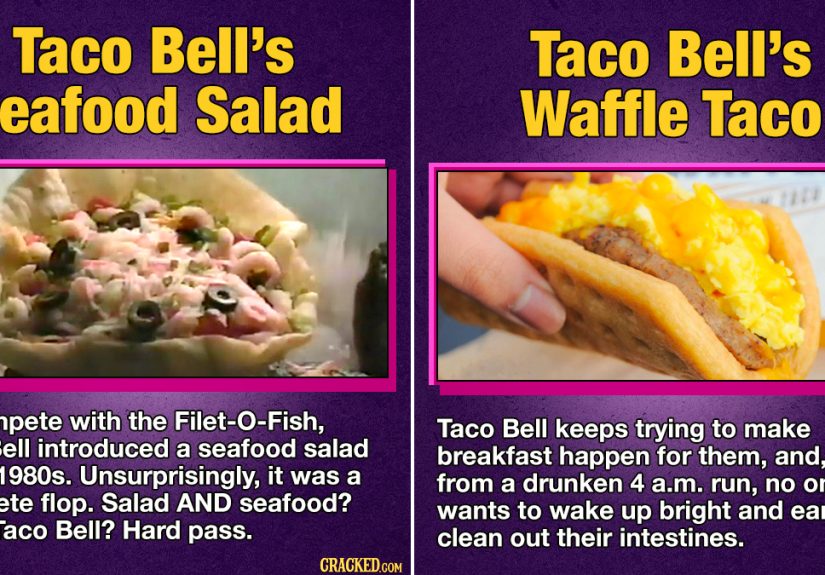
Taco Bell has built an empire on beef, beans, cheese, tortillas, and the beautiful idea that “fourth meal” counts as a lifestyle. Seafood salad, however, was a harder sell. Introduced in the 1980s, Taco Bell’s seafood salad tried to bring a lighter, more coastal vibe to a restaurant best known for crunchy tacos and late-night cravings.
The concept was not impossible, but the setting was suspicious. Seafood at a fast-food taco chain requires a level of trust many customers simply did not have. Even if the product was safely prepared, the phrase “Taco Bell seafood salad” sounded like the beginning of a cautionary tale. It disappeared quickly, and the chain mostly stayed in its lane afterward.
3. Burger King Halloween Whopper
The Halloween Whopper was a limited-time Burger King burger with a black bun flavored with A.1. sauce. Visually, it was dramatic. In theory, it was spooky. In practice, it became famous for something no fast-food brand wants attached to a national campaign: customers reported unexpected green bathroom results after eating it.
The burger itself was not radically different from a Whopper, but the black bun made it look like fast food from a haunted cafeteria. The real issue was that the conversation around the product moved from taste to digestion. Once your sandwich becomes a biology discussion, the marketing department has lost control of the room.
4. McDonald’s McLean Deluxe
The McLean Deluxe was McDonald’s attempt to ride the low-fat wave of the early 1990s. The burger was marketed as a lighter option, using a very lean beef patty helped along by additives intended to keep it moist. On paper, it was clever. In the mouth, many customers found it underwhelming.
A low-fat burger at McDonald’s is already a philosophical puzzle. People ordering burgers usually want juicy, salty, satisfying fast foodnot a patty that tastes like it read a fitness pamphlet and lost its personality. The McLean Deluxe became a symbol of the era when brands tried to remove fat from everything, including joy.
5. Burger King Satisfries
Satisfries were Burger King’s lower-calorie fries, introduced with a special batter designed to absorb less oil. The problem was not that healthier fries were a bad idea. The problem was that customers do not usually pull into Burger King because they are seeking a moderate potato experience.
They cost more than regular fries and asked customers to believe that fast-food fries could be a responsible life choice. That is a tough pitch. If someone wants fries, they usually want fries that fully commit to being fries. Satisfries sounded like a compromise, and compromise rarely wins in a paper bag full of burgers.
6. KFC Double Down
The KFC Double Down became instantly famous because it replaced bread with two fried chicken fillets and stuffed bacon, cheese, and sauce in the middle. It was less a sandwich than a dare with napkins.
Some people loved it. Others looked at it and heard their arteries politely clearing their throats. The Double Down returned more than once as a limited-time item, proving that America enjoys flirting with chaos. But as an everyday menu product, it was heavy, salty, greasy, and awkward to hold. A sandwich should not require the grip strength of a rock climber and the confidence of a stunt driver.
7. Pizza Hut Hot Dog Bites Pizza
Pizza Hut has never been shy about crust innovation. Stuffed crust was brilliant. Hot Dog Bites Pizza, however, pushed the concept into carnival territory. The pizza came with 28 mini hot dogs wrapped around the edge like tiny meat guards protecting the cheese.
Was it pizza? Was it pigs in a blanket? Was it dinner wearing a snack necklace? The answer was yes, unfortunately. The idea was clearly built for attention, and it got plenty of it. But after the novelty wore off, customers were left with a pizza that made every slice feel like a negotiation.
8. Domino’s Oreo Dessert Pizza
Domino’s Oreo Dessert Pizza took a thin dessert-style crust, added vanilla sauce, and covered it with Oreo cookie crumbles. This sounds harmless until you remember it came from the same place as pepperoni pizza, garlic crust, and buffalo wings. Dessert pizza can work, but this one lived in a strange zone between cookie, flatbread, and lunchroom experiment.
The product was sweet, messy, and very much of its time. It felt like something invented by asking, “What do people like?” and then combining the answers without checking whether they belonged together. Oreos are great. Pizza is great. Not every famous food needs to be introduced to every other famous food.
9. Taco Bell Waffle Taco
The Waffle Taco arrived during Taco Bell’s big breakfast push. It used a folded waffle as the shell and filled it with eggs, cheese, and sausage or bacon, served with syrup. Structurally, it was ambitious. Emotionally, it was confusing.
The biggest issue was the waffle shell. A taco shell should support its contents. A waffle is more of a soft breakfast mattress. Add eggs, cheese, meat, and syrup, and suddenly the whole thing feels like brunch folded into a napkin. Taco Bell eventually leaned harder into breakfast items that made more sense, like the Breakfast Crunchwrap.
10. McDonald’s Fish McBites
Fish McBites were bite-sized pieces of fried fish, launched as a seafood alternative around Lent. The idea followed the logic of Chicken McBites, but fish is more delicate, more divisive, and less forgiving in nugget form.
Many customers were already comfortable with the Filet-O-Fish because it came in sandwich form with tartar sauce and a soft bun. Fish McBites removed that familiar structure and asked diners to eat poppable fish pieces from a box. That is a much harder sell, especially when chicken nuggets are sitting nearby looking normal.
11. Burger King Mac n’ Cheetos
Mac n’ Cheetos were deep-fried sticks filled with macaroni and cheese and coated in Cheetos-flavored dust. They looked like oversized orange snack puffs hiding a dairy-based secret.
As a novelty item, they were undeniably memorable. As food, they were a lot. The texture had to juggle crunch, pasta, cheese, and powdered snack flavor all at once. Some fans still miss them, but the product also represents the era when fast-food chains believed every menu item needed to be a mashup, preferably one that turned fingers orange.
12. Burger King Whopperito
The Whopperito was Burger King’s attempt to turn the Whopper into a burrito. It used Whopper-style beef, vegetables, and sauce wrapped in a flour tortilla with a queso-style element. The name alone sounded like a product created in a brainstorming session where nobody was allowed to say “maybe not.”
The Whopper works because it is a burger. A burrito works because the fillings are built for a tortilla. The Whopperito tried to make flame-grilled burger flavors behave like Tex-Mex, and the result was polarizing. It was interesting, but interesting is not always the same as good.
13. McDonald’s McLobster
The McLobster was McDonald’s lobster-roll-style sandwich, tested and sold regionally at different points, especially in areas where lobster made more cultural sense. In theory, lobster rolls are delicious. In practice, “McDonald’s lobster” is a phrase that makes people check the price, then check the exit.
The McLobster faced two major problems: ingredient cost and consumer skepticism. Lobster is expensive, seasonal, and associated with freshness. McDonald’s is associated with speed, fries, and a clown with real estate holdings. The pairing was always going to feel strange outside very specific markets.
14. Burger King Bacon Sundae
The Bacon Sundae was exactly what it sounded like: vanilla soft serve with fudge, caramel, and bacon. Sweet-and-salty desserts can be fantastic. Bacon can absolutely work with maple, chocolate, or doughnuts. But the Burger King version felt less like a refined dessert and more like someone dropped breakfast into the ice cream machine.
The visual did not help. Strips of bacon sticking out of soft serve made the dessert look like it was trying to win a county fair contest judged by raccoons. It was bold, but bold does not always mean repeatable.
15. Wendy’s SuperBar
Wendy’s SuperBar was not a single product but an entire buffet-style fast-food experiment. It offered salad, pasta, Mexican-inspired items, and more. Many people remember it fondly, and nostalgia is powerful. But from a modern food-service perspective, it sounds like a maintenance nightmare.
Buffets require constant cleaning, restocking, temperature control, and customer etiquette. Put that inside a fast-food restaurant built for speed, and you create a system where one sneeze guard has to carry the weight of civilization. The SuperBar was ambitious, affordable, and memorable, but it also belonged to a very different dining era.
16. Sonic Pickle Juice Slush
Sonic’s Pickle Juice Slush was a limited-time icy drink with sweet slush texture and dill pickle flavor. Pickle lovers are passionate, and pickle flavor has shown up in chips, popcorn, dips, and even candy. But drinking it through a straw is another level of commitment.
The flavor was designed to be playful and surprising, which it was. But a pickle slush also forces the brain to process dessert temperature, sports-drink saltiness, and sandwich-adjacent flavor all at once. For some customers, that was fun. For others, it was like sipping a frozen deli counter.
What These Discontinued Fast-Food Items Teach Us
The funniest thing about gross fast-food products is that many are not truly inedible. Most were professionally developed, tested, advertised, and served by major chains with serious budgets. The failure usually came from a mismatch between idea and expectation.
Fast-food customers are open to novelty, but only when the novelty solves a craving. A Crunchwrap works because it is portable, crunchy, cheesy, and satisfying. Stuffed crust works because it turns the boring part of pizza into the fun part. But a seafood salad at Taco Bell or a lobster roll at McDonald’s asks customers to trust a brand outside its comfort zone. That trust is difficult to earn in a drive-thru lane.
Texture also matters. Many discontinued fast-food products failed because they were awkward to eat. The Double Down was greasy and bunless. The Waffle Taco was structurally fragile. The Hot Dog Bites Pizza turned every slice into a two-part meal. Fast food should be easy. The more instructions a product requires, the more likely people are to return to fries.
Another lesson is that “viral” does not mean “viable.” The Halloween Whopper got attention, the Bacon Sundae got headlines, and Mac n’ Cheetos got social media buzz. But buzz fades. Restaurants need repeat orders, not just curious first bites. A product that people buy once for a photo may not survive as a menu staple.
Experience Section: Eating Weird Fast Food Is a Very Specific Kind of Adventure
Anyone who has ever ordered a strange limited-time fast-food item knows the experience starts before the first bite. It begins with the menu board. You are in line, pretending to be a normal responsible person, when you see a sign for something like a pickle slush, bacon sundae, or burger wrapped like a burrito. Your brain says no. Your curiosity says, “But what if history needs a witness?”
That is the strange magic of discontinued fast-food products. They turn an ordinary lunch into a tiny event. You do not order a Hot Dog Bites Pizza because you need dinner. You order it because you want to know whether a pizza crust can become a ring of tiny hot dogs without society collapsing. You do not order a Double Down because it is practical. You order it because the human spirit occasionally demands nonsense wrapped in fried chicken.
The first bite is always the moment of truth. Sometimes it is better than expected. That is how cult followings are born. A weird item may look ridiculous but deliver exactly the salty, cheesy, crunchy chaos someone wanted. Other times, the first bite confirms every fear. The texture is wrong. The sauce is too sweet. The bun is an alarming color. The cheese is located where cheese should not be located. Suddenly, you understand why the item was available “for a limited time.”
There is also a social side to these foods. Strange fast-food items are rarely eaten silently. People text photos. They argue in cars. They make one friend try a bite while that friend says, “Absolutely not,” and then does it anyway. In that sense, even the grossest fast-food products succeed at something: they create a story. Years later, people may not remember what they ordered last Tuesday, but they remember the day someone brought a Bacon Sundae back to the table like it was evidence from a trial.
These menu flops also reveal how personal taste can be. One person’s disaster is another person’s lost treasure. There are people who genuinely miss Mac n’ Cheetos. Some still speak lovingly about Wendy’s SuperBar. Others would probably defend the McDLT in court. Nostalgia adds seasoning that no test kitchen can measure.
Still, most discontinued fast-food items disappear for understandable reasons. They are too expensive, too messy, too strange, too hard to prepare, or too disconnected from what customers actually want from that chain. Fast food is at its best when it understands the assignment. When it forgets the assignment, we get pineapple cheeseburgers and frozen pickle drinks.
And honestly, the world would be less entertaining without them. These products may have failed, but they gave us something better than another plain burger: they gave us stories, jokes, debates, and proof that even billion-dollar brands sometimes stand in the kitchen and ask, “What if we put Oreos on pizza?”
Conclusion
The 16 grossest fast-food products on this list prove that menu innovation is a risky game. Sometimes a wild idea becomes iconic. Sometimes it becomes a retired legend whispered about by former employees and brave customers. From the Hula Burger to the Pickle Juice Slush, these discontinued fast-food products show what happens when chains chase attention, trends, or novelty a little too hard.
Not every product was terrible. Some were simply too weird for mass appeal. Others were ahead of their time, behind their time, or located in a timeline that should have been folded like a Waffle Taco and quietly recycled. But each one earned its place in fast-food history by being unforgettable. In the end, that may be the real secret sauce: even a bad idea can become delicious content.
SEO Tags
Note: This article is written for web publishing in standard American English, based on publicly documented fast-food history and rewritten in original, natural language without source-link markup.