Table of Contents >> Show >> Hide
- Quick Verdict: Which Countertop Compost Bins Stand Out Most?
- What Makes a Great Countertop Compost Bin in 2025?
- Best Overall: Epica Kitchen Countertop Compost Bin
- Best Value: OXO Easy-Clean Compost Bin
- Best Stainless Steel Design: Simplehuman Compost Caddy
- Best Large Capacity: Full Circle Fresh Air
- Best Eco-Friendly Pick: Bamboozle
- What About Electric “Countertop Composters”?
- How to Choose the Right Bin for Your Kitchen
- What Can You Put in a Countertop Compost Bin?
- Countertop Composting in Real Life: What the Experience Actually Feels Like
- Final Thoughts
If your kitchen produces a daily parade of onion skins, coffee grounds, eggshells, and the occasional cucumber that died in the crisper before it achieved its dreams, a countertop compost bin can make a real dent in your food waste. It is one of those small kitchen upgrades that sounds humble, looks humble, and then quietly changes your routine for the better. Suddenly, scraps stop going straight to the trash, your prep station feels more organized, and your conscience gets to stop side-eyeing that landfill-bound avocado pit.
For 2025, Bob Vila’s picks offer a smart snapshot of what matters most in a countertop compost bin: odor control, easy cleaning, practical size, and a design that does not make your kitchen look like you are conducting a middle-school science fair experiment. After comparing Bob Vila’s current list with other major testing and review outlets, a clear pattern shows up. The best bins are not always the fanciest ones. In fact, the winners tend to be the models that solve three annoyances beautifully: stink, mess, and “Where am I supposed to put this thing?”
The strongest picks this year fall into two camps. First, there are classic passive bins that simply hold scraps until you carry them outside, take them to a community drop-off, or empty them into a municipal organics cart. Then there are electric food recyclers, which reduce scraps faster and control odors better, but are not quite the same thing as a traditional compost caddy. Knowing which type you need is half the battle and all of the victory.
Quick Verdict: Which Countertop Compost Bins Stand Out Most?
If you want the simplest answer, the Epica Kitchen Countertop Compost Bin remains the most balanced all-around choice. It has the look most people want, the size most households need, and the odor control that keeps a kitchen from smelling like yesterday’s salad bar. The OXO Easy-Clean Compost Bin is the best practical value, especially for cooks who want a one-hand lid and low-maintenance cleanup. The Simplehuman Compost Caddy wins for sleek design and versatility, while the Full Circle Fresh Air is a strong pick for bigger families or frequent cooks who generate a lot of scraps.
If sustainability and style are equally important to you, Bamboozle is the eye candy of the bunch. And if your biggest concern is odor and speed, not just temporary scrap storage, the Vitamix FoodCycler and similar electric units enter the chat like overachieving kitchen gadgets with something to prove.
What Makes a Great Countertop Compost Bin in 2025?
The best countertop compost bin is not just a bucket with good branding. It needs to fit how people really cook. In a busy kitchen, a good bin should be easy to open while your hands are wet, oily, or covered in carrot peel confetti. It should be simple to empty without dribbling mystery liquid onto the floor. It should resist odors well enough that fruit flies do not start treating your backsplash like beachfront property.
Capacity matters, too. A tiny bin looks cute until you are emptying it every day. A giant one sounds convenient until scraps linger too long and your kitchen turns into a cautionary tale. For many homes, the sweet spot is roughly 1 to 1.5 gallons. That size is big enough for a few days of scraps but small enough to keep turnover frequent.
Material is another dividing line. Stainless steel remains popular because it is durable, easy to wipe down, and less likely to absorb smells over time. Plastic bins can still be excellent, especially when they are thoughtfully shaped and easy to clean, but cheaper plastic models often lose points once they trap odors or stain. Ceramic bins can look lovely, though they usually appeal more to shoppers prioritizing aesthetics over maximum convenience.
Best Overall: Epica Kitchen Countertop Compost Bin
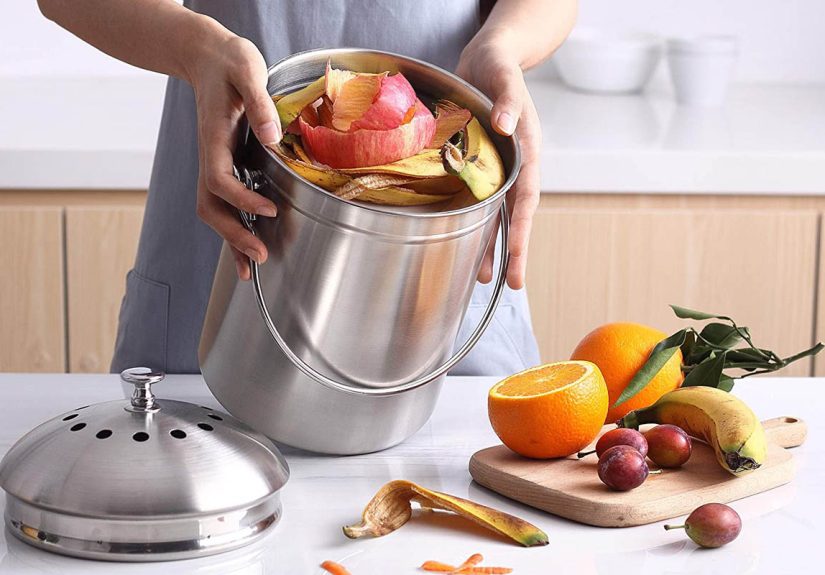
Bob Vila’s best overall pick earns that label for a reason. The Epica hits the practical sweet spot better than almost anything else in the category. It is roomy without becoming a countertop hog, and its stainless steel body gives it a clean, polished look that blends in with modern kitchens instead of shouting, “I am full of banana peels!”
What really makes the Epica work is balance. The activated charcoal filter helps tame odors, the stainless steel construction resists rust and staining, and the shape is compact enough to tuck into a corner. It is the kind of bin that disappears into your routine, which is exactly what a good kitchen tool should do. Serious Eats also praised Epica for strong odor control and noted that it contained smells for more than a week during testing, which is impressive if your household cooks often and empties the bin on a steady schedule.
Who should buy it? Pretty much anyone who wants one reliable countertop compost bin and never wants to think very hard about it again.
Best Value: OXO Easy-Clean Compost Bin
The OXO Easy-Clean Compost Bin is the answer for shoppers who love the phrase “easy to clean” more than they love decorative handles or artisanal finishes. Bob Vila gave it the bang-for-the-buck nod, and other outlets also keep circling back to it because it nails the boring but crucial stuff: ease of use, easy emptying, and fast cleanup.
The big win here is the lid and interior design. OXO’s bin is made for everyday kitchen traffic. You can flip it open quickly, scrape scraps in with one hand, and rinse it out without scrubbing gunk from awkward corners. The rounded interior and smooth surfaces make a bigger difference than you might think. In compost-bin terms, fewer crevices means fewer regrets.
Its biggest weakness is also its tradeoff: it is better for short-term scrap holding than long, lazy stretches between emptying. In other words, it is ideal for people who want a tidy kitchen helper, not a tiny countertop time capsule. If you cook often and empty your scraps every couple of days, it is excellent.
Best Stainless Steel Design: Simplehuman Compost Caddy
Simplehuman makes products for people who would like their trash-adjacent items to look suspiciously elegant, and this caddy absolutely fits that mission. Bob Vila’s stainless steel pick stands out because it offers something many countertop bins do not: placement flexibility. It can sit on the counter, dock onto compatible trash bins, or work with an optional wall mount.
That versatility matters in smaller kitchens where counter space is treated like beachfront property. The removable inner bucket also helps with cleaning, and the soft-seal lid keeps smells more controlled than you might expect from such a compact, minimalist design.
It is not the cheapest choice, and you are paying partly for aesthetics, but this is one of the few compost caddies that can legitimately pass as kitchen decor instead of eco-guilt storage. If you want your compost setup to feel intentional and polished, this is one of the smartest premium picks.
Best Large Capacity: Full Circle Fresh Air
Some households produce scraps like they are training for a vegetable-peeling Olympics. For those kitchens, Bob Vila’s large-capacity pick makes a lot of sense. The Full Circle Fresh Air bin offers more room than many rivals, which means fewer trips outside and less constant emptying.
Its standout feature is the airflow design. Instead of depending primarily on a traditional charcoal filter, it uses ventilation to reduce odor buildup. That approach is helpful for people who hate buying replacement filters or simply want fewer recurring costs. It also opens with a push button, which sounds small until you are holding a cutting board full of celery tops and need the bin to cooperate immediately.
This model is especially appealing for larger households, meal preppers, and anyone who cooks with a lot of fresh produce. The only caveat is that larger bins demand discipline. More space is convenient, but only if you still empty it regularly.
Best Eco-Friendly Pick: Bamboozle
Bamboozle is what happens when a compost bin goes to design school and comes back with strong opinions about color palettes. Bob Vila names it the best eco-friendly option, and other publications also like it for beginners and style-conscious shoppers.
The appeal is obvious. It is made from bamboo fiber-based material, comes in soft modern shades, and looks far less industrial than the average metal caddy. In a kitchen where every visible item has to earn its place aesthetically, Bamboozle makes a compelling case for itself.
But this is not just a pretty face. Reviewers consistently point to its usefulness for everyday scrap collection and its odor control via replaceable filters. For apartment dwellers, casual composters, and anyone trying to ease into a lower-waste routine without putting an ugly bin on display, Bamboozle is one of the friendliest entry points.
What About Electric “Countertop Composters”?
This is where things get interesting and where marketing language gets a little cheeky. Many electric countertop units are often called composters, but several expert reviews make an important distinction: most of them are better described as food recyclers. They grind and dry food scraps, reduce odor, and shrink volume dramatically, but they usually do not create finished compost in the same way a traditional compost pile or worm system does.
That does not make them useless. Far from it. It just means they solve a different problem. If you live in an apartment, hate odors, or want to reduce food waste volume fast, electric models can be fantastic. Bob Vila’s odor-filtration pick, the Vitamix FoodCycler, makes sense for households that want push-button convenience. Martha Stewart, The Spruce, WIRED, and other outlets also point to machines like Lomi, Reencle, and FoodCycler when speed and smell control matter more than old-school composting ritual.
So which should you choose? A classic compost bin is better if you already have curbside organics pickup, a backyard pile, or a local drop-off site. An electric unit is better if your kitchen needs maximum odor control and faster processing. Think of a passive bin as a holding station and an electric recycler as a volume-reduction machine with a sustainability side quest.
How to Choose the Right Bin for Your Kitchen
Choose by lifestyle, not just by looks
If you cook once in a while and mostly generate coffee grounds and the occasional fruit peel, a compact bin is enough. If you chop vegetables daily, cook from scratch, and generate a mountain of scraps before dinner, go larger.
Match odor control to your tolerance level
If you are very sensitive to smells, prioritize charcoal filters, ventilation systems, or an electric recycler. If you empty the bin frequently, you can get away with a simpler design.
Think about cleaning before you buy
A gorgeous compost bin that is annoying to wash will eventually become a problem in a cute outfit. Smooth interiors, removable liners, and dishwasher-safe components matter more than shoppers often realize.
Be honest about your compost destination
Are you dumping scraps into a backyard pile, curbside organics bin, worm system, or electric recycler? Your answer determines whether you need long holding time, bag compatibility, or faster processing.
What Can You Put in a Countertop Compost Bin?
For traditional home composting, the usual safe stars are fruit and vegetable scraps, coffee grounds, tea, eggshells, and other plant-based kitchen waste. If you are feeding a backyard pile, you will also need “browns” such as dry leaves, shredded paper, or cardboard to balance moisture-rich food scraps.
Meat, dairy, and large bones are where things get trickier. Many standard backyard systems are not ideal for them because they can create odor and pest issues. Some municipal programs accept more materials than home piles do, and some electric recyclers can process items that a basic backyard bin should not. Translation: always match your countertop collection habits to your final composting method. Your bin is only the first stop in the journey, not the whole road trip.
Countertop Composting in Real Life: What the Experience Actually Feels Like
Living with a countertop compost bin is one of those habits that sounds a little fussy before you start and weirdly satisfying after a week. On day one, it may feel like you are adding another container to an already container-heavy kitchen. You set it near the cutting board, toss in a few onion skins, and wonder whether this is really going to make a difference or just create a tiny tower of produce sadness by the coffee maker.
Then something shifts. Instead of scraping everything into the trash, you start noticing how much of cooking is actually compostable. Celery leaves, lemon rinds, garlic skins, strawberry tops, coffee grounds, avocado peels, tea bags, and eggshells suddenly become part of a new rhythm. Prep gets faster because you are not making constant trips to the trash can. Your counter stays tidier because scraps have a home. And oddly enough, cooking feels less wasteful and more deliberate.
The first real test usually comes around day three or four. This is when you find out whether your bin’s lid is actually doing its job, whether the opening is convenient, and whether the inside is going to rinse clean or demand a passive-aggressive scrub session. A good bin makes this moment uneventful. A bad one starts to smell like warm compost tea and life choices.
One of the most noticeable differences is psychological. When scraps are visible in a compost bin instead of vanishing into the trash, you become more aware of what you are throwing away. That half bag of spinach that melted in the fridge? You notice it. The cilantro you forgot about? You notice that too. In a strange but useful way, composting can make you better at meal planning because waste becomes less invisible.
For apartment dwellers, the experience is a little different. The countertop bin becomes more of a staging area than a full composting system. You fill it during the week, empty it into a community compost drop-off or a curbside organics cart, and repeat. It still feels worthwhile because it cuts down on trash smells and makes food waste easier to separate. You may not have a garden waiting outside, but you still get the satisfaction of keeping organic waste out of the regular garbage stream.
For families, the biggest surprise is often volume. Kids can generate a shocking amount of compostable material through snack fruit alone. Apple cores multiply. Banana peels appear from nowhere. Carrot sticks become orange confetti. A larger bin quickly starts to make sense, especially if you cook dinner most nights. For solo cooks or couples, a smaller caddy usually works better because it encourages frequent emptying and keeps odors down.
The experience also changes with the seasons. In summer, you may empty the bin more often because warm kitchens accelerate odors. In cooler months, you can sometimes stretch the interval a little longer. If you use compostable liners, you may find them helpful for cleanup, though some people prefer no liner at all and a quick wash instead. There is a bit of trial and error here, and that is normal.
Most people eventually settle into a system that feels almost automatic. Scraps go into the countertop bin while cooking. The full bin goes to the garden pile, green cart, or recycler. The bin gets rinsed, dried, and returned to its spot. No drama, no smell cloud, no countertop chaos. That is the real magic of a good compost bin. It does not demand attention. It quietly helps your kitchen run better while making your waste stream a little smarter.
Final Thoughts
The best countertop compost bins of 2025 are not trying to reinvent the kitchen. They are trying to solve a humble, daily problem elegantly. Bob Vila’s picks get the categories right, and the broader consensus from other testing outlets helps sharpen the takeaway. If you want the best all-around classic bin, choose Epica. If you want the best everyday value, choose OXO. If you want style and flexibility, Simplehuman is a strong splurge. If you need more capacity, Full Circle earns its space. If you want a greener-looking eco pick, Bamboozle is charming and capable. And if you want serious odor reduction with faster processing, a FoodCycler-style electric unit may be your better match.
In short, the right countertop compost bin is the one that fits your kitchen habits so naturally that you stop thinking about it. That is the dream: less waste, less smell, less mess, and one less reason to glare at a banana peel on your cutting board.