Table of Contents >> Show >> Hide
- Quick Venus Planet Facts
- Where Is Venus in the Solar System?
- Venus Is Earth’s TwinBut Only on Paper
- The Atmosphere of Venus: A Planetary Pressure Cooker
- A Day on Venus Is Longer Than a Year
- The Surface of Venus: Volcanoes, Mountains, and Lava Plains
- Does Venus Have Water?
- Venus Has No Moons or Rings
- Venus and the Search for Life
- Major Missions to Venus
- Venus in Culture and Human Imagination
- Experiences and Reflections Related to Venus Planet Facts
- Conclusion: Why Venus Matters
Venus looks like the elegant celebrity of the night sky: bright, beautiful, and impossible to ignore. But behind that creamy cloud cover is a world so extreme it makes a pizza oven look like a snow cone stand. If Earth is the comfortable houseplant corner of the solar system, Venus is the locked greenhouse where the thermostat broke, the air became poisonous, and the floor turned volcanic.
That is exactly what makes Venus so fascinating. Among all the planets, Venus is often called Earth’s “sister planet” because the two worlds are close in size, mass, density, and rocky composition. Yet the similarities stop right around the front door. Venus has a crushing atmosphere, surface temperatures hot enough to melt lead, clouds made of sulfuric acid, and a day that lasts longer than its year. In other words, Venus is not just a planet; it is a cosmic plot twist.
In this guide to Venus planet facts, we’ll explore its orbit, atmosphere, surface, rotation, visibility, volcanoes, missions, and why scientists keep returning to this strange world for clues about Earth, climate, and planets beyond our solar system.
Quick Venus Planet Facts
- Planet order: Second planet from the Sun
- Planet type: Rocky terrestrial planet
- Average distance from the Sun: About 67 million miles
- Length of year: About 225 Earth days
- Length of rotation: About 243 Earth days
- Surface temperature: Around 867°F to 872°F
- Main atmosphere gas: Carbon dioxide
- Clouds: Sulfuric acid clouds
- Moons: None
- Rings: None
- Nickname: Earth’s twin or Earth’s evil twin
Where Is Venus in the Solar System?
Venus is the second planet from the Sun, located between Mercury and Earth. Because its orbit lies inside Earth’s orbit, Venus never appears far from the Sun in our sky. That is why we usually see it shortly after sunset or before sunrise, glowing like a tiny cosmic lantern near the horizon.
This is also why Venus is famous as both the Morning Star and the Evening Star. It is not actually a star, of course, but ancient skywatchers can be forgiven for the nickname. Venus is so bright that it can cast faint shadows under very dark conditions. After the Sun and Moon, it is one of the brightest natural objects visible from Earth.
Why Is Venus So Bright?
Venus is bright for three main reasons. First, it is relatively close to Earth. Second, it is covered in thick, reflective clouds. Third, those clouds bounce a large amount of sunlight back into space. Think of Venus as wearing a planet-sized white jacket made of acid clouds. Stylish? From a distance, yes. Friendly? Absolutely not.
Venus Is Earth’s TwinBut Only on Paper
Venus and Earth are often compared because they are similar in size and structure. Venus has a diameter of about 7,521 miles, only slightly smaller than Earth’s 7,926 miles. Its gravity is also close to Earth’s; a 100-pound person on Earth would weigh about 91 pounds on Venus. That sounds almost comfortable until you remember the heat, pressure, and toxic atmosphere waiting outside.
Both planets are rocky worlds with metallic cores, rocky mantles, and solid crusts. Both formed in the inner solar system. Both may have had important early histories involving volcanic activity and possibly water. But their paths diverged dramatically. Earth became blue, breathable, and full of life. Venus became a runaway greenhouse world wrapped in a dense carbon dioxide blanket.
The Atmosphere of Venus: A Planetary Pressure Cooker
The atmosphere of Venus is one of the most extreme in the solar system. It is made mostly of carbon dioxide, with smaller amounts of nitrogen and trace gases. The atmosphere is so thick that the surface pressure is about 90 to 93 times greater than sea-level pressure on Earth. Standing on Venus would feel something like being deep underwater, except the “water” is a scorching, toxic sky and the beach vacation has clearly gone terribly wrong.
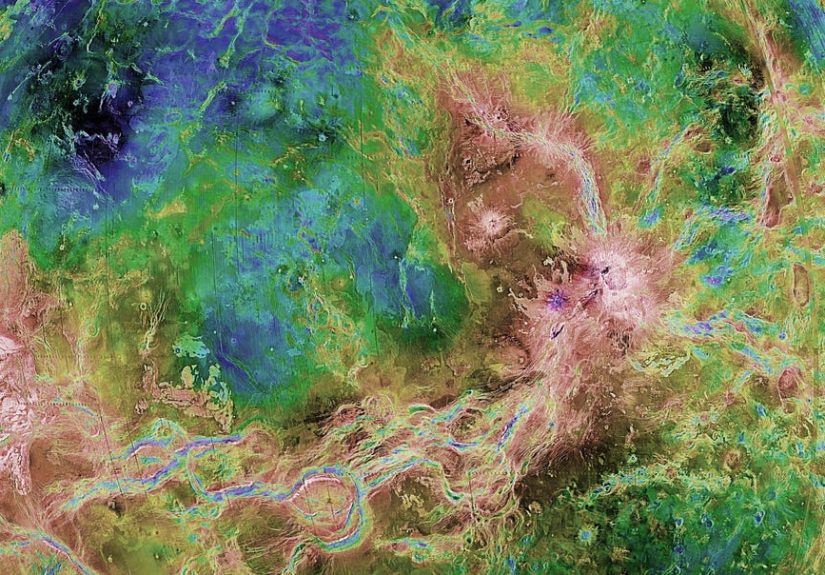
Venus also has clouds made of sulfuric acid. These clouds cover the planet completely, hiding the surface from ordinary visible-light cameras. That is why spacecraft have used radar to map Venus. Radar can pierce the thick cloud cover and reveal mountains, plains, volcanoes, craters, and lava flows below.
Runaway Greenhouse Effect
The most famous Venus planet fact is its heat. Venus is the hottest planet in the solar system, even though Mercury is closer to the Sun. The reason is the runaway greenhouse effect. Carbon dioxide traps heat, and Venus has an enormous amount of it. Sunlight enters the atmosphere, the surface absorbs energy, and heat becomes trapped under the dense atmospheric blanket.
On Earth, greenhouse gases help keep the planet warm enough for life. On Venus, the greenhouse effect went into overdrive. The result is a surface temperature around 867°F to 872°F, hot enough to melt lead. If you brought a cookbook to Venus, every recipe would be “place item on ground and wait three seconds.”
A Day on Venus Is Longer Than a Year
Venus has one of the strangest rotations in the solar system. It takes about 225 Earth days to orbit the Sun, which means a Venusian year is shorter than an Earth year. But Venus rotates so slowly that one full spin takes about 243 Earth days. That means a day on Venus is longer than a year on Venus.
Even weirder, Venus rotates backward compared with most planets. This is called retrograde rotation. If you could somehow stand safely on Venus and see through the clouds, the Sun would rise in the west and set in the east. It would also take a very long time to do it, so maybe pack a snack. Actually, pack several generations of snacks.
Why Does Venus Rotate Backward?
Scientists are still studying why Venus spins this way. Possible explanations include ancient collisions, gravitational interactions with the Sun, and atmospheric effects over long periods of time. Whatever the cause, Venus is a reminder that planets do not always follow the tidy rules we expect. The solar system has personality, and Venus is the dramatic one.
The Surface of Venus: Volcanoes, Mountains, and Lava Plains
Because Venus hides under permanent clouds, its surface was mysterious for much of human history. Spacecraft changed that. NASA’s Magellan mission used radar in the early 1990s to map almost the entire surface of the planet. What it found was a world dominated by volcanic landforms, broad plains, mountains, rift zones, lava channels, and unusual circular structures called coronae.
Much of Venus appears to have been shaped by volcanism. The planet has thousands of volcanoes, from small shield volcanoes to enormous volcanic rises. Some lava flows stretch across huge distances. There are also pancake-shaped domes, likely formed by thick lava that oozed slowly and spread outward like batter on a skillet. Space geology does occasionally sound like breakfast.
Is Venus Still Volcanically Active?
Evidence has grown stronger that Venus may still be geologically active. Scientists studying old radar data have identified possible changes in volcanic regions, including signs of lava flows and surface deformation. If Venus is still erupting today, it would help explain how the planet releases internal heat without Earth-style plate tectonics.
This matters because volcanic activity can shape atmospheres, surfaces, and long-term planetary evolution. Venus may look frozen in misery, but geologically speaking, it may still have plenty of drama happening beneath the clouds.
Does Venus Have Water?
Today, Venus is extremely dry. There is only a tiny amount of water vapor in its atmosphere. But scientists have long wondered whether ancient Venus may have had oceans or a more Earth-like climate. If Venus once had liquid water, its transformation into a furnace world would be one of the most important climate stories in the solar system.
The question remains open. Some models suggest early Venus could have supported water under certain conditions. Other research suggests it may have become hostile very early. Future missions may help answer whether Venus was once a blue world before becoming the solar system’s cautionary tale in high heels.
Venus Has No Moons or Rings
Unlike Earth, Venus has no moon. Unlike Saturn, Jupiter, Uranus, and Neptune, it has no ring system. It travels around the Sun alone. Scientists are not completely sure why Venus lacks a moon. One possibility is that any former moon was lost due to gravitational interactions. Another is that Venus never captured or formed one in the first place.
This lonely status does make Venus easier to describe at parties: no moons, no rings, no breathable air, no gentle weather, and absolutely no patio seating.
Venus and the Search for Life
The surface of Venus is far too hot and pressurized for life as we know it. However, scientists have discussed whether the upper atmosphere could be more hospitable. At certain cloud levels, temperatures and pressures are less extreme than at the surface. That has led to speculation about whether microbial life could exist high in the Venusian clouds.
Reports of unusual atmospheric chemistry, including debated detections of gases such as phosphine, have renewed interest in the question. However, there is no confirmed evidence of life on Venus. The safer and more scientific answer is this: Venus is interesting enough to investigate, but extraordinary claims need extraordinary evidence.
Major Missions to Venus
Venus has been visited by many spacecraft. NASA’s Mariner 2 became the first successful spacecraft to fly by another planet when it passed Venus in 1962. Later missions from the Soviet Venera program achieved remarkable milestones, including landers that sent data and images from the surface before being destroyed by the brutal environment.
NASA’s Magellan mission transformed our understanding of Venus by mapping the surface with radar. Japan’s Akatsuki mission has studied the planet’s atmosphere and weather. Future missions, including NASA’s DAVINCI and VERITAS, are designed to investigate the atmosphere, surface, volcanic history, and possible ancient habitability of Venus.
Why Scientists Keep Studying Venus
Venus is not just interesting because it is weird. It is scientifically valuable because it helps us understand how Earth-sized rocky planets evolve. Why did Earth become habitable while Venus became hostile? How do atmospheres change over billions of years? What makes a planet lose water? How common are Venus-like worlds around other stars?
These questions matter far beyond our solar system. As astronomers discover more rocky exoplanets, Venus becomes a warning label and a reference point. A planet can be Earth-sized and still be completely unlivable. Size alone does not make a world friendly.
Venus in Culture and Human Imagination
Venus has captured human attention for thousands of years. Ancient civilizations tracked it carefully because of its brightness and predictable appearances. It was associated with beauty, love, and powerful deities in many cultures. The planet’s modern name comes from the Roman goddess of love and beauty.
There is something wonderfully ironic about that name. Venus is beautiful from Earth, but the closer we look, the less romantic it becomes. It is like receiving a glittering invitation to a luxury resort, then discovering the resort is made of acid clouds and the swimming pool is lava-adjacent.
Experiences and Reflections Related to Venus Planet Facts
One of the best ways to appreciate Venus is not through a telescope, a spacecraft image, or a thick science textbook. It is by stepping outside at twilight and looking toward the western sky after sunset, or toward the eastern sky before sunrise. When Venus is visible, it often appears so bright that people mistake it for an airplane, a satellite, or something more mysterious. The funny part is that Venus does not blink, flash, or hurry away. It simply shines, calm and confident, as if it knows it is the superstar of the evening.
For many skywatchers, Venus is the first planet they ever notice without being told what to look for. You do not need expensive equipment. You do not need a mountaintop observatory. You only need a clear view of the horizon and a little patience. That accessibility makes Venus feel personal. It is not just a fact in a science article; it is a neighbor you can spot from your driveway, apartment balcony, or park bench.
Seeing Venus also changes how you think about distance. That bright dot is a whole world: nearly Earth-sized, wrapped in clouds, rotating slowly, hiding volcanoes under an atmosphere that could crush machines. From Earth, it looks gentle. Up close, it is one of the harshest places ever explored. That contrast is part of the magic. Astronomy often begins with beauty and ends with humility.
Learning Venus planet facts can also make everyday Earth feel more precious. Our planet has breathable air, liquid water, a protective magnetic field, moderate temperatures, and weather that, while occasionally annoying, is not made of sulfuric acid. Venus shows how different a rocky planet’s destiny can become. It reminds us that habitability is not automatic. A world needs the right balance of atmosphere, temperature, chemistry, and time.
There is also a practical lesson in Venus: appearances can be hilariously misleading. The planet named for beauty is a furnace. The “sister” of Earth is wildly inhospitable. The bright point in the peaceful dawn sky is covered with crushing pressure and volcanic plains. Venus teaches curiosity. It says, “Look closer.” And when science looks closer, the universe becomes stranger, richer, and more interesting than our first glance ever suggested.
So the next time Venus glows above the horizon, take a moment to admire it. That single light has guided ancient observers, inspired myths, challenged spacecraft engineers, and puzzled planetary scientists. It is beautiful, dangerous, mysterious, and scientifically priceless. Not bad for a neighbor with no moons, no rings, and absolutely terrible weather.
Conclusion: Why Venus Matters
Venus is one of the most fascinating planets in the solar system because it is both familiar and alien. It is close to Earth in size and structure, yet its atmosphere, climate, rotation, and surface conditions are dramatically different. From its runaway greenhouse effect to its volcanic landscape and backward spin, Venus is full of facts that challenge simple ideas about how planets work.
Studying Venus helps scientists understand climate, geology, atmospheres, and the delicate conditions that make a planet habitable. It also gives us a better lens for studying Earth and distant exoplanets. Venus may not be a place for beach vacations, but as a scientific destination, it is irresistible.
Note: This article synthesizes established planetary science information from reputable astronomy, space science, museum, and educational sources, including NASA-related resources and major U.S. science institutions, rewritten in original web-ready language for publication.