Table of Contents >> Show >> Hide
- What Does It Mean to Refinance a Car Loan?
- When to Refinance a Car Loan
- When Refinancing a Car Loan Is a Bad Idea
- How to Tell If Refinancing Is Worth It
- How to Refinance a Car Loan Without Making Costly Mistakes
- Smart Steps to Refinance a Car Loan
- Practical Refinance Scenarios
- Experiences and Lessons From Real Refinance Situations
- Final Thoughts
Refinancing a car loan sounds wonderfully adult and responsible, which is another way of saying it does not sound fun at all. But done at the right time, it can save real money, lower your monthly payment, or help you pay your car off faster. Done carelessly, though, it can turn a perfectly decent loan into a longer, pricier ride with more interest and more regret. Nobody wants that.
If you are wondering when to refinance a car loan, the answer is not simply “when rates look lower” or “when your payment feels rude.” The smartest time to refinance is when the math improves your situation, not just your mood. That means looking at your interest rate, loan term, remaining balance, vehicle value, credit profile, and the total amount you will pay over time.
This guide breaks down exactly when refinancing makes sense, when it does not, and how to avoid the mistakes that trip up borrowers who focus only on the monthly payment. Because yes, a lower payment can feel like a small miracle. But if it drags your loan out for years, that miracle may come with a pretty expensive invoice.
What Does It Mean to Refinance a Car Loan?
Refinancing a car loan means replacing your current auto loan with a new one, usually from a different lender, though sometimes from the same lender if they allow it. The new loan pays off the old loan, and then you start making payments under the new terms.
Those new terms may include:
- A lower interest rate
- A lower monthly payment
- A shorter repayment term
- A longer repayment term
- A different lender with better service or better loan features
In plain English, refinancing is a do-over for your car loan. Not a rewind of your life choices, sadly, but at least a second chance at the financing part.
When to Refinance a Car Loan
1. Your Credit Score Has Improved
This is one of the biggest reasons to refinance a car loan. Maybe your score was bruised when you bought the car. Maybe you were fresh out of school, new to credit, or recovering from a rough financial stretch. Now your score is stronger, your payment history looks better, and lenders may see you as less risky.
A better credit profile can help you qualify for a lower APR. Even a modest rate drop can reduce the amount of interest you pay, especially if you still have plenty of time left on the loan.
2. Interest Rates or Loan Offers Are Better Than What You Have
Sometimes the problem is not you. It is the original loan. If you financed through a dealership on a hectic Saturday and signed faster than you read, there is a chance your rate was not the best available. Dealership financing is not automatically bad, but it is often convenient first and optimized later.
If you now qualify for better terms through a bank, credit union, or online lender, refinancing may make sense. This is especially true if your current loan came with a high APR, steep monthly payment, or an unnecessarily long term.
3. You Need a Lower Monthly Payment
Life changes. Rent climbs. Insurance gets dramatic. Groceries suddenly behave like luxury goods. If your car payment is squeezing your budget, refinancing to a lower monthly payment can create breathing room.
That said, this is where people get into trouble. A lower payment is helpful, but only if you understand why it is lower. If the payment drops because you got a lower interest rate, great. If it drops mainly because the loan term got stretched out, you may pay more total interest in the long run.
4. You Want to Pay the Car Off Faster
Not all refinancing is about shrinking the payment. Sometimes the smarter move is the opposite. If your finances improved and you want to get rid of debt sooner, refinancing into a shorter term may save money overall.
Your monthly payment could rise, but your total interest cost may fall. For borrowers who can comfortably afford the change, this can be one of the best reasons to refinance an auto loan.
5. Your Original Loan Was Just Plain Bad
Maybe you bought in a hurry. Maybe your previous lender charged a very high rate. Maybe you accepted terms because you thought you had no other choice. Refinancing can be a smart cleanup strategy if the original financing was expensive, confusing, or badly structured.
If your new loan gives you a lower APR, better term, and clearer repayment path, refinancing can turn a messy deal into a manageable one.
When Refinancing a Car Loan Is a Bad Idea
1. You Are Near the End of the Loan
If you only have a few payments left, refinancing may not save enough to be worth the trouble. At that stage, a large portion of your interest has often already been paid. Starting a new loan late in the game can be like changing seats on a plane five minutes before landing. Technically possible, maybe, but not exactly life-changing.
2. You Will Extend the Loan Too Much
This is the classic trap. Borrowers see a lower payment and assume the deal is better. Sometimes it is. Sometimes it is just longer.
For example, imagine you have 30 months left on your current loan. A new lender offers a much lower payment, but over 48 months. Your budget feels better each month, but you may end up paying interest for an extra year and a half. The total cost can rise even while the payment falls.
3. You Owe More Than the Car Is Worth
If you are upside down on your loan, meaning the balance is higher than the car’s market value, refinancing can be harder. Some lenders will not approve the loan at all. Others may approve it only if the loan-to-value ratio fits their rules.
Negative equity does not always make refinancing impossible, but it can limit your options and make the numbers less attractive.
4. Your Vehicle Does Not Meet Lender Requirements
Lenders often have rules about vehicle age, mileage, remaining loan balance, and how much time is left on the loan. So even if refinancing sounds perfect in theory, your car may not qualify in practice.
Older vehicles, high-mileage vehicles, very small loan balances, or loans with little time remaining can all make refinancing more difficult.
5. Fees or Prepayment Penalties Eat the Savings
Some borrowers forget to check whether paying off the original loan early triggers a fee. If your current loan has a prepayment penalty, that cost needs to be part of your math.
A refinance only helps if the savings exceed the costs. Otherwise, you are just doing paperwork for cardio.
How to Tell If Refinancing Is Worth It
The right question is not “Can I refinance my car loan?” It is “Will refinancing improve my total financial picture?”
Here is the simplest way to evaluate it:
- Check your current loan balance, APR, monthly payment, and months remaining.
- Get refinance quotes from multiple lenders.
- Compare the new APR, monthly payment, and loan term.
- Calculate the total amount you would pay under the new loan.
- Subtract any fees or penalties.
If the refinance lowers your total cost, or meaningfully improves your monthly budget without causing long-term damage, it may be a smart move.
Here is a simple example. Suppose you have $15,000 left on your current loan at 9% APR with 36 months remaining. A new lender offers 6% APR. If you refinance into another 36-month loan, you may lower both your payment and total interest. But if you refinance into 60 months, the payment may drop much more while the total interest paid could remain similar or even increase. Same relief now, very different outcome later.
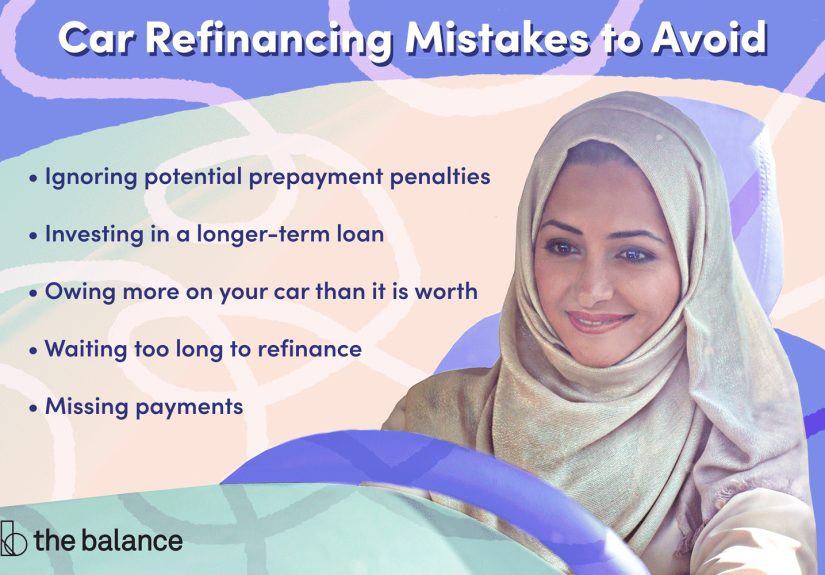
How to Refinance a Car Loan Without Making Costly Mistakes
Mistake 1: Shopping Only by Monthly Payment
Never judge a refinance offer by the payment alone. Look at the APR, term length, and total repayment amount. A shiny low payment can hide a much more expensive loan.
Mistake 2: Applying Everywhere Over a Long Period
Rate shopping is smart. Spreading applications out for months is not. Try to compare offers within a short time frame so the credit impact stays as limited as possible.
Mistake 3: Ignoring the Value of the Car
Before refinancing, check what your car is worth and compare it with what you owe. This helps you understand whether you have equity, are underwater, or sit in the awkward middle where your car and loan are basically playing tug-of-war.
Mistake 4: Not Reading the Current Loan Contract
Your current agreement matters. Check for prepayment penalties, payoff procedures, and whether your lender requires anything specific when the loan is closed out.
Mistake 5: Choosing the Longest Possible Term
A longer term can help in a genuine cash-flow emergency. But making it your default choice just because the payment looks nicer can cost you more later. Aim for the shortest term that still fits comfortably into your budget.
Mistake 6: Skipping Prequalification
Whenever possible, start with lenders that allow you to prequalify. This lets you see likely terms before committing to a full application, which can help you compare options more efficiently.
Mistake 7: Forgetting About Timing
Refinancing too soon can be tricky if the title transfer, registration, and original loan paperwork are still fresh. Refinancing too late can also be a problem if the car is older, the balance is low, or there is not enough time left on the loan to create meaningful savings.
Smart Steps to Refinance a Car Loan
- Check your credit. Know where you stand before you shop.
- Review your current loan. Confirm payoff amount, remaining term, and any penalties.
- Estimate your car’s value. This helps you understand your equity position.
- Compare multiple lenders. Banks, credit unions, and online lenders can all price differently.
- Run the numbers. Compare total cost, not just monthly payment.
- Keep paying the old loan until the refinance is complete. Do not assume the old lender is paid off until you verify it.
Practical Refinance Scenarios
Example 1: Refinance for Savings
A borrower bought a used SUV with fair credit and accepted a 10.4% APR. Twelve months later, their credit score improved, their debt dropped, and they refinanced into a 6.8% APR with roughly the same payoff timeline. The monthly payment fell a bit, but the real win was lower total interest.
Example 2: Refinance for Budget Relief
Another borrower faced a tighter budget after a move. They refinanced to a lower rate and a slightly longer term. Their monthly payment dropped enough to avoid late payments and keep the rest of their bills on track. The total interest cost rose somewhat, but for them the cash-flow relief was worth it. That is not a mistake if it is intentional and fully understood.
Example 3: Refinance Mistake
A borrower saw an ad promising a much lower payment and signed quickly. The new loan extended the term by two years, included fees, and barely changed the APR. The payment shrank, but the total cost climbed. That is the kind of “savings” that deserves air quotes.
Experiences and Lessons From Real Refinance Situations
Talk to enough drivers about refinancing, and you will hear the same pattern again and again: the successful ones did the boring stuff first. They checked their credit, looked up the value of the car, read the old loan, and compared several offers. The unsuccessful ones usually started with one sentence: “I just wanted a lower payment.” That sentence is not evil, but it does tend to wander into expensive neighborhoods.
One common experience is the borrower who financed a car during a chaotic season. Maybe they needed transportation immediately for work, or maybe they bought during a period when their credit was shaky. At the time, the loan felt like a necessary compromise. A year later, after making consistent payments and improving their credit, they refinanced and were surprised by how much better the offers looked. For those borrowers, refinancing was not about gaming the system. It was simply about getting a loan that finally matched their actual financial profile.
Another familiar story comes from people who learned the difference between payment relief and cost savings the hard way. They refinanced into a much longer term because the lower monthly number looked irresistible. For a while, the deal felt like a win. Then they realized they were still paying for a car they thought would be paid off much sooner. The lesson here is not that long terms are always wrong. It is that you should choose them on purpose, not by accident.
There are also borrowers who refinanced for emotional reasons as much as financial ones. Their original lender had poor service, confusing statements, or awkward payment systems. Even when the savings were modest, moving to a lender with clearer terms, better online access, and more predictable support made their lives easier. That kind of improvement matters too. Money is math, but it is also stress, time, and sleep.
Borrowers with older or high-mileage vehicles often report a different experience: frustration. They assume refinancing should be easy because they have been paying on time, only to learn that lenders care not just about them, but also about the car. Vehicle age, mileage, balance size, and equity all play a role. Their lesson is practical: before you get emotionally attached to a refinance offer, make sure your vehicle actually fits the lender’s rules.
Then there is the borrower who almost refinanced, ran the numbers carefully, and decided not to. That is not failure. That is financial maturity in sweatpants. Sometimes the best refinance decision is to keep your existing loan because the savings are too small, the fees are too high, or the remaining term is too short to make a switch worthwhile.
The biggest shared lesson from these experiences is simple: refinancing works best when it solves a specific problem. Lower the rate. Reduce the payment. Shorten the term. Improve the lender experience. But if the goal is fuzzy and the math is ignored, the loan can get longer, the car can age, and the borrower can end up wondering why their “better deal” feels suspiciously expensive.
Final Thoughts
The best time to refinance a car loan is when the numbers clearly improve your situation. That may happen because your credit score got stronger, you found a lower APR, or you need a more manageable monthly payment. The key is to compare the full cost of the loan, not just the bill due next month.
If you remember only one thing, make it this: a good refinance should solve a problem without quietly creating a bigger one. So compare offers, read the fine print, and make sure your “better payment” is actually a better deal. Your future self, and your wallet, will both appreciate the effort.