Table of Contents >> Show >> Hide
- What Is Vedic Math Multiplication?
- Way 1: Use the Nikhilam Method for Numbers Near a Base
- Way 2: Use Vertically and Crosswise for General Multiplication
- Way 3: Use the Same-Front-Digits Shortcut When the Last Digits Add to 10
- How to Choose the Right Vedic Math Multiplication Method
- Common Mistakes to Avoid
- Why These Methods Help With Math Confidence
- Experiences Related to “3 Ways to Multiply Using Vedic Math”
- Conclusion
Multiplication does not have to feel like pushing a shopping cart with one square wheel. Once you learn a few Vedic math patterns, certain problems become faster, cleaner, and a lot more satisfying. The beauty of these methods is not that they replace all multiplication. It is that they help you spot structure. And when math has structure, your brain stops panicking and starts cooperating.
In this guide, you will learn 3 ways to multiply using Vedic Math, along with step-by-step examples, common mistakes, and tips for knowing which method to use. These techniques are especially helpful for mental math, faster homework checks, and building number sense. Think of them as shortcuts with logic, not magic with a costume.
What Is Vedic Math Multiplication?
Vedic math is commonly taught as a collection of arithmetic patterns and formulas that help people compute more efficiently. In multiplication, the big advantage is speed. But the deeper advantage is flexibility. Instead of using one method for every problem, you choose the method that best matches the numbers in front of you.
That is the real secret: good multiplication is often about choosing the right strategy. If the numbers are close to 100, use one approach. If the digits line up nicely, use another. If the last digits have a special relationship, there is often a shortcut waiting for you like a math ninja hiding behind a place-value chart.
Way 1: Use the Nikhilam Method for Numbers Near a Base
The Nikhilam method works best when both numbers are close to a power of 10 such as 10, 100, 1000, and so on. This is one of the most popular Vedic math multiplication tricks because it turns a bulky multiplication problem into subtraction and a much smaller multiplication.
When to Use It
- Numbers close to 10, like 8 × 9
- Numbers close to 100, like 98 × 97
- Numbers close to 1000, like 1003 × 1007
How It Works
Pick the nearest base. Then find how far each number is from that base. Those differences are called deficiencies if the numbers are below the base, or surpluses if they are above it.
You then build the answer in two parts:
- The left part comes from cross-subtracting or cross-adding.
- The right part comes from multiplying the two differences.
Example 1: 98 × 97
Both numbers are close to 100.
- 98 is 2 less than 100
- 97 is 3 less than 100
Step 1: Cross-subtract.
98 – 3 = 95
or 97 – 2 = 95
Step 2: Multiply the deficiencies.
2 × 3 = 6
Since the base is 100, the right side must have two digits. So write 6 as 06.
Answer: 9506
Example 2: 103 × 107
Now both numbers are above 100.
- 103 is 3 more than 100
- 107 is 7 more than 100
Step 1: Cross-add.
103 + 7 = 110
or 107 + 3 = 110
Step 2: Multiply the surpluses.
3 × 7 = 21
Answer: 11021
Why This Method Is So Handy
The Nikhilam method is excellent for numbers near a base because it avoids full long multiplication. Instead of multiplying 98 by 97 directly, you only multiply 2 by 3. That is a much friendlier conversation for your brain.
Common Mistake
The most common error is forgetting how many digits belong on the right side. If your base is 100, you need two digits. If your base is 1000, you need three. That tiny detail can turn a perfect shortcut into a very confident wrong answer.
Way 2: Use Vertically and Crosswise for General Multiplication
The Vertically and Crosswise method, also called Urdhva-Tiryagbhyam, is the all-purpose star of Vedic multiplication. It works for many types of multiplication problems and is especially useful once you understand place value and carrying.
When to Use It
- Two-digit by two-digit multiplication
- Problems where you want a fast mental structure
- Cases where the numbers are not especially close to 10 or 100
How It Works
You multiply digits vertically and crosswise in stages, usually from right to left if you are thinking in the standard written style.
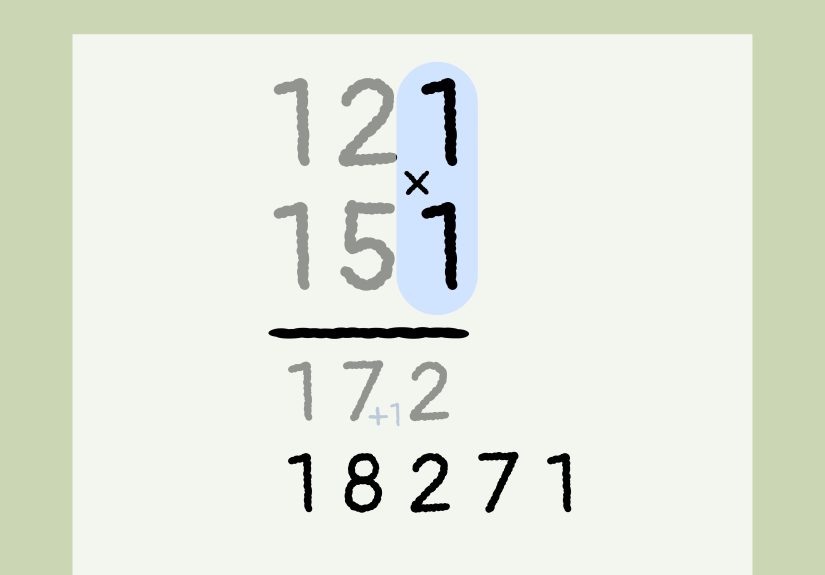
Example: 23 × 14
Write it as:
23
14
Step 1: Multiply the last digits vertically.
3 × 4 = 12
Write 2, carry 1
Step 2: Multiply crosswise and add.
(2 × 4) + (3 × 1) = 8 + 3 = 11
Add the carry: 11 + 1 = 12
Write 2, carry 1
Step 3: Multiply the first digits vertically.
2 × 1 = 2
Add the carry: 2 + 1 = 3
Answer: 322
Why People Love This Method
This method gives a clear pattern. Right side, middle crosswise, left side. Once that rhythm clicks, multiplication starts to feel less like memorized machinery and more like choreography. Slightly nerdy choreography, yes, but still choreography.
Another Quick Example: 34 × 12
- Last digits: 4 × 2 = 8
- Crosswise: (3 × 2) + (4 × 1) = 6 + 4 = 10
- First digits: 3 × 1 = 3
So the answer is 408.
Common Mistake
People often forget to carry properly from one stage to the next. The structure is simple, but only if each step is tidy. Messy carry handling is how good intentions become creative fiction.
Way 3: Use the Same-Front-Digits Shortcut When the Last Digits Add to 10
This is one of the most elegant Vedic-style multiplication shortcuts. Use it when:
- the leading digits are the same, and
- the last digits add up to 10
Examples include 47 × 43, 62 × 68, and 114 × 116.
How It Works
The answer also comes in two parts:
- Multiply the shared front number by one more than itself.
- Multiply the last digits together.
Then combine those two parts.
Example 1: 47 × 43
The first digits are both 4, and 7 + 3 = 10.
Left part: 4 × 5 = 20
Right part: 7 × 3 = 21
Answer: 2021
Example 2: 62 × 68
The first digits are both 6, and 2 + 8 = 10.
Left part: 6 × 7 = 42
Right part: 2 × 8 = 16
Answer: 4216
Why This Trick Feels So Good
Because it looks impossible for about two seconds, and then suddenly it feels obvious. That little shock of “Wait, that actually works?” is one of the reasons people enjoy mental math shortcuts so much.
Bonus Pattern
A closely related shortcut is squaring numbers that end in 5. For example, 65² becomes 6 × 7 followed by 25, which gives 4225. It is not one of the main three methods in this article, but it is too pretty to leave out completely.
How to Choose the Right Vedic Math Multiplication Method
- Use Nikhilam when both numbers are close to 10, 100, or 1000.
- Use Vertically and Crosswise when the numbers are more general and you want a systematic method.
- Use the same-front-digits shortcut when the leading digits match and the last digits total 10.
That is the strategic side of Vedic math multiplication. You are not just multiplying. You are first reading the numbers. And that reading step often saves the most time.
Common Mistakes to Avoid
- Using a shortcut on numbers that do not fit the pattern
- Forgetting the correct number of digits on the right side in Nikhilam
- Dropping carries in the Vertically and Crosswise method
- Rushing because the method feels easy after one example
The fastest way to get good at these methods is not to memorize twenty examples. It is to understand why each pattern works. Once the logic is clear, the speed follows naturally.
Why These Methods Help With Math Confidence
One underrated benefit of Vedic math is confidence. A student who knows only one multiplication method may freeze when a problem looks unusual. A student with multiple strategies can experiment. That changes the emotional experience of math. It becomes less about fear and more about pattern recognition.
These methods also reinforce important ideas such as place value, number decomposition, mental calculation, and multiplication patterns. In other words, they are not just tricks for showing off at the dinner table, though they are fully capable of doing that too.
Experiences Related to “3 Ways to Multiply Using Vedic Math”
Many learners describe their first experience with Vedic multiplication the same way: confusion, then curiosity, then a slightly dramatic moment of delight. At first, the methods can look too neat to be real. Students who are used to the standard algorithm often stare at a shortcut like 47 × 43 = 2021 and assume someone has made a typo. Then they check it with long multiplication, realize it works, and suddenly the room gets interesting. That moment matters because it turns multiplication from a chore into a puzzle. Instead of asking, “What steps do I memorize?” students start asking, “What pattern do I notice?” That shift alone can make math feel more human and less robotic.
In classrooms, these methods often help different kinds of learners for different reasons. Some students like Nikhilam because it reduces a hard problem into tiny, manageable pieces. A learner who feels nervous about 98 × 97 may feel much calmer doing 95 and 2 × 3. Other students prefer Vertically and Crosswise because it gives a strong structure they can follow every time. It feels organized, almost musical. Right, middle, left. Carry. Repeat. Then there are students who love the pattern-based shortcut where the first digits match and the last digits add to 10. That method tends to create the biggest grin because it feels like discovering a backstage door in a building everyone else is entering from the front.
Parents and tutors also tend to have memorable experiences with these methods. Many adults were taught one “official” multiplication process in school, so when they first see a Vedic approach, they are skeptical. Then they try a few examples and realize the methods are not random at all. They are built on number relationships. That often leads to a useful conversation at home. Instead of correcting a child with, “That is not how I learned it,” a parent may start asking, “Show me why that works.” That is a powerful change. It turns homework from a wrestling match into a discussion. The child feels smart for explaining the method, and the adult gets to rediscover math without the old school stress attached to it.
These techniques also show up in everyday life more often than people expect. Someone estimating a sale price, checking a restaurant bill, or doing quick calculations during exam prep may use a Vedic-style shortcut without even announcing it. A student multiplying 103 × 107 on a test can save time with the base method. A shopper mentally checking 62 items at 68 cents might not write down the same-front-digits trick exactly, but the habit of looking for number patterns still helps. That is the real value of learning multiple multiplication strategies. They train the mind to look at numbers flexibly. And flexible thinking travels well, whether you are solving a worksheet, planning a budget, or trying not to embarrass yourself while helping a younger sibling with homework.
Perhaps the most common long-term experience is that students stop seeing fast math as something only “math people” can do. Once they learn a few reliable shortcuts and practice them enough to feel natural, the mystery starts to fade. Speed becomes less about talent and more about familiarity. That is encouraging, especially for learners who have spent years assuming they are bad at math. Vedic multiplication will not make every problem easy, and it does not eliminate the need to understand the basics. But it often gives learners a new entry point. For many people, that is the beginning of a much healthier relationship with math: less dread, more pattern spotting, and a lot fewer dramatic sighs over two-digit multiplication.
Conclusion
If you want to multiply faster, Vedic math gives you more than shortcuts. It gives you a way to think. The Nikhilam method is perfect near powers of 10. Vertically and Crosswise gives you a general-purpose system. And the same-front-digits shortcut is a small masterpiece for special cases. Learn all three, practice them with easy numbers first, and you will start seeing multiplication as a pattern game instead of a paper-heavy struggle.
The best part is that these methods do not fight with standard math. They strengthen it. And any math strategy that makes numbers feel friendlier deserves a seat at the table.
Note: This HTML body is clean for web publishing and excludes unnecessary artifact strings such as contentReference[oaicite:0]{index=0}.