Table of Contents >> Show >> Hide
- Why addressing a married couple correctly matters
- 1. Use the traditional shared-last-name format for a formal wedding
- 2. Use a modern shared-last-name format when you want both names visible
- 3. Write both full names when the married couple uses different last names
- 4. Lead with titles or hyphenated names when the couple has a special form of address
- Outer envelope vs. inner envelope: what changes?
- Common mistakes to avoid when addressing married couples
- How to choose the best format for your wedding style
- Conclusion
- Experiences and real-life lessons from addressing wedding invitations to a married couple
Addressing wedding invitations sounds easy right up until you are staring at a stack of envelopes, a spreadsheet full of names, and one very specific question: “Wait, is it Mr. and Mrs. John Smith, or does that make me sound like I borrowed my etiquette from 1957?” The good news is that there is not just one correct way to address wedding invitations to a married couple. The better news is that you do not need a monocle, a calligraphy degree, or a direct line to your great-aunt Linda to get it right.
Modern wedding etiquette gives couples more flexibility than ever, but it still comes down to three simple goals: be respectful, be clear, and use the names and titles your guests actually want. That means the “best” format depends on the couple’s shared last name, whether they use different surnames, whether either spouse has a professional title, and how formal your wedding is overall.
In this guide, you will learn four reliable ways to address wedding invitations to a married couple, along with when to use each one, what examples look like on the outer and inner envelope, and which common mistakes can quietly make a beautifully designed invitation feel awkward. In other words, this is the wedding stationery help you need before your penmanship starts sweating.
Why addressing a married couple correctly matters
Wedding invitation etiquette is not about being stuffy for sport. It is about making guests feel acknowledged. A correctly addressed envelope signals that you know who is invited, you respect how they identify, and you took the extra minute to get their names right. That tiny detail can set the tone for the entire event.
It also helps avoid confusion. The outer envelope is typically the more formal one, while the inner envelope, if you are using one, can be more relaxed. If you are mailing only one envelope, use the more formal outer-envelope style. This matters because the wording on the envelope often communicates exactly who is invited. If you are vague, guests may make assumptions. And assumptions have been known to show up with plus-ones.
Before choosing a format, ask yourself these questions:
- Do both spouses use the same last name?
- Do they prefer traditional titles, modern titles, or no titles at all?
- Did one spouse keep a maiden name or use a hyphenated name?
- Does either spouse use a professional title such as Doctor?
- Is your wedding formal, semi-formal, or intentionally relaxed?
Once you know those answers, the right format usually becomes obvious.
1. Use the traditional shared-last-name format for a formal wedding
The most classic way to address a wedding invitation to a married couple is the traditional format for spouses who share one last name. This is the version many people picture automatically:
Outer envelope example:
Mr. and Mrs. Andrew Bennett
Inner envelope example:
Mr. and Mrs. Bennett
or
Andrew and Claire
This style works best when:
- the couple shares the same last name
- they are comfortable with traditional etiquette
- your wedding is formal or black-tie
- you want a timeless, polished look
Why do people still use this version? Because it is elegant, compact, and instantly recognizable. It has a traditional wedding feel that pairs beautifully with formal paper, scripted calligraphy, and full names on the invitation suite.
That said, traditional does not automatically mean ideal for every guest. Some married women dislike being identified only through their spouse’s first and last name. If that describes your guest, skip this format and use one of the more modern options below. Etiquette is supposed to show respect, not accidentally start a group chat.
Best for: formal weddings, older relatives who prefer classic conventions, and couples who actively like traditional address styles.
Avoid this style if: the couple does not share one last name, the wife prefers her own first name to appear, or either person has told you they prefer a more contemporary form of address.
2. Use a modern shared-last-name format when you want both names visible
If a married couple shares a last name but you want the envelope to reflect both individuals more clearly, a modern format is usually the sweet spot. It respects formality while also making both spouses visible on the page.
Outer envelope examples:
Mr. Andrew Bennett and Mrs. Claire Bennett
Mr. Andrew and Mrs. Claire Bennett
Claire and Andrew Bennett
Inner envelope examples:
Mr. and Mrs. Bennett
Claire and Andrew
This approach works beautifully for contemporary weddings, mixed-age guest lists, or any situation where you want your envelopes to feel polished without sounding overly old-school. It is also useful when the couple is traditional enough to use titles but not traditional enough to want one spouse effectively swallowed by the other’s name.
One reason this format has become popular is that it offers flexibility. You can keep courtesy titles such as Mr., Mrs., or Ms. for a more formal feel, or you can remove titles entirely if your wedding style is more relaxed. For example:
Casual modern example:
Claire and Andrew Bennett
If you go title-free, make sure the tone of your wedding supports it. A chic backyard dinner? Lovely. A cathedral ceremony with a string quartet and embossed stationery? You may want to keep the titles unless you know your guest list well.
Another benefit of this format is that it can feel more personal. Guests often notice when you have taken the time to write both names thoughtfully. It says, “We invited both of you,” rather than “One of you came with a bonus human.”
Best for: modern weddings, couples who share a last name, and hosts who want a respectful but updated format.
3. Write both full names when the married couple uses different last names
Not every married couple shares a surname, and your invitation should reflect that reality accurately. If one spouse kept a maiden name, the couple uses different last names socially, or both have maintained their original surnames, the cleanest solution is to write both full names.
Outer envelope examples:
Ms. Jordan Ramirez and Mr. Ethan Cole
Mrs. Jordan Ramirez and Mr. Ethan Cole
Jordan Ramirez and Ethan Cole
If the line is too long:
Ms. Jordan Ramirez
Mr. Ethan Cole
Inner envelope examples:
Ms. Ramirez and Mr. Cole
Jordan and Ethan
This format is especially important because guessing wrong can be more awkward than people realize. If a married woman kept her last name and you casually mash the couple into one surname on the envelope, you are not being formal. You are being confidently incorrect in cursive.
When deciding whose name goes first, there is flexibility. Some etiquette guides recommend listing the person you know best first. Others suggest alphabetical order if you are equally close to both. Some traditional formats place the woman’s name first in mixed-gender couples with different last names. In real-world use, the safest move is to prioritize the couple’s own preference if you know it. If you do not know, consistency across your guest list matters more than obsessing over one universal rule.
This format also works for same-sex married couples who use different last names. In those cases, alphabetical order is often the simplest and most neutral option unless you know the couple prefers something else.
Best for: married couples with different surnames, women who kept a maiden name, same-sex spouses with different last names, and modern weddings focused on accuracy and clarity.
4. Lead with titles or hyphenated names when the couple has a special form of address
The fourth major format applies when one or both spouses use a professional, military, judicial, or religious title, or when one spouse has a hyphenated last name. In these situations, the invitation should reflect the title or full surname correctly, even if that changes the order.
When one spouse has a professional title
Examples:
Dr. Maya Patel and Mr. Henry Lawson
The Honorable Rebecca Nguyen and Mr. Lucas Nguyen
Captain Elena Brooks and Mr. Daniel Brooks
In formal etiquette, the spouse with the higher-ranking or distinguished title is usually listed first. So if one person is a doctor and the other is not, the doctor typically leads the line. The same logic applies to judges, clergy, and some military titles.
When both spouses share the same professional title
Examples:
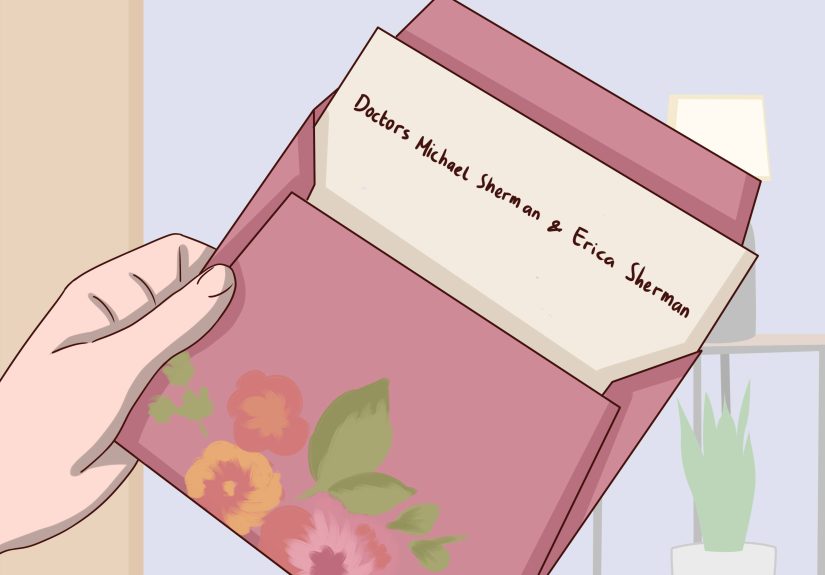
Dr. Avery Kim and Dr. Riley Kim
The Doctors Avery and Riley Kim
Drs. Avery and Riley Kim
If both spouses are doctors and share a last name, you can use either both full names or a pluralized form of the title, depending on your wedding’s level of formality and the visual space on the envelope.
When one spouse has a hyphenated last name
Examples:
Ms. Olivia Carter-James and Mr. Daniel James
Olivia Carter-James and Daniel James
The rule here is simple: write the name the guest actually uses. Do not shorten a hyphenated name just because the envelope looks crowded. A wedding invitation is not the place to freelance someone else’s identity.
Best for: doctors, military officers, judges, clergy, academics, or any married couple whose title or surname structure needs special attention.
Outer envelope vs. inner envelope: what changes?
If you are using both an outer and inner envelope, the outer one is usually more formal and complete. The inner one can be shorter and more relaxed.
Example for a traditional shared-last-name couple:
Outer:
Mr. and Mrs. Andrew Bennett
Inner:
Mr. and Mrs. Bennett
or
Andrew and Claire
Example for a different-last-name couple:
Outer:
Ms. Jordan Ramirez and Mr. Ethan Cole
Inner:
Ms. Ramirez and Mr. Cole
or
Jordan and Ethan
If you are mailing only one envelope, default to the outer-envelope style. In other words, keep it formal enough to stand on its own.
Common mistakes to avoid when addressing married couples
1. Assuming every married woman wants “Mrs.”
Some do. Some do not. If you are unsure, “Ms.” is often the safer modern option unless you know a guest prefers “Mrs.”
2. Combining surnames that are not actually shared
If the couple uses different last names, write both names. Do not invent a matching last name because it fits better on the envelope.
3. Ignoring professional titles
If your guest is a physician, judge, clergy member, or military officer, use the appropriate title when relevant. These details matter more in formal invitation etiquette than many people realize.
4. Using nicknames on the outer envelope
The outer envelope should generally use full names. Save nicknames for the inner envelope, place cards, or the moment your cousin actually arrives wearing cowboy boots to a black-tie wedding.
5. Being inconsistent across the guest list
You do not need every envelope to follow the exact same structure, but your overall system should make sense. If you use titles for one formal married couple, use titles for the others unless you know there is a preference-based reason not to.
How to choose the best format for your wedding style
If your wedding is very formal, classic etiquette rules tend to look right at home. If your wedding is modern, artistic, or intentionally relaxed, contemporary naming formats often feel more authentic. The real trick is matching the envelope style to both the event and the guests.
Here is a simple shortcut:
- Formal wedding: use titles and full names
- Semi-formal wedding: use titles or full names, whichever feels more natural
- Casual wedding: first and last names without titles can work well
- Unsure what your guests prefer: confirm their names and titles before printing
That last point matters more than any etiquette book. Respect beats tradition every time.
Conclusion
There is no single magical formula for addressing wedding invitations to a married couple, but there are four dependable approaches that cover nearly every real-life situation. If the couple shares a last name and likes tradition, use the classic Mr. and Mrs. format. If they share a last name but want something more current, list both names clearly. If they use different last names, write both full names without forcing them into one surname. And if titles or hyphenated names are involved, let those details lead the way.
The best wedding invitation etiquette is not about proving you memorized a rulebook. It is about making your guests feel recognized, welcomed, and correctly named before they ever step into your celebration. That is the kind of detail people remember, and thankfully, it costs much less than peonies.
Experiences and real-life lessons from addressing wedding invitations to a married couple
Anyone who has addressed wedding invitations by hand knows the task starts out feeling charming and ends somewhere between “mindful craft project” and “administrative test of character.” Couples often assume the hard part is picking the paper, the ink color, or the stamp. Then the guest list arrives, and suddenly the real challenge is figuring out how to address twenty-seven married couples without offending anyone, confusing anyone, or accidentally inventing three new surnames.
One of the most common experiences couples talk about is discovering just how different “married couple” can look on paper. One spouse may use a shared last name professionally but prefer a maiden name socially. Another may still like a traditional Mrs. on formal mail but absolutely want her own first name included. A third may be a doctor, while the other is a judge, which is when the envelope stops feeling like stationery and starts feeling like a pop quiz. The lesson is simple: assumptions are rarely elegant.
Another frequent experience is the balancing act between tradition and personality. Many couples planning a formal wedding love the look of classic envelope wording, especially on thick cotton paper with beautiful script. But once they start writing names, they realize some traditional formats do not reflect the way their guests actually identify. That is often the moment modern etiquette becomes a lifesaver. It allows hosts to keep the invitation refined while still using both spouses’ names, preferred titles, or distinct last names. In practice, that flexibility can make the difference between an envelope that looks polished and one that quietly feels out of touch.
There is also the very real experience of line length. On a spreadsheet, “Dr. Alexandra Monroe-Williams and Mr. Christopher Williams” looks perfectly innocent. On a 5-by-7 envelope, it suddenly becomes a dramatic event. This is where many couples learn that good invitation etiquette is not just about correctness. It is also about layout. Splitting names onto two lines, adjusting spacing, or choosing a cleaner script font can solve a problem that etiquette alone cannot. In other words, design and manners are more closely related than they first appear.
Some hosts also discover that addressing invitations becomes unexpectedly emotional. Names carry identity, history, marriage choices, family relationships, and sometimes old sensitivities. Writing a married couple correctly is not just a clerical task. It is a small act of recognition. That is why the most successful couples usually create a simple system early: confirm names, confirm titles, note shared or separate surnames, and stick to a consistent style. It saves time, reduces stress, and prevents the dreaded last-minute envelope rewrite after someone notices that Aunt Rebecca has not used “Mrs.” in fifteen years.
Perhaps the best real-world takeaway is that guests usually notice care more than perfection. If your invitation clearly includes both spouses, respects their names, and matches the tone of your wedding, you are doing it right. Etiquette is not supposed to make people nervous. It is supposed to make them feel considered. And if you manage that while keeping your handwriting legible after envelope number eighty-two, that is not just good etiquette. That is a minor wedding-planning miracle.