Table of Contents >> Show >> Hide
- What Are Grams and Kilograms?
- The Grams to Kilograms Formula
- How to Convert Grams to Kilograms Step by Step
- Examples of Converting Grams to Kilograms
- Grams to Kilograms Conversion Table
- Decimal Shortcut: Move the Decimal Point
- Why Divide by 1,000?
- Common Mistakes When Converting Grams to Kilograms
- Real-Life Uses for Grams to Kilograms Conversion
- Practice Problems
- How to Check Your Answer
- Grams vs. Kilograms: Which Unit Should You Use?
- Quick Reference: Grams to Kilograms Formula
- Helpful Experiences and Practical Tips for Converting Grams to Kilograms
- Conclusion
Converting grams to kilograms is one of those math skills that looks tiny on paper but shows up everywhere in real life: cooking, science homework, grocery shopping, shipping labels, gym equipment, nutrition facts, and that mysterious kitchen scale you bought with confidence and then avoided like it owed you money. The good news? This conversion is beautifully simple. No secret math handshake required.
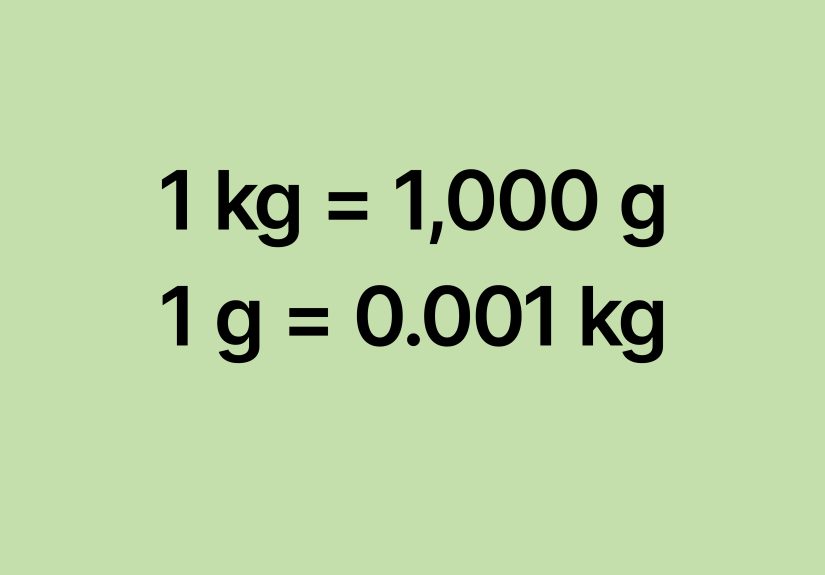
To convert grams to kilograms, divide the number of grams by 1,000. That is the entire magic trick. Since one kilogram equals 1,000 grams, moving from grams to kilograms means moving from a smaller unit to a larger unit. In other words, the number gets smaller, but the actual mass stays exactly the same. Your bag of flour does not lose weight just because you changed the unit. If only laundry worked that way.
In this guide, you will learn the grams to kilograms formula, step-by-step examples, common mistakes to avoid, quick mental math tips, practical conversion tables, and real-world situations where this simple metric conversion saves time and prevents confusion.
What Are Grams and Kilograms?
A gram, abbreviated as g, is a metric unit of mass used for measuring relatively small amounts. You will often see grams on food labels, recipe ingredients, medicine packaging, laboratory measurements, jewelry descriptions, and school science assignments. A paper clip, for example, has a mass of about one gram. Tiny, but surprisingly useful.
A kilogram, abbreviated as kg, is also a metric unit of mass, but it is used for larger amounts. People commonly use kilograms to measure body mass, bags of rice, pet food, luggage, produce, weights, and shipping packages. One kilogram equals 1,000 grams, which makes the relationship between the two units clean, decimal-based, and much easier than trying to remember how many ounces are in a pound before your coffee kicks in.
The Grams to Kilograms Formula
The basic formula is:
Or, using abbreviations:
That is the main rule for converting grams to kilograms. Because a kilogram is 1,000 times larger than a gram, you divide by 1,000 when going from grams to kilograms. If you are converting in the opposite direction, from kilograms to grams, you multiply by 1,000.
Simple Memory Trick
When converting from a smaller unit to a larger unit, the number usually becomes smaller. Since grams are smaller than kilograms, converting grams to kilograms means division. Think of it like packing loose coins into bigger rolls: fewer rolls, same value.
How to Convert Grams to Kilograms Step by Step
Here is the easiest method:
- Write down the number of grams.
- Divide that number by 1,000.
- Add the kilogram symbol, kg, after the answer.
For example, suppose you want to convert 2,500 grams to kilograms:
So, 2,500 grams equals 2.5 kilograms.
Examples of Converting Grams to Kilograms
Example 1: Convert 500 Grams to Kilograms
Use the formula:
Answer: 500 grams = 0.5 kilograms.
This is the same as half a kilogram. If you have ever bought a 500 g bag of coffee, congratulations: you were holding 0.5 kg of motivation.
Example 2: Convert 1,000 Grams to Kilograms
Answer: 1,000 grams = 1 kilogram.
This is the anchor point of the conversion. Memorize it, and most gram-to-kilogram questions become much easier.
Example 3: Convert 3,750 Grams to Kilograms
Answer: 3,750 grams = 3.75 kilograms.
This type of conversion is common when measuring food, packages, or bulk ingredients.
Example 4: Convert 85 Grams to Kilograms
Answer: 85 grams = 0.085 kilograms.
Small gram values become decimals when converted to kilograms. That is normal. Do not panic when the answer looks tiny. The mass did not vanish; it simply changed units.
Example 5: Convert 12,000 Grams to Kilograms
Answer: 12,000 grams = 12 kilograms.
Larger numbers often become cleaner when converted to kilograms, which is why kilograms are more convenient for heavier objects.
Grams to Kilograms Conversion Table
| Grams (g) | Kilograms (kg) |
|---|---|
| 1 g | 0.001 kg |
| 10 g | 0.01 kg |
| 50 g | 0.05 kg |
| 100 g | 0.1 kg |
| 250 g | 0.25 kg |
| 500 g | 0.5 kg |
| 750 g | 0.75 kg |
| 1,000 g | 1 kg |
| 2,500 g | 2.5 kg |
| 10,000 g | 10 kg |
Decimal Shortcut: Move the Decimal Point
Dividing by 1,000 is the same as moving the decimal point three places to the left. This is often faster than long division.
For example:
Another example:
If the number does not have a visible decimal point, imagine it at the end. So 72 is really 72.0. Move that decimal three places left, filling empty spaces with zeros if needed.
Why Divide by 1,000?
The metric system is based on powers of ten, which makes conversions friendly and predictable. The prefix kilo- means one thousand. Therefore, one kilogram is one thousand grams.
Because kilograms are larger than grams, you need fewer kilograms to describe the same mass. That is why the number decreases when you convert grams to kilograms. A 2,000 g bag of rice and a 2 kg bag of rice are the same bag. One label just looks more dramatic, like it is auditioning for a grocery-store action movie.
Common Mistakes When Converting Grams to Kilograms
Mistake 1: Multiplying Instead of Dividing
The most common mistake is multiplying grams by 1,000 instead of dividing. Remember: grams are smaller, kilograms are larger. To go from a smaller unit to a larger unit, divide.
Mistake 2: Forgetting the Unit Symbol
Numbers without units are like socks without partners: technically present, but not very helpful. Always include kg after your final answer.
Mistake 3: Moving the Decimal the Wrong Way
When converting grams to kilograms, move the decimal point three places to the left. Moving it to the right would make the number bigger, which is what happens when converting kilograms to grams.
Mistake 4: Rounding Too Early
If you are solving a multi-step problem, do the full conversion first, then round at the end. Rounding too early can make your final answer less accurate, especially in science, medicine, nutrition, or shipping calculations.
Real-Life Uses for Grams to Kilograms Conversion
Cooking and Baking
Recipes often list ingredients in grams, especially when precision matters. If a recipe calls for 1,500 g of flour and your scale or storage container uses kilograms, you need to know that 1,500 g equals 1.5 kg.
Nutrition Labels
Food labels usually show serving sizes in grams. If you are comparing larger quantities, such as total food weight over several servings, converting grams to kilograms can make the number easier to understand.
Science and School Assignments
In science, mass is frequently measured in grams for small objects and kilograms for larger ones. Physics problems often require kilograms because many formulas use SI units. Converting correctly helps your calculations behave instead of running wild through the worksheet.
Shipping and Packages
Shipping services often use kilograms for package mass, while product labels may list grams. If a box contains items totaling 2,850 g, that package has a mass of 2.85 kg before adding packaging materials.
Fitness and Health Tracking
Dumbbells, body mass, meal prep containers, and supplement servings may use grams or kilograms depending on the context. Understanding the conversion helps you compare values without guessing.
Practice Problems
Try converting these grams to kilograms:
- 300 g
- 1,250 g
- 6,800 g
- 45 g
- 20,000 g
Answers
- 300 g ÷ 1,000 = 0.3 kg
- 1,250 g ÷ 1,000 = 1.25 kg
- 6,800 g ÷ 1,000 = 6.8 kg
- 45 g ÷ 1,000 = 0.045 kg
- 20,000 g ÷ 1,000 = 20 kg
How to Check Your Answer
A quick way to check your answer is to reverse the conversion. After converting grams to kilograms, multiply your answer by 1,000. If you get the original number of grams, your answer is correct.
Example:
Since the original value was 2,750 g, the conversion is correct.
Grams vs. Kilograms: Which Unit Should You Use?
Use grams when measuring small objects or precise amounts. Ingredients, jewelry, lab samples, paper, spices, and nutrition facts usually make sense in grams. Use kilograms when measuring larger items such as luggage, furniture, body mass, pet food, produce bags, or shipping boxes.
A good rule: if the number in grams is large and full of zeros, kilograms may be cleaner. For example, 8,000 g is easier to read as 8 kg. Your eyes will thank you. They have enough problems dealing with tiny terms and conditions.
Quick Reference: Grams to Kilograms Formula
Here is the key takeaway:
If you remember only one thing, remember this: divide grams by 1,000 to get kilograms.
Helpful Experiences and Practical Tips for Converting Grams to Kilograms
One of the easiest ways to become comfortable with grams and kilograms is to connect the numbers to everyday objects. The conversion may look abstract at first, but once you start seeing it in real life, it becomes second nature. For example, a 500 g package of pasta is 0.5 kg. Two of those packages make 1 kg. A 250 g stick or block of an ingredient is 0.25 kg. Four of them equal 1 kg. Suddenly, the math feels less like a textbook and more like grocery-store detective work.
In the kitchen, grams-to-kilograms conversion is especially useful when scaling recipes. Suppose a bakery recipe calls for 3,000 g of flour. If you are planning inventory, writing a shopping list, or comparing bag sizes, 3 kg is much easier to understand. The same applies to sugar, rice, oats, butter, and other bulk ingredients. Small recipe measurements may stay in grams, but larger totals usually look cleaner in kilograms.
For students, the best experience-based tip is to write the conversion factor every time until it feels automatic. Instead of jumping straight to the answer, write:
Then ask yourself, “Am I going from smaller to larger?” Since grams are smaller and kilograms are larger, divide. This habit prevents the classic mistake of multiplying when you should divide. It also builds confidence for other metric conversions, such as milligrams to grams, meters to kilometers, and milliliters to liters.
Another practical tip is to estimate before calculating. If you are converting 980 g, your answer should be just under 1 kg. If you are converting 4,200 g, your answer should be a little over 4 kg. Estimation helps you catch errors quickly. If your calculator says 980 g equals 980,000 kg, something has gone dramatically wrong. Either the decimal moved the wrong way, or your calculator is trying to launch a cargo ship.
In shipping and online selling, converting grams to kilograms can help you avoid surprise costs. A product may weigh 850 g by itself, but after adding a box, wrapping, tape, and inserts, the total package might be 1.1 kg. That difference matters when shipping rates are based on weight ranges. Converting all item weights into kilograms makes it easier to compare package totals and avoid underestimating.
Fitness and nutrition tracking offer another common example. Food portions may be listed in grams, while body mass or larger meal-prep totals may be easier to understand in kilograms. If someone prepares 2,400 g of cooked food for several meals, that is 2.4 kg total. Breaking it into six equal portions gives 400 g per portion, or 0.4 kg each. The unit you choose depends on what makes the information easiest to read.
The biggest lesson from real use is simple: do not memorize dozens of conversions when one rule does the job. Grams to kilograms always follows the same pattern. Divide by 1,000, move the decimal three places left, and label the answer in kg. Once you practice with familiar items, the conversion becomes quick, practical, and almost impossible to forget.
Conclusion
Converting grams to kilograms is simple because the metric system is built around powers of ten. Since 1 kilogram equals 1,000 grams, all you need to do is divide the number of grams by 1,000. Whether you are solving homework problems, measuring recipe ingredients, checking package weight, reading nutrition labels, or organizing science data, this conversion is fast, useful, and reliable.
The formula is easy to remember:
Once you understand that grams are smaller and kilograms are larger, the direction of the math makes sense. Divide to go from grams to kilograms. Multiply to go from kilograms to grams. That is the whole conversion story, neatly packed into a metric box with no assembly required.