Table of Contents >> Show >> Hide
- Why Paper Football Still Works So Well
- What You Need
- How to Make a Paper Football
- How to Flick a Paper Football the Right Way
- How to Play Paper Football
- Paper Football Problems and Easy Fixes
- Fun Variations to Try
- Why This Little Craft Deserves More Respect
- Extra Experiences: Why Making a Paper Football Feels Bigger Than It Is
- Conclusion
If you have one sheet of paper, a flat surface, and the competitive spirit of a caffeinated squirrel, you have everything you need to make a paper football. This tiny triangle has entertained kids, bored office workers, siblings, cousins, and suspiciously competitive adults for generations. It is cheap, fast, oddly satisfying, and much less likely to break a lamp than a real football. Usually.
In this guide, you will learn exactly how to make a paper football, how to flick it properly, how to set up a simple game, and how to avoid the classic folding mistakes that turn your “football” into a sad paper dumpling. You will also get practical tips, fun variations, and a few real-life insights into why this old-school tabletop game still refuses to go out of style.
Why Paper Football Still Works So Well
Some crafts are beautiful. Some crafts are educational. Some crafts quietly live in a drawer forever after five minutes of excitement. Paper football is different. It becomes a game the second you finish folding it. That is part of the charm.
You do not need glue, glitter, batteries, or a deep emotional commitment to scrapbooking. You just fold, flick, and immediately challenge the nearest human. It is also wonderfully portable. At home, in a classroom during free time, at a family gathering, or during a weather-forced indoor afternoon, a paper football turns dead time into game time with almost no setup.
Better yet, it mixes craft, coordination, and light strategy. The folding sharpens attention to detail. The flicking rewards control more than brute force. And the game itself creates endless opportunities for house rules, rematches, and dramatic accusations of “That absolutely counted.”
What You Need
- 1 sheet of standard paper, preferably thin printer paper or notebook paper
- Scissors, if you are cutting the sheet into a smaller strip
- A marker, if you want to draw football laces
- A table, desk, countertop, or other flat playing surface
- Optional goalposts made with fingers, straws, craft sticks, or LEGO bricks
The best paper for a paper football is usually thinner paper. Thick cardstock looks confident, but once you start folding over and over, it behaves like a stubborn gym bag zipper. Thin paper makes cleaner creases and is much easier to tuck at the end.
How to Make a Paper Football
There are a few slightly different ways to fold a paper football, but the easiest method is the classic triangle-fold version. Follow these quick steps and you will have a playable football in just a few minutes.
Step 1: Start with the right size paper
Take a standard 8.5-by-11-inch sheet of paper and cut it in half lengthwise, sometimes called “hot dog style.” You only need one half for a single football. If you want a smaller football, cut a narrower strip. If you want one that feels more substantial, keep the strip wider.
A good beginner size is half a sheet. It is large enough to handle easily but still folds into a neat triangle without becoming bulky.
Step 2: Fold the strip in half lengthwise
Take your long strip and fold it lengthwise one more time. Press the crease firmly. This gives the football a tighter structure and helps it keep its shape later.
Do not rush this crease. A lazy crease now becomes a floppy football later, and nobody wants to lose because their paper equipment had the spine of overcooked pasta.
Step 3: Make your first triangle fold
At one end of the strip, fold one corner diagonally across the paper to make a triangle. You are basically starting a chain of triangles that will continue all the way up the strip.
This first fold sets the tone. If it is crooked, the rest of the football will also be crooked, like a tiny paper life lesson.
Step 4: Keep folding triangles up the strip
Continue flipping the triangle upward, then sideways, then upward again, following the shape already formed. Each fold wraps the paper around itself. Keep going until you are near the end of the strip.
By this point, the football should look compact and triangular. If it looks more like an abstract napkin sculpture, stop and check whether your folds have stayed aligned.
Step 5: Tuck the final flap into the pocket
Once you reach the end, you should have a small flap left over. Tuck that flap into the pocket created by the folded layers. This locks the football in place. If the pocket seems tight, gently squeeze it open rather than forcing the paper like you are trying to win an arm-wrestling contest against stationery.
If the flap will not tuck in neatly, your paper may be too thick or your folds may be a bit loose. Refold more tightly and try again.
Step 6: Add details if you want
At this point, your paper football is technically ready. If you want it to look more football-ish, draw white laces or stripes with a marker or gel pen. This is optional, but it adds charm and makes the football easier to spot when it inevitably disappears under a couch cushion.
How to Flick a Paper Football the Right Way
Making the football is only half the story. The flick is where legends are born, confidence is shattered, and family members become suspiciously intense.
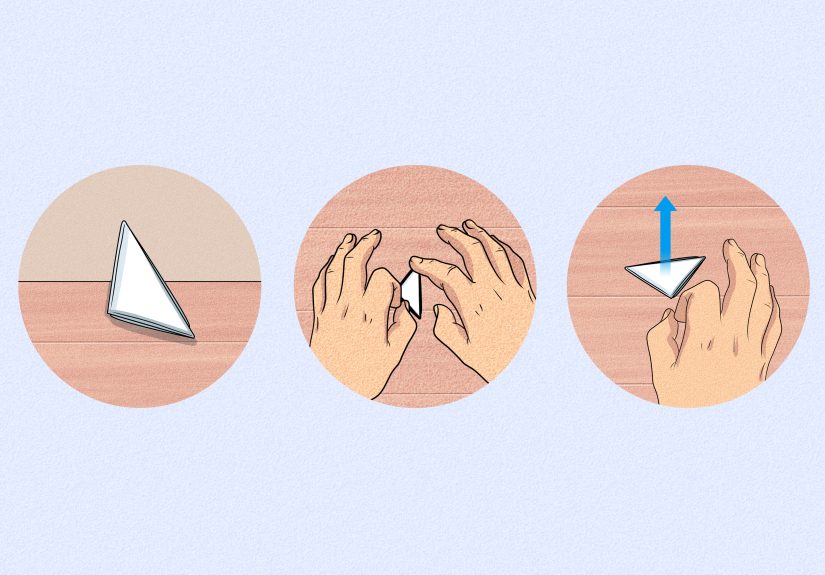
To flick the football, stand it upright on one point. The long edge should be vertical and facing you. Hold it steady with one finger. Then use a finger from your other hand to snap or flick the long edge forward.
The goal is not to smash it into orbit. A good paper football shot is controlled, clean, and aimed. Too much force sends it tumbling wildly. Too little force makes it flop over like it just heard bad news.
Tips for a better flick
- Use a smooth, firm surface for more predictable movement
- Keep your football standing straight before you flick
- Aim before flicking instead of relying on hope and chaos
- Practice with the same hand position to build consistency
- Experiment with force, because accuracy usually beats drama
There is real science hiding inside the fun. Your fingers store and release energy, the football gains motion, the table surface creates friction, and any shot through the air is affected by gravity and air resistance. So yes, technically, you are doing physics. Very dramatic physics.
How to Play Paper Football
The beauty of paper football is that the rules are flexible. Nearly every household, classroom, or lunch table has its own version. Still, there are a few common rules that make the game easy to set up.
Basic setup
Two players sit across from each other at a table. One player starts with the football at their end. The goal is to slide or flick the football so it lands hanging off the opponent’s table edge without falling. That usually counts as a touchdown.
Common scoring ideas
- Touchdown: 6 points if the football hangs over the edge of the table without falling
- Field goal: 3 points if you flick it through goalposts after a touchdown or as a separate shot, depending on your house rules
- Extra point: 1 point for a shorter follow-up flick through finger goalposts
Goalposts
The classic version uses fingers for the uprights. One player forms a goalpost with both hands by touching index fingers and thumbs. If you want a more stable setup, use straws, craft sticks, or LEGO bricks to build goalposts. This can make games more consistent and save someone from taking a paper point to the face.
Simple house rules that make the game better
- Choose a starting line so nobody keeps sneaking closer
- Set a winning score, such as 21 or 35
- Agree whether a bouncing shot counts or not
- Decide whether touching the football after the flick is allowed
- Keep a rematch policy, because emotions will escalate
Paper Football Problems and Easy Fixes
Your football will not stay folded
This usually means the paper is too thick or the folds are too loose. Switch to thinner paper and crease more sharply. The final tuck should feel snug, not impossible.
Your football looks uneven
Your first triangle fold was probably off. Start over and make the first diagonal as neat as possible. The rest of the folds depend on it.
Your flicks keep wobbling
Check your surface first. A textured or sticky table can ruin the path. Also make sure the football is upright and not leaning before the flick.
People keep arguing about whether a touchdown counts
Welcome to paper football, where tiny triangles produce full-size debates. The easiest rule is this: if part of the football hangs over the edge and it does not fall when hands are removed, it counts.
Fun Variations to Try
Mini tournament mode
Make several footballs in different colors and host a bracket. This is great for family game night, classroom centers, or a football-themed party.
DIY field goal challenge
Build a goalpost from straws and a paper cup or from LEGO bricks on a cardboard base. Mark yard lines on green paper and create a mini stadium vibe.
Skill-shot mode
Instead of regular scoring, set up targets at different distances. The farther the shot, the more points it earns. Suddenly everyone becomes part athlete, part engineer, part suspiciously confident commentator.
Decorated team footballs
Use markers to make team colors, draw laces, or label each football with a player’s name. It turns a simple craft into a personalized game-day activity.
Why This Little Craft Deserves More Respect
A paper football seems almost too simple to matter, but that is exactly why it lasts. It does not depend on apps, batteries, subscriptions, or instructions long enough to require coffee. It gives immediate payoff. In one minute, a boring sheet of paper becomes something you can aim, launch, defend, and celebrate.
It also invites creativity. Some people make tiny footballs for accuracy. Others make larger ones for better grip. Some add homemade goalposts, yard lines, scoreboards, and playoff systems. Give humans a folded triangle and about ten spare minutes, and somehow a sports league appears.
That is part of the genius of paper football. It is both a craft and an excuse. An excuse to laugh, compete, learn control, and pass time in a way that still feels hands-on and social. In a world full of screens asking for attention every five seconds, that is no small victory.
Extra Experiences: Why Making a Paper Football Feels Bigger Than It Is
There is something strangely memorable about learning how to make a paper football for the first time. It usually happens in a casual setting, not a grand one. Maybe it is at a kitchen table while waiting for dinner. Maybe it is at school during indoor recess. Maybe it is during a family party when the adults are busy talking and someone hands you a sheet of paper and says, “Here, I’ll show you.” A minute later, you are fully invested in the outcome of a flicked triangle. Human beings are wonderfully easy to entertain when the setup is good.
One of the best things about paper football is that it creates instant participation. You do not need experience to join in. You do not even need to be especially crafty. One person folds, another person watches, and by the second football everybody wants their own. Even people who claim they are “just observing” somehow end up measuring angles, making goalposts with their hands, and demanding another round after a narrow miss. It has a sneaky way of turning spectators into competitors.
There is also a certain shared comedy built into the game. Someone always flicks way too hard and launches the football into another room. Someone always celebrates too early. Someone always insists that the football was clearly hanging over the edge if you “look at it from the correct angle,” which usually means their angle. These little moments are part of the experience. The craft is simple, but the drama arrives fully assembled.
For kids, making a paper football can feel like discovering a secret trick. A plain sheet becomes a toy through a sequence of folds that seems almost like magic. For adults, it often feels nostalgic. It brings back school desks, rainy afternoons, waiting rooms, cafeteria tables, and those tiny competitions that felt much more important than they had any right to be. That is the real power of this activity. It is not just about making something. It is about making a moment.
Paper football also has a way of encouraging experimentation without making it feel like work. People naturally start asking questions. Does thinner paper fly better? Does a smaller football slide farther? Is a softer flick more accurate? What happens on a smoother table? Before long, you are basically running your own miniature sports lab, except with more laughter and fewer clipboards.
And maybe that is why the craft survives generation after generation. It is quick, inexpensive, and fun, but it also creates stories. You remember the impossible field goal. You remember the ridiculous miss. You remember the tiny football that vanished under the refrigerator forever. The object itself is almost nothing. The experience around it is everything.
So yes, learning how to make a paper football is a simple skill. But it is also one of those rare little activities that punches above its weight. It fills time, sparks competition, invites creativity, and turns an ordinary sheet of paper into an excuse for connection. Not bad for a folded triangle with an ego.
Conclusion
If you want a craft that is quick, cheap, fun, and instantly playable, a paper football is hard to beat. With just a few folds, you can turn a plain strip of paper into a classic tabletop game that works for kids, adults, parties, rainy days, and spontaneous competitions. Keep the folds neat, use thin paper, practice your flick, and do not be surprised if a “one quick game” becomes a full-blown championship series.
The best part is that paper football does not ask for much. One sheet, one table, two players, and suddenly the room has energy. That is the kind of low-effort, high-reward activity that deserves a permanent place in your fun toolbox.