Table of Contents >> Show >> Hide
- Why Low Baggy Pants Fall Down in the First Place
- Step 1: Pick Baggy Pants, Not Just Bigger Pants
- Step 2: Decide How Low You Actually Want Them to Sit
- Step 3: Measure Yourself Before You Buy Anything
- Step 4: Focus on the Hips and Seat More Than the Waist Label
- Step 5: Choose the Right Rise for the Look
- Step 6: Use a Belt That Actually Fits
- Step 7: Tighten the Belt at the Right Place, Not the Tightest Place
- Step 8: Let Your Base Layer Work With the Outfit
- Step 9: Pick the Right Fabric While You Learn the Style
- Step 10: Control the Inseam So the Pants Do Not Fight Your Shoes
- Step 11: Balance the Top Half of the Outfit
- Step 12: Test the Pants in Real Life Before You Commit
- Step 13: Tailor the Legs if Needed, but Do Not Rely on Tailoring to Fix Bad Rise
- Common Mistakes to Avoid
- Final Thoughts
- Extra Experience Section: What Wearing Really Low Baggy Pants Actually Feels Like
- SEO Tags
Really low baggy pants are one of those looks that can be incredibly cool when done right and absolutely chaotic when done wrong. There is a fine line between relaxed and ridiculous, and that line is usually located somewhere between your hips, your belt, and your dignity. The goal is not to spend all day yanking your pants upward like you are in a slapstick comedy. The goal is to make the style look intentional, comfortable, and easy.
If you love oversized silhouettes, roomy denim, loose cargo pants, or wide-leg trousers worn low on the hips, the trick is simple in theory: the pants need to look loose without actually behaving like they are trying to escape. In practice, that means paying attention to fit, rise, waist placement, inseam, fabric, and styling. In other words, this is not just “buy giant pants and hope for the best.” That method has already ruined enough sidewalks.
This guide breaks down 13 practical steps for wearing really low baggy pants without losing them, along with examples, styling tips, and common mistakes to avoid. By the end, you will know how to keep the look relaxed, modern, and secure enough to survive walking, sitting, stairs, and that one moment when you have to move faster than expected.
Why Low Baggy Pants Fall Down in the First Place
Before getting into the steps, it helps to understand the problem. Most low baggy pants fall because people focus only on width. They buy a pair that is huge everywhere, including the waistband, and then act shocked when gravity does what gravity has always done. A successful low-slung look depends on the top block of the pants: the waist, hips, seat, and rise. The legs can be roomy. The waistband cannot be random.
That is why the best version of this style usually combines a roomy leg with a controlled fit at the part of the pants that actually holds onto your body. Think relaxed, not lawless.
Step 1: Pick Baggy Pants, Not Just Bigger Pants
The first rule is brutal but helpful: oversized is not the same thing as baggy. A truly baggy cut is designed to give you extra room in the thigh and leg while still having some structure through the waist and hips. Simply buying pants three or four sizes too large often creates a puddle of denim with trust issues.
What to look for
Search for words like baggy, wide-leg, loose fit, relaxed straight, or oversized silhouette. These cuts are built to look roomy on purpose. That matters because a well-cut baggy pant hangs better, stacks better, and stays put better than a pair that is just wildly oversized in every direction.
Step 2: Decide How Low You Actually Want Them to Sit
“Really low” means different things to different people. For some, it means just below the hips. For others, it means the waistband is in a long-distance relationship with the natural waist. Be specific before you shop or get dressed.
If you want a wearable everyday version, aim for the waistband to sit low on the hips but still feel anchored when you walk. If you want the dramatic early-2000s-inspired version, understand that the styling, underwear, belt tension, and movement restrictions all become more important. Lower placement increases the chance of slippage. That is not fashion cruelty; it is simple mechanics.
Step 3: Measure Yourself Before You Buy Anything
This step is not glamorous, but it saves you from buying “perfect” pants that are only perfect for standing still in your bedroom mirror. Measure your waist, hips, and inseam. Also pay attention to rise, because rise affects where the pants can sit comfortably.
Quick example
If your natural waist measures 32 inches but your hips are fuller, a pair labeled 32 might feel too tight low on the body, while a 36 may slide right off. The sweet spot might be a cut designed for more room through the seat and thigh, or a 34 with the right rise and a belt. The lesson: numbers alone do not tell the whole story. The shape does.
Step 4: Focus on the Hips and Seat More Than the Waist Label
When wearing pants really low, the waistband is no longer sitting at your natural waist. It is resting closer to your hips. That means the fit around your hips and seat becomes incredibly important. If the seat is too slick, too loose, or too shallow, the pants will drift downward all day. If the seat fits well, the pants have something to hold onto besides your hopes.
A good test is to put the pants where you plan to wear them and walk around for five minutes. If they immediately slide or twist, the issue is not your belt. The issue is the fit through the upper half of the pants.
Step 5: Choose the Right Rise for the Look
Rise is the distance from the crotch seam to the waistband, and it affects how the pants sit and feel. This matters more than many people realize. A very high rise can still be worn lower, but it may bunch strangely. A low rise may look right, but if the cut is wrong for your body, it can tug, pull, or slide.
Best approach
Try mid-rise and low-rise options first. Mid-rise pants often work especially well because they give you more styling flexibility. You can wear them at the waist, slightly below it, or noticeably lower on the hips without turning your day into a constant pants-rescue mission.
Step 6: Use a Belt That Actually Fits
This is the step many people skip, and it shows. A tiny belt on giant pants is decoration. A belt that is too long is a snake. A belt that fits correctly is a tool.
Pick a belt size that works with your pant size and the point where the pants will sit on your body. Then tighten it enough to secure the pants without creating a harsh bunching effect around the waistband. The belt should support the look, not turn the top of the pants into a wrinkled paper bag.
Style tip
For denim or cargo pants, a simple leather belt, web belt, or sturdy canvas belt usually works well. Keep it clean and functional. This is not the time for a delicate belt that looks like it belongs on a prom dress.
Step 7: Tighten the Belt at the Right Place, Not the Tightest Place
Low baggy pants sit on a wider part of the body than the natural waist. That means you cannot always tighten them the same way you would normal jeans. If you over-tighten the belt, the pants may stay up, but they will fold, bulge, and look awkward. If you under-tighten it, congratulations, you are now one quick step away from a public plot twist.
The trick is to fasten the belt where the pants naturally settle on your hips, then adjust by one notch at a time. Walk, sit, stand, and move. The correct setting usually feels secure but not strangled.
Step 8: Let Your Base Layer Work With the Outfit
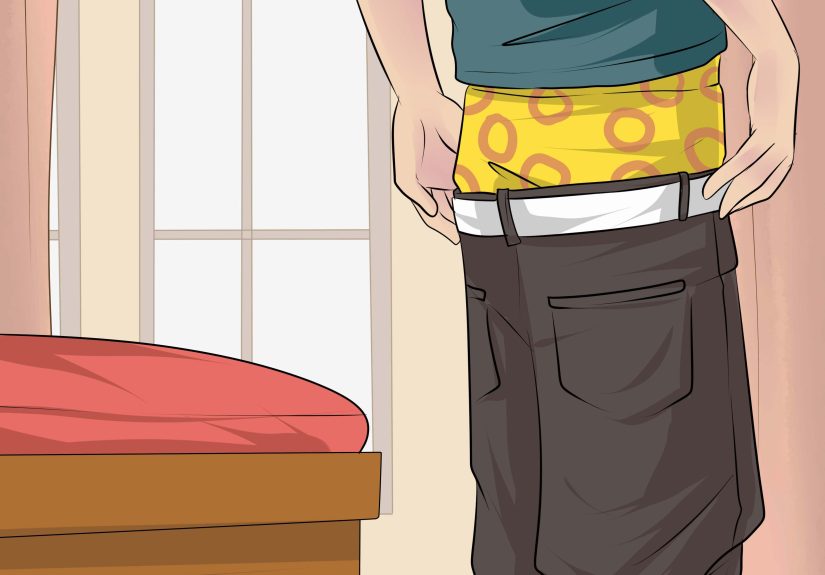
If the look includes visible boxers, compression shorts, or a longer base layer, make it intentional. Clean, well-fitting underlayers can improve comfort and make low baggy pants feel more secure. Sloppy or oversized underwear, on the other hand, can add bulk, shift around, and make the pants sit unevenly.
Think of the base layer as part of the architecture of the outfit. It should help the pants lie better, not create extra sliding surfaces. A fitted boxer brief is usually more practical than anything bunchy.
Step 9: Pick the Right Fabric While You Learn the Style
If you are new to really low baggy pants, start with denim, twill, or structured cotton instead of slippery, drapey fabric. Heavier materials often hang more predictably and feel easier to control. They also make the silhouette look intentional, which is a big deal with oversized dressing.
Soft, fluid fabrics can look amazing once you know what you are doing, but they also reveal every fit mistake. One wrong move and your “relaxed fashion statement” starts looking like you borrowed pajama pants from a giant.
Step 10: Control the Inseam So the Pants Do Not Fight Your Shoes
Baggy pants usually look best with some stack, but too much extra length creates drag, bunching, and accidental heel-grabbing. If the pants are low and wide and extra long, that is a lot happening below the knee.
Easy rule
Try the pants on with the exact shoes you plan to wear most often. Chunky sneakers, skate shoes, boots, and slim sneakers all affect the break differently. The hem should look relaxed, not like it is sweeping the floor out of spite.
Step 11: Balance the Top Half of the Outfit
Really low baggy pants already create a strong silhouette, so the top half of your outfit should balance the volume. A fitted tank, cropped tee, shrunken hoodie, clean oversized sweatshirt, or simple jacket can all work. The key is intention.
If both the top and bottom are wildly oversized with no shape or contrast, the outfit can lose definition fast. You do not need a skin-tight shirt, but you do want some control somewhere. Style loves balance almost as much as belts love belt loops.
Outfit examples
A pair of low baggy jeans with a fitted white tee and sneakers looks effortless. Low cargo pants with a cropped hoodie and skate shoes can feel streetwear-inspired. Baggy trousers with a tucked tank and bomber jacket create a cleaner fashion-forward version of the same idea.
Step 12: Test the Pants in Real Life Before You Commit
Mirror approval is not enough. You need movement approval. Sit down. Take the stairs. Bend slightly. Walk fast. Get in and out of a chair. If the pants survive all that without sliding, twisting, pinching, or exposing more than you intended, you are on the right track.
This step matters because some pants look incredible while standing still and become deeply unserious the second your body behaves like a human body. A reliable pair of low baggy pants should let you move without requiring one hand to remain on active waistband duty.
Step 13: Tailor the Legs if Needed, but Do Not Rely on Tailoring to Fix Bad Rise
Tailoring can absolutely improve baggy pants. Hemming the length, cleaning up the leg opening slightly, or refining the silhouette can make a huge difference. But if the rise feels wrong or the pants fundamentally do not sit right on your body, tailoring may not save them.
That is why it is smart to buy pants with the correct upper-body fit first, then tailor the lower half if needed. In other words: fix the easy stuff, respect the hard stuff, and do not expect a tailor to perform miracles on a pair of pants that never liked you in the first place.
Common Mistakes to Avoid
Buying too much waist and calling it a style choice
Roomy legs are stylish. A waistband that drops three inches every ten steps is not.
Ignoring the shoes
The shoes affect where the hem lands, how much the pants stack, and whether the whole look feels polished or clumsy.
Choosing weak belt loops or flimsy fabric
If the structure is poor, the pants are harder to control when worn low.
Forgetting comfort
If you cannot sit normally, breathe normally, or walk naturally, the look is not working as well as you think it is.
Final Thoughts
Wearing really low baggy pants without losing them is not about luck. It is about understanding where the pants sit, how they are cut, and what keeps them anchored. The best pairs have enough volume to look relaxed, enough structure to stay on, and enough styling support from the belt, shoes, and top half of the outfit to feel intentional.
So yes, you can absolutely wear really low baggy pants and still move through the world like a functional person. Just remember the golden rule: the pants should look carefree, not be careless. There is a difference, and your waistband knows it.
Extra Experience Section: What Wearing Really Low Baggy Pants Actually Feels Like
One of the most interesting things about this style is that your experience with it changes fast once you stop thinking of it as just a trend and start treating it like a fit problem with a fashion solution. Most people who try really low baggy pants for the first time have the same reaction: “These look amazing when I stand still.” Then they walk across a room and realize the pants are suddenly negotiating their own exit strategy. That is normal. The first lesson is that low baggy pants teach you very quickly whether you bought the right pair or just bought a large pair.
A common real-world experience is discovering that two pairs of pants that look almost identical on a hanger can behave completely differently on the body. One pair will sit low and look cool all day with only a minor adjustment here and there. The other pair will slide, bunch, twist, and make you feel like you should have brought backup pants. Usually the difference comes down to the seat, rise, and fabric. That is why people who get really good at this look start paying attention to fit details instead of just the general vibe.
Another thing people notice is how much shoes matter. The wrong shoes can make the pants feel longer, sloppier, and heavier. The right shoes suddenly make the whole outfit click. Chunkier sneakers often give the hem something to land on. Boots can make the silhouette feel stronger. Very flat shoes can work too, but only when the inseam is under control. It is one of those style lessons that sounds small until you see the outfit transform in ten seconds.
There is also the confidence factor. Really low baggy pants tend to look best when the person wearing them is not fussing with them every twelve seconds. Constant adjusting makes even a good outfit look uncomfortable. Once people find the right pair, though, the opposite happens: they stop thinking about the pants and start using them as a base for the rest of the look. That is usually the turning point where the style stops feeling like a costume and starts feeling personal.
Finally, people often realize that this look works best when it reflects their actual routine. If you walk a lot, sit through long classes, run errands, or move around all day, you will probably prefer a version that sits low but still feels secure. If you are dressing mainly for photos, events, or a very controlled styling moment, you can push the look lower and more dramatic. Neither approach is wrong. The best experience comes from choosing the version that matches your real life. That is the secret nobody tells you: the coolest low baggy pants are usually the ones you do not have to think about once you put them on.