Table of Contents >> Show >> Hide
- First, What Exactly Is Multiple Myeloma?
- When Doctors Start Suspecting Myeloma
- The Diagnostic Workup: A Clear Checklist (Not a Guessing Game)
- Blood Tests That Do the Heavy Lifting
- Urine Tests: The 24-Hour Jug You Didn’t Ask For
- Bone Marrow Aspiration & Biopsy: The “Receipt” for the Diagnosis
- Imaging: Looking for Bone Damage and Hidden Lesions
- The Criteria That Turn “Suspicious” Into “Diagnosed”
- What Your Results Mean: Turning Medical Data into a Plan
- A Walk-Through Example (Because “M spike” Isn’t a Love Song)
- Questions to Ask After a Myeloma Diagnosis
- The Bottom Line
- Experiences: The Human Side of Getting Diagnosed (and Getting Through It)
Getting worked up for multiple myeloma can feel like you’ve been drafted into a medical reality show:
blood draws, urine jugs, scans that sound like spaceship parts, and thenplot twista bone marrow biopsy.
The good news is that the diagnostic process is very structured. Doctors aren’t just “running tests.”
They’re answering a few specific questions: Is this myeloma? If yes, how active is it?
And what does that mean for treatment and prognosis?
This guide breaks down how multiple myeloma is diagnosed in the real world, what each test is looking for,
and how the results fit together. (And yes, we’ll talk about the infamous 24-hour urine collection. You deserve
a heads-up.)
Quick note: This is educational informationnot medical advice. Your care team is the final word on your situation.
First, What Exactly Is Multiple Myeloma?
Multiple myeloma is a cancer of plasma cells, a type of white blood cell in your bone marrow
that normally makes antibodies to help fight infection. In myeloma, a group of plasma cells becomes abnormal,
multiplies, and starts producing a large amount of one “copy” of an antibody (or part of one). This is often called
monoclonal protein, M protein, or an M spike.
Why the diagnosis focuses on proteins, bones, and kidneys
Myeloma cells can crowd out healthy bone marrow (leading to anemia and low blood counts), weaken bones (causing
bone pain, fractures, or lytic lesions), and damage kidneys (often related to abnormal proteins). That’s why the
workup usually involves three big categories:
- Blood and urine tests (to detect M protein and organ effects)
- Bone marrow testing (to confirm abnormal plasma cells and measure risk features)
- Imaging (to look for bone and bone marrow involvement)
When Doctors Start Suspecting Myeloma
Sometimes the first clue is a symptom like persistent back or rib pain that doesn’t match your workout routine,
or fatigue that makes your usual coffee laughably ineffective. Other times myeloma is found after “routine” lab work
shows something offlike anemia, high calcium, kidney problems, or unusually high total protein.
Common reasons a clinician might start a myeloma evaluation include:
- Bone pain (especially back, ribs, hips) or fractures with minimal trauma
- Fatigue, shortness of breath, or weakness from anemia
- Frequent infections
- Kidney dysfunction (sometimes discovered on labs before symptoms)
- High calcium (which can cause constipation, confusion, thirst, or frequent urination)
- Unexplained weight loss or general “something isn’t right” symptoms
The Diagnostic Workup: A Clear Checklist (Not a Guessing Game)
A typical diagnostic pathway looks like this:
- Screening labs suggest a plasma cell disorder.
- More specific protein testing confirms whether there’s monoclonal protein.
- Bone marrow testing determines how many abnormal plasma cells are present and how they behave.
- Imaging checks for bone lesions or marrow involvement.
- Doctors apply formal criteria to label it as MGUS, smoldering myeloma, or active myeloma.
- Staging and risk tests help guide treatment choices.
Blood Tests That Do the Heavy Lifting
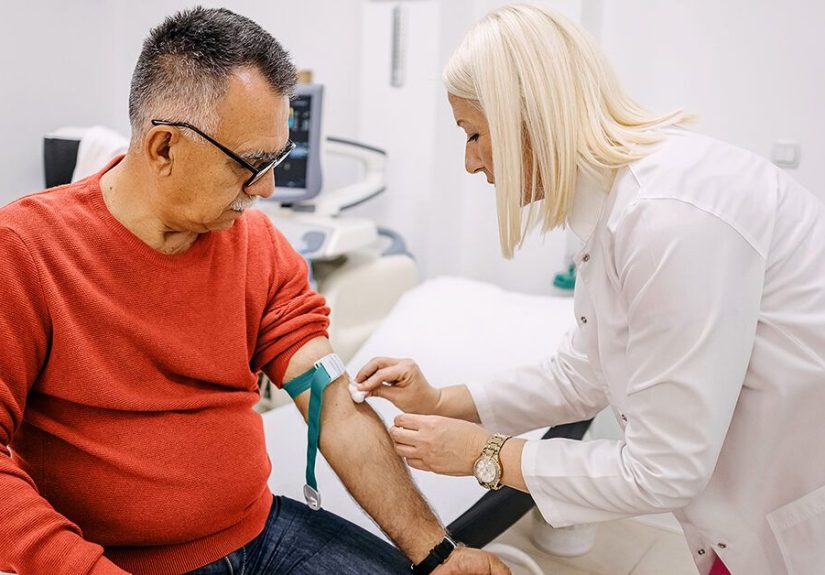
Blood tests can do three things at once: detect abnormal protein, reveal organ stress, and help stage the disease.
Here are the big ones you’ll often see:
1) Complete blood count (CBC)
A CBC looks at red blood cells, white blood cells, and platelets. Myeloma can cause anemia
(low red blood cells), which is one of the classic “myeloma-defining” issues when it’s due to the disease.
2) Comprehensive metabolic panel (CMP) and related labs
These labs check kidney function (like creatinine), calcium levels, liver markers, and sometimes albumin.
Myeloma may show up as elevated calcium or impaired kidney function.
Albumin is also used in staging.
3) Serum protein electrophoresis (SPEP) + immunofixation
SPEP separates proteins in the blood and can reveal an M spike, suggesting a monoclonal protein.
Immunofixation is like the “name tag” testit identifies the type of monoclonal protein (for example, IgG kappa).
Together, these help confirm that the protein pattern isn’t just inflammation or a random lab blip.
4) Serum free light chain assay
Some myelomas produce mainly light chains (kappa or lambda) rather than whole antibodies. The free light chain test
measures these and looks at the ratio between involved and uninvolved light chains. This matters because certain ratios can indicate
high-risk activity even before classic symptoms appear.
5) Quantitative immunoglobulins
These measure overall antibody levels (IgG, IgA, IgM). Myeloma often causes a high level of one type and suppression of others,
which can help explain infection risk.
6) Beta-2 microglobulin, LDH, and sometimes other markers
Beta-2 microglobulin and albumin are key components of the International Staging System (ISS),
and LDH can also play a role in modern risk/staging approaches. These aren’t “diagnosis” tests by themselves,
but they help define how aggressive the disease appears.
Urine Tests: The 24-Hour Jug You Didn’t Ask For
Urine testing looks for myeloma protein that may be spilling into urine. You might hear:
UPEP (urine protein electrophoresis) and urine immunofixation. Light chains in urine are often called
Bence Jones proteins.
Many clinicians request a 24-hour urine collection because a single sample can miss how much protein your kidneys
are handling over a full day. It’s inconvenient, yesbut it can provide important information about tumor burden and kidney risk.
Bone Marrow Aspiration & Biopsy: The “Receipt” for the Diagnosis
If blood/urine tests raise strong suspicion, the next step is often a bone marrow aspiration and biopsymost commonly
from the back of the hip bone. Think of it as the definitive “what’s happening at headquarters” test.
What it tells your doctor
- Percentage of plasma cells in the marrow (and whether they’re clonal/abnormal)
- Cell features under the microscope (how the cells look and behave)
- Flow cytometry (a detailed fingerprint of abnormal cells)
- Cytogenetics/FISH testing (chromosomal changes linked to higher- or standard-risk disease)
You may see results mentioning changes such as del(17p), t(4;14), t(14;16), or 1q gain/amplification.
These don’t usually change whether it’s myeloma, but they can strongly influence risk stratification and treatment strategy.
What the procedure feels like (honest but not scary)
People worry about this partand that’s understandable. The procedure is typically quick, often done with local numbing medicine,
sometimes with additional medication for relaxation. Many patients describe pressure and a brief, intense “pull” sensation during the aspiration.
Afterward, soreness for a day or two is common. It’s not fun, but it’s also not endless.
Imaging: Looking for Bone Damage and Hidden Lesions
Myeloma can cause areas of bone destruction (lytic lesions) and marrow changes that don’t always show up on old-school X-rays.
That’s why modern workups often use more sensitive imaging such as:
- Whole-body low-dose CT (good for detecting bone lesions)
- PET/CT (can show active disease and some extramedullary involvement)
- Whole-body MRI or targeted MRI (excellent for marrow involvement and focal lesions)
Some centers may still use a skeletal survey (a series of X-rays), especially when advanced imaging isn’t available right away,
but CT, PET/CT, and MRI can detect problems earlier and more accurately in many cases.
The Criteria That Turn “Suspicious” Into “Diagnosed”
Here’s the key point: a monoclonal protein alone does not automatically mean multiple myeloma.
There are precursor conditions that can look similar on screening tests.
MGUS vs smoldering myeloma vs active myeloma
- MGUS (monoclonal gammopathy of undetermined significance):
low levels of monoclonal protein and limited marrow involvement, with no organ damage from myeloma. - Smoldering multiple myeloma:
higher protein and/or marrow plasma cells than MGUS, but still no “myeloma-defining events.”
This is monitored closely because the risk of progression is higher. - Active multiple myeloma:
meets formal diagnostic criteria indicating organ damage or high-risk biomarkers that justify treatment.
CRAB and SLiM-CRAB: the “myeloma-defining events”
Traditionally, myeloma became “active” when it caused end-organ damage summarized as CRAB:
- C = elevated calcium
- R = renal (kidney) dysfunction
- A = anemia
- B = bone lesions
Newer criteria allow treatment before those complications occur when biomarkers show extremely high riskoften called
SLiM-CRAB (the “SLiM” are biomarkers that count as myeloma-defining events in the right context):
- S: ≥ 60% clonal plasma cells in the bone marrow
- Li: involved/uninvolved free light chain ratio ≥ 100 (with sufficient involved light chain level)
- M: MRI showing more than one focal lesion (commonly > 5 mm)
Why does this matter? Because treating someone at very high risk of near-term progression may prevent fractures,
kidney injury, and other complicationsessentially getting ahead of the damage rather than chasing it.
What Your Results Mean: Turning Medical Data into a Plan
Once the diagnosis category is clear, doctors look at the “shape” of the disease:
how much myeloma is present, whether it’s affecting organs, and what the risk profile suggests.
Staging (ISS and beyond)
Staging systems use lab values (commonly including beta-2 microglobulin and albumin) and may incorporate other markers such as LDH
and high-risk cytogenetic findings. The goal isn’t to label you with a number for the sake of itit’s to estimate prognosis,
standardize care, and help guide intensity of treatment and monitoring.
Risk stratification (the genetics piece)
Cytogenetic/FISH results can identify higher-risk disease biology. This may influence:
- how urgently treatment is started (when borderline)
- which drug combinations are favored
- how closely the disease is monitored after therapy
- whether a specialist center or clinical trial is recommended
Baseline measurements (so future tests make sense)
Myeloma is often monitored through repeated blood/urine tests and sometimes follow-up imaging or marrow tests.
That’s why the initial workup is so detailed: it creates a baseline for measuring response.
A Walk-Through Example (Because “M spike” Isn’t a Love Song)
Let’s say Jordan, age 62, visits a doctor for persistent back pain and fatigue. A CBC shows anemia. A metabolic panel shows borderline kidney function.
The doctor orders a myeloma screen:
- SPEP shows an M spike, and immunofixation identifies IgG kappa monoclonal protein.
- Serum free light chains are abnormal with a skewed kappa/lambda ratio.
- A 24-hour urine test shows measurable monoclonal protein.
Next comes imaging. Whole-body low-dose CT shows several lytic lesions in the spine. A bone marrow biopsy finds 35% clonal plasma cells,
and FISH reveals a chromosomal change associated with higher-risk disease.
Jordan now meets criteria for active multiple myeloma (clonal plasma cells plus bone lesions and anemia attributable to myeloma).
The meaning of that diagnosis isn’t just “you have myeloma”it also tells the team:
(1) treatment is indicated, (2) baseline markers are established, and (3) risk features will shape the treatment strategy.
Another scenario: Taylor has no bone lesions, normal calcium, and normal kidney functionbut has an extremely high free light chain ratio
and MRI shows multiple focal lesions. Even without classic CRAB symptoms, those findings can qualify as active myeloma under SLiM criteria,
because the risk of near-term progression is high enough that treatment may prevent organ damage.
Questions to Ask After a Myeloma Diagnosis
Appointments can move fast, and suddenly you’re trying to remember whether “IgA lambda” was your diagnosis or a new streaming service.
Consider asking:
- What diagnosis category do I have: MGUS, smoldering myeloma, or active multiple myeloma?
- What is my myeloma type (e.g., IgG, IgA, light-chain)? What are my key lab markers to track?
- Do I have any CRAB features or SLiM biomarkers?
- What did the bone marrow biopsy show (percent plasma cells, flow cytometry, FISH/cytogenetics)?
- What imaging was done, and were bone lesions found?
- What stage/risk category am I in, and how does that affect treatment options?
- Should I see a myeloma specialist or get a second opinion at a center that treats a high volume of myeloma?
- How will we monitor my disease and treatment response?
The Bottom Line
Multiple myeloma diagnosis is a step-by-step process designed to be precise: confirm abnormal plasma cells, measure monoclonal protein,
check for organ damage or high-risk biomarkers, and use imaging to see what’s happening in bone and marrow.
The result isn’t just a labelit’s a roadmap that guides what happens next.
If you’re in the middle of testing, it can feel like everything is happening at once. But each test has a job,
and together they answer the most important question: Is this a condition we watch, or one we treat now?
Experiences: The Human Side of Getting Diagnosed (and Getting Through It)
The medical checklist is one thing. Living through it is another. Many people describe the diagnostic phase as the most emotionally
exhausting partnot because the tests are the worst (though the bone marrow biopsy has a strong fan club of exactly zero),
but because of the waiting. Waiting for lab results. Waiting for imaging appointments. Waiting for the pathology report.
Waiting while your brain fills the silence with the loudest possible “what if.”
A common experience is feeling strangely “in between.” You might not feel sick every minute, yet you’re suddenly dealing with words like
plasma cell cancer, monoclonal protein, and cytogenetics. Some people describe it as being told,
“We found smoke,” and then spending weeks figuring out whether it’s burnt toast or an actual fire.
Patients often say the first blood and urine results are a shock because they look so definitive on paper (“M spike present” sounds pretty
confident). But the follow-up explanation matters: monoclonal proteins can appear in precursor conditions, and the difference between MGUS,
smoldering myeloma, and active myeloma changes the next step completely. That uncertainty can feel like emotional whiplashrelief one moment,
dread the next, and confusion hovering over everything like a fog machine set to “dramatic.”
The practical side is real, too. People talk about juggling time off work, arranging rides (especially if sedation is used),
dealing with insurance approvals for PET/CT or MRI, and learning a new language of labs. Many find it helpful to bring a notebookor a friend
who takes notesbecause it’s hard to absorb staging and treatment planning while your mind is still stuck on, “Did they just say biopsy?”
Others ask for printed summaries or copies of key results (SPEP/immunofixation, free light chains, marrow report, imaging impression),
so they can review them later when their brain is no longer running on adrenaline.
Emotionally, people often cycle through fear, anger, and an odd sense of guilt (“Maybe I ignored symptoms too long”).
It can help to remember: myeloma is frequently discovered because of nonspecific issues like back pain or fatigue, and it’s also sometimes
found incidentally. Self-blame is commonand usually undeserved.
Support systems matter. Some patients feel best with a tight circle and clear boundaries; others want to talk to everyone.
Many find comfort in connecting with reputable myeloma organizations or support groups, especially to learn what questions to ask
and how monitoring works. Caregivers often report their own version of “scanxiety,” tootrying to stay calm for their loved one while quietly
Googling acronyms in the parking lot. If that’s you, you’re not alone, and it’s okay to ask the medical team to slow down and explain things twice.
The goal of diagnosis isn’t just to identify myelomait’s to help you feel oriented, informed, and ready for the next step, whatever it is.