Table of Contents >> Show >> Hide
- Why Animal Drawings Can Support Wildlife Conservation
- The Big Conservation Message Behind the Series
- Drawing 1: The Elephant A Gentle Giant With Ecosystem Muscle
- Drawing 2: The Tiger Stripes, Shadows, and Survival
- Drawing 3: The Sea Turtle Ancient Navigator of a Changing Ocean
- Drawing 4: The Monarch Butterfly Tiny Wings, Huge Journey
- Drawing 5: The Scarlet Macaw Color, Intelligence, and Rainforest Rhythm
- Drawing 6: The Coral Reef Seahorse Small Creature, Vast Ecosystem
- How Intricate Drawing Builds Respect for Biodiversity
- How This Artwork Supports Conservation in Practical Ways
- What These Six Animals Teach Us About the Earth
- Personal Experiences Behind the Series
- Conclusion: Drawing a Wilder, Kinder Future
Some people collect stamps. Some people collect sneakers. I apparently collect tiny pencil lines until my hand cramps and my coffee goes cold. My latest series, six intricate animal drawings supporting wildlife conservation, began as a simple idea: choose six species from very different habitats, study their forms carefully, and create detailed artwork that celebrates the breathtaking biodiversity of Earth.
But the project quickly became more than a drawing challenge. Each animal taught me something about survival, adaptation, habitat, and the awkward human habit of accidentally making life harder for every creature that does not have a real estate lawyer. From elephants shaping forests to monarch butterflies crossing continents on wings thinner than tissue paper, these drawings became small visual love letters to the wild world.
This article shares the story behind the six artworks, the conservation message each animal carries, and why wildlife art still matters in a world overflowing with screens, statistics, and people arguing online about whether a hot dog is a sandwich. Spoiler: biodiversity is not a sandwich. It is the whole picnic.
Why Animal Drawings Can Support Wildlife Conservation
Wildlife conservation is the practice of protecting animal and plant species and the habitats they need to survive. That may sound tidy in one sentence, but in real life it involves science, policy, community action, habitat restoration, education, and a lot of muddy boots. Art fits into that work because it can make conservation feel personal before the facts even arrive.
A statistic tells us that wildlife populations are under pressure. A drawing lets us look directly into the eye of an elephant, the shell pattern of a sea turtle, or the powdery wing of a monarch butterfly and think, “Oh. This life is not abstract.” That emotional connection is powerful. People often protect what they notice, and detailed animal drawings are basically a polite way of saying, “Please notice this creature before it becomes a memory.”
Biodiversity refers to the variety of life on Earth, including genes, species, ecosystems, and the relationships between them. It includes everything from whales to mosses, coral reefs to prairie grasses, fungi to the tiny organisms doing invisible chores in soil and water. When biodiversity is healthy, ecosystems tend to be stronger, more resilient, and better able to support lifeincluding human life, which is a detail humans occasionally forget while building parking lots.
The Big Conservation Message Behind the Series
The heart of this project is simple: wildlife art can celebrate beauty while also raising awareness about biodiversity loss. Many species face overlapping threats, including habitat loss, climate change, pollution, illegal wildlife trade, invasive species, overexploitation, and human-wildlife conflict. Habitat loss is especially serious because even the most magnificent animal cannot thrive without a place to eat, breed, migrate, hide, and raise young.
That is why each drawing in my series focuses not only on the animal, but also on its world. I did not want floating heads on blank paper, even though floating heads are much easier and far less likely to make me mutter at a background texture for three hours. I wanted each animal surrounded by clues about its ecosystem: leaves, water, coral, grasses, flowers, shadows, feathers, and the small details that say, “This creature belongs somewhere.”
Drawing 1: The Elephant A Gentle Giant With Ecosystem Muscle
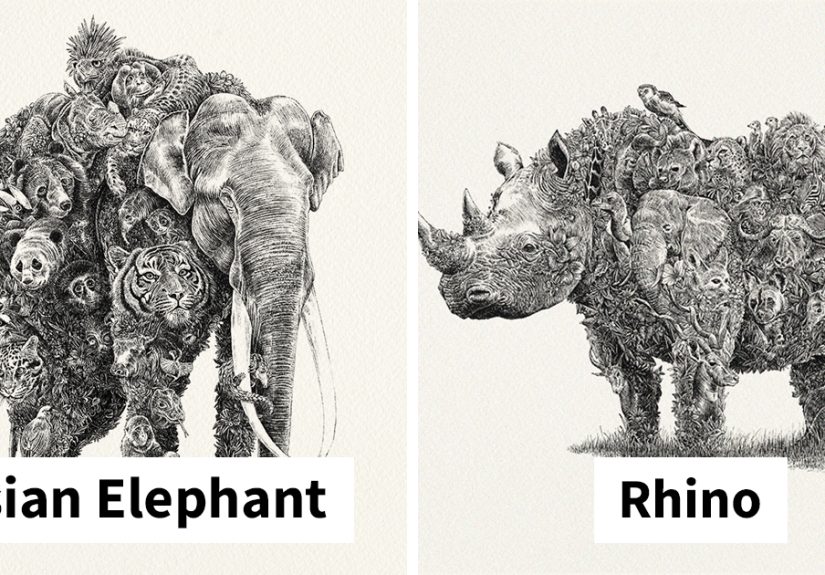
The first drawing in the series is an elephant, built with slow graphite shading and a slightly unreasonable number of wrinkles. Elephants are famous for their intelligence, memory, social bonds, and emotional depth. They are also ecosystem engineers. As they move through landscapes, elephants spread seeds, open pathways, create water access, and help shape the environments around them.
In the drawing, I focused on the texture of the skin, the fan-like ear, and the calm weight of the animal’s gaze. The goal was not to make the elephant look cute in a greeting-card way. I wanted it to feel ancient, patient, and strongas if it had seen entire forests grow up around it and had opinions about my pencil technique.
Conservation meaning
Elephants face major threats from poaching, habitat loss, and conflict with people. African elephants are heavily affected by ivory poaching, while Asian elephants are especially threatened by shrinking habitat and increasing contact with farms, roads, and settlements. Protecting elephants means protecting large, connected landscapes and supporting communities that live near them.
For viewers, the elephant drawing asks a quiet question: what happens when a species too large to ignore is still pushed into smaller and smaller spaces?
Drawing 2: The Tiger Stripes, Shadows, and Survival
The tiger drawing was the most dramatic piece, mostly because tigers come preloaded with drama. Those stripes are not decoration; they are camouflage, identity, and optical wizardry. Drawing them required patience, discipline, and the occasional deep sigh of a person who has just realized one misplaced stripe can make a tiger look like it lost a fight with a barcode scanner.
I placed the tiger partly in shadow, with leaves breaking across its face. The composition reflects how wild tigers are both powerful and vulnerable. They are apex predators, but even apex predators cannot hunt in forests that are gone or survive safely in landscapes broken apart by roads, farms, and illegal trade.
Conservation meaning
Tigers have lost much of their historic range. Their key threats include poaching, illegal wildlife trade, habitat loss, climate change, and conflict with humans. Conservation efforts often focus on protecting tiger landscapes, strengthening anti-poaching work, restoring prey populations, and reducing demand for tiger parts.
The tiger artwork celebrates biodiversity by showing the predator as part of a larger system. A tiger is not just a tiger. It is connected to deer, forests, rivers, grasses, local communities, and the health of an entire habitat.
Drawing 3: The Sea Turtle Ancient Navigator of a Changing Ocean
The sea turtle drawing gave me a chance to move from forests to oceans. I used flowing lines around the shell and flippers to suggest motion through water. Sea turtles look calm, but they are endurance athletes in disguise. Some migrate vast distances between feeding areas and nesting beaches, following routes older than many human civilizations.
The shell was the star of this piece. I treated every scute like a small map, layering patterns until the turtle seemed to carry the ocean on its back. This is where art becomes a sneaky teacher. A viewer may come for the beautiful pattern, then stay long enough to learn that sea turtles are affected by fishing bycatch, plastic pollution, coastal development, artificial lighting, climate change, vessel strikes, and the loss of nesting habitat.
Conservation meaning
Sea turtle conservation has seen real progress in some places, especially where nesting beaches are protected and fishing gear is improved to reduce accidental capture. Turtle excluder devices, beach monitoring, responsible lighting, and marine protected areas can make a difference. The sea turtle drawing is a reminder that conservation is not only about doom. It is also about solutions that work when people commit to them.
Drawing 4: The Monarch Butterfly Tiny Wings, Huge Journey
The monarch butterfly drawing was the smallest animal in the series, but it carried one of the biggest stories. Monarchs are known for their long-distance migration and their dependence on milkweed as a host plant for caterpillars. The idea that an insect this delicate can travel across countries is both scientifically impressive and emotionally unfair. I get tired walking from the parking lot to the grocery store.
For this drawing, I used fine ink lines to create the wing veins and soft shading to show the fragile edges. Around the butterfly, I added milkweed leaves and flowers to connect the species to the habitat it needs. Without milkweed, monarch caterpillars cannot complete their life cycle. Without nectar plants, adult butterflies lose vital fuel for migration.
Conservation meaning
Monarch populations have declined due to a mix of habitat loss, climate stress, pesticide exposure, and changes along migration routes. Conservation actions can happen at many scales, from national habitat programs to backyard pollinator gardens. Planting native milkweed and nectar plants may seem small, but for a butterfly, a small patch can be a roadside diner, nursery, and rest stop all in one.
The monarch piece celebrates biodiversity by showing that even the smallest creatures can connect continents, seasons, plants, and people.
Drawing 5: The Scarlet Macaw Color, Intelligence, and Rainforest Rhythm
The fifth drawing is a scarlet macaw, because after several graphite-heavy pieces, my pencils were begging for color. Scarlet macaws are brilliant birds with red, yellow, and blue feathers that look almost too bold to be real. They are also intelligent, social, loud, and fully capable of making a forest sound like it has opinions.
I drew the macaw perched among layered leaves, with the feathers carefully built from repeated strokes. Bird art has a long history in science and conservation. Before wildlife photography became common, illustration helped people identify species, study anatomy, and appreciate animals they might never see in person. Today, bird art continues to inspire curiosity and action.
Conservation meaning
Many bird species are affected by habitat loss, climate change, pollution, collisions, and the wildlife trade. North American bird research has shown major population declines across many habitats, reminding us that even familiar species can be in trouble. Tropical birds such as macaws also depend on intact forests, nesting sites, and protection from illegal capture.
The macaw drawing is my loudest piece visually, but its message is quiet: color belongs in the world. Forests should not become silent galleries of what used to live there.
Drawing 6: The Coral Reef Seahorse Small Creature, Vast Ecosystem
The final drawing features a seahorse in a coral reef scene. I chose a seahorse because it feels almost mythical, like nature had leftover parts from a horse, a dragon, and a question mark, then decided to make something charming. But the real star of the drawing is the reef itself. Coral reefs support extraordinary marine biodiversity, shelter young fish, protect coastlines, and sustain communities through fishing and tourism.
This drawing required the most detail: coral branches, tiny fish, bubbles, soft textures, and the curled tail of the seahorse gripping its surroundings. Reefs are visually complex because they are biologically complex. Every shape seems to house another life form, and every shadow suggests movement.
Conservation meaning
Coral reefs are threatened by warming oceans, acidification, pollution, sedimentation, destructive fishing practices, and disease. Coral bleaching events have become a major concern as ocean temperatures rise. The seahorse drawing represents the hidden worlds that depend on reef health. Protecting coral reefs means reducing pollution, supporting sustainable fisheries, cutting greenhouse gas emissions, and restoring damaged habitats where possible.
How Intricate Drawing Builds Respect for Biodiversity
One unexpected lesson from this project is that detail changes attention. When I draw an elephant wrinkle, a tiger whisker, or the edge of a butterfly wing, I cannot treat the animal as a symbol only. I have to slow down and study how it is built. That study creates respect.
Intricate animal drawings force the artist to notice what casual viewing skips. A sea turtle shell is not just “a shell.” It is a pattern of plates, scars, curves, and growth. A macaw feather is not just “red.” It contains shifts of light, structure, and movement. A coral reef is not just “pretty underwater stuff.” It is a living system full of relationships.
That same attention is what conservation needs. Biodiversity is not saved by vague affection alone. It is protected through careful observation, good science, strong laws, community leadership, sustainable choices, habitat protection, and public support. Art can invite people into that conversation without making them feel as if they accidentally walked into a lecture hall with fluorescent lighting.
How This Artwork Supports Conservation in Practical Ways
Wildlife art can support conservation through awareness, fundraising, education, and advocacy. Prints can raise money for habitat protection or rehabilitation programs. Exhibitions can introduce audiences to endangered species. Social media posts can turn a drawing into a mini conservation lesson. Classroom activities can help children connect creativity with ecology. Even a single artwork can start a conversation that leads someone to plant native flowers, reduce plastic use, support a wildlife organization, or learn more about a threatened species.
For this series, I designed each drawing with three goals. First, the artwork had to be beautiful enough to stop someone scrolling. Second, it had to include accurate natural details. Third, it had to point toward a conservation message without becoming a poster that yells, “CARE HARDER!” Nobody likes being yelled at by a poster.
Instead, the series uses curiosity. Why does the monarch need milkweed? Why does the tiger need connected forest? Why do sea turtles return to beaches? Why do coral reefs matter to fish and people? When someone asks one good question, conservation has already gained a foothold.
What These Six Animals Teach Us About the Earth
Together, the six drawings create a small map of global biodiversity. The elephant represents grasslands and forests. The tiger represents predator-prey balance and connected landscapes. The sea turtle represents ocean migration and coastal habitats. The monarch represents pollination and the importance of native plants. The scarlet macaw represents rainforest life and bird conservation. The seahorse represents coral reef complexity and marine fragility.
They are very different animals, but their stories overlap. Each depends on habitat. Each is affected by human decisions. Each has beauty that is more than decoration. Each reminds us that conservation is not only about saving rare species in faraway places. It is about protecting the systems that keep Earth alive, colorful, breathable, and wonderfully weird.
Personal Experiences Behind the Series
Creating these six intricate animal drawings felt less like finishing an art project and more like taking six field trips without leaving my desk. My workspace became a strange little ecosystem of pencil shavings, reference sketches, half-empty mugs, and sticky notes with phrases like “more shell texture” and “do not overwork tiger nose.” Very scientific, obviously.
The elephant was the first piece I started, and it immediately humbled me. I thought wrinkles would be repetitive. They were not. Every crease changed direction, depth, and personality. After a few hours, I realized I was not simply drawing old skin; I was drawing a record of movement, weather, dust, age, and survival. That changed the mood of the whole series. The animals were no longer subjects to decorate a page. They were lives with histories.
The tiger taught me patience. Stripes look bold from far away, but up close they require careful planning. Too many dark marks and the face becomes heavy. Too few and the tiger loses its presence. While drawing it, I kept thinking about how easily balance can be disturbed in nature. A forest can look endless until roads slice through it. A predator can look invincible until its prey disappears. The tiger became my reminder that strength does not make a species safe.
The sea turtle was the most calming piece. I worked on it during a week when everything felt noisy, and the slow curve of the shell gave me a rhythm. Still, the research behind the drawing was sobering. Learning about bycatch, plastic pollution, and artificial lights confusing hatchlings made the peaceful image feel more urgent. I wanted the turtle to look graceful, but not decorative. It needed to carry the weight of a species that has crossed oceans for millions of years and now has to dodge fishing gear and floating trash. Evolution prepared it for sharks, not grocery bags.
The monarch butterfly surprised me emotionally. It is easy to underestimate insects because they are small, but drawing a monarch wing under magnification made it feel monumental. The pattern was architectural. The migration story was heroic. I began noticing milkweed, roadside flowers, and small garden spaces differently. A vacant corner with native plants suddenly looked like infrastructure. Not shiny infrastructure with ribbon-cutting ceremonies, but real survival infrastructure for pollinators.
The scarlet macaw was pure visual joy. After days of graphite, adding intense color felt like opening a window. But the macaw also reminded me that beauty can make animals vulnerable. Bright feathers, intelligence, and charisma often attract human attention, and not all attention is kind. The illegal wildlife trade turns living beings into objects. While drawing the macaw’s eye, I kept trying to capture alertness and personality. I wanted viewers to feel that this bird is not an ornament. It is a mind in feathers.
The seahorse and coral reef piece was the most complicated composition. Every section of the reef seemed to demand its own tiny universe. I made mistakes, erased, redrew, and briefly considered moving to a blank-wall minimalist phase. But the complexity was the point. Coral reefs are not simple backgrounds; they are crowded cities of life. Drawing them helped me understand why reef loss is so devastating. When coral suffers, countless other species lose shelter, food, and breeding space.
By the end of the project, I felt more connected to wildlife conservation than I had expected. I started as an artist wanting to make six detailed animal drawings. I finished as a person who reads labels more carefully, notices native plants, avoids unnecessary plastic, supports conservation groups when possible, and talks about biodiversity with the enthusiasm of someone who has definitely spent too much time shading elephant wrinkles.
The experience also taught me that conservation does not always begin with grand gestures. Sometimes it begins with attention. A person notices a drawing, learns a fact, changes a habit, shares a message, plants a flower, supports a habitat project, or teaches a child the name of a bird. Those actions may seem small, but nature is built from small connections. A seed, a feather, a reef polyp, a butterfly egg, a pencil lineeach one matters more than it first appears.
Conclusion: Drawing a Wilder, Kinder Future
My 6 intricate animal drawings support wildlife conservation and celebrate biodiversity of the Earth by turning attention into affection, and affection into action. The elephant, tiger, sea turtle, monarch butterfly, scarlet macaw, and coral reef seahorse each represent a different part of the living planet. Together, they remind us that biodiversity is not background scenery. It is the active, breathing, swimming, flying, crawling network that keeps Earth rich and resilient.
Art cannot replace science, policy, habitat protection, or community conservation. But it can open the door. It can make people pause. It can transform a distant issue into a face, a pattern, a wing, a shell, or a pair of watchful eyes. And sometimes, that pause is where responsibility begins.
Note: This article is based on real wildlife conservation information synthesized from reputable science, conservation, wildlife, and environmental education sources.