Table of Contents >> Show >> Hide
- What Are Prairie House Blocks?
- Why the Name “Prairie House” Matters
- Key Prairie-Style Architecture Features Found in the Block Concept
- Educational Benefits of Prairie House Blocks
- Prairie House Blocks for Architecture Lovers
- How to Use Prairie House Blocks at Home
- Prairie House Blocks in the Classroom
- What Makes Wooden Blocks Different from Modern Building Toys?
- Buying and Collecting Considerations
- Specific Examples of Activities with Prairie House Blocks
- Experiences Related to Prairie House Blocks
- Conclusion: Why Prairie House Blocks Still Feel Fresh
Prairie House Blocks are not your average “stack it until it falls and blame the dog” toy. They sit at a charming intersection of architecture, design history, wooden construction play, and the kind of quiet creativity that makes a childor a grown-up with coffee and a free afternoonfeel like a tiny Frank Lloyd Wright in socks. Inspired by Prairie-style architecture and associated with the design language of Frank Lloyd Wright, this wooden block concept brings together clean geometry, low horizontal forms, and hands-on building in a way that feels both educational and oddly calming.
At first glance, Prairie House Blocks may look simple: wooden pieces, a house design, and a box that hopefully survives family storage systems. But the real magic is in what they invite you to do. Instead of pressing buttons, charging batteries, or listening to a toy sing the same three seconds of music until everyone in the room questions their life choices, these blocks ask the builder to slow down, look closely, balance pieces, solve problems, and think like a designer.
This article explores what Prairie House Blocks are, why they matter, how they connect to Prairie-style architecture, and why wooden construction toys remain surprisingly powerful learning tools. Whether you are a parent, teacher, collector, architecture fan, or someone who simply appreciates beautiful toys that do not require a software update, Prairie House Blocks deserve a closer look.
What Are Prairie House Blocks?
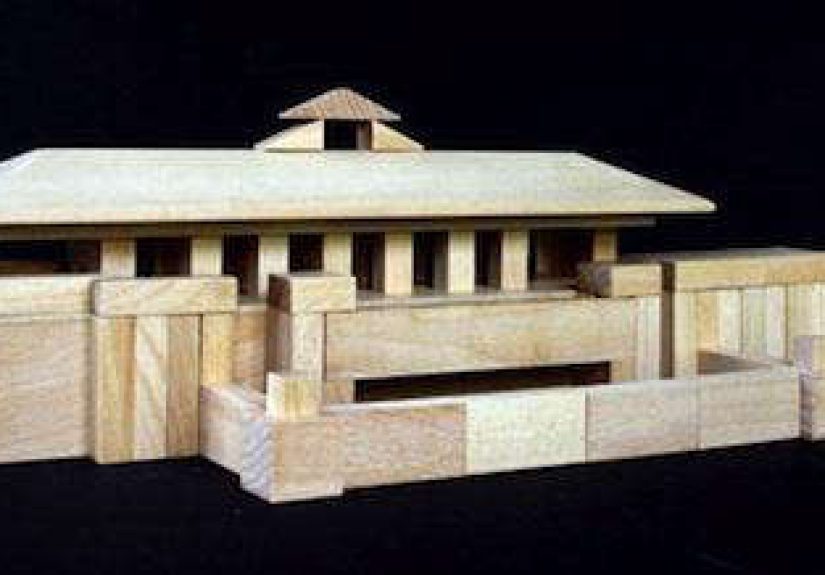
Prairie House Blocks are a wooden construction block set inspired by the Prairie House design tradition, especially the architecture associated with Frank Lloyd Wright. The set is commonly described as containing 68 wooden blocks, along with a box and lid. The pieces are made to be arranged into a Prairie-style house form, and the set typically includes an instruction sheet with information about Wright, the design, and how to assemble and store the blocks.
One of the most interesting details is that the blocks are connected in size and material to Froebel Gifts, the educational building materials that influenced many designers and thinkers. Froebel blocks were originally developed as part of a kindergarten learning system that encouraged children to understand form, pattern, symmetry, proportion, and spatial relationships through play. In other words, before STEM toys had shiny packaging and acronyms, wooden blocks were already quietly doing the job.
Prairie House Blocks are often appreciated by two very different audiences. The first group includes children, families, and educators who want a hands-on building toy that develops patience, creativity, and spatial thinking. The second group includes architecture lovers and collectors who see the set as a miniature tribute to one of America’s most important design movements. It is a toy, yesbut it is also a tiny architectural conversation in a box.
Why the Name “Prairie House” Matters
The word “Prairie” in Prairie House Blocks is not just decorative branding. It points to the Prairie School of architecture, a movement that emerged in the United States in the late 19th and early 20th centuries. Frank Lloyd Wright became the most famous figure associated with the style, and his Prairie homes helped reshape the idea of what an American house could look like.
Before Prairie-style architecture became influential, many homes borrowed heavily from European traditions. Wright and other Prairie School architects wanted something different. They wanted buildings that felt connected to the American landscape, especially the wide, flat, open horizons of the Midwest. The result was a style built around strong horizontal lines, low-pitched roofs, deep overhanging eaves, open interiors, natural materials, and a close relationship between the house and its surroundings.
In a Prairie-style home, the building does not shout, “Look at me, I am taller than your uncle’s fishing story!” Instead, it stretches outward, settles into the land, and creates a sense of calm. Prairie House Blocks capture that idea in miniature. When arranged into a house, the pieces emphasize layers, balance, and horizontal structure rather than tall towers or fantasy castles. That makes the building experience feel more architectural and less like a race to see who can create the tallest wobbling disaster.
Key Prairie-Style Architecture Features Found in the Block Concept
Strong Horizontal Lines
Prairie-style buildings are famous for their horizontal emphasis. Rooflines, window bands, terraces, and wall planes often stretch outward, echoing the flat prairie landscape. In a block set inspired by this style, horizontal stacking becomes more than a construction technique. It becomes part of the design lesson. Builders see how long lines can make a structure feel grounded, stable, and peaceful.
Low, Shelter-Like Roof Forms
Prairie homes often use low-pitched or hipped roofs with wide overhangs. These roof shapes visually press the house toward the earth rather than lifting it upward. With blocks, this idea can be explored through layered roof pieces and balanced arrangements. The roof is not just a lid; it becomes the architectural “hat” that gives the house personality. A Prairie roof says, “I am calm, elegant, and I will keep the rain off your imaginary furniture.”
Open, Integrated Design
Frank Lloyd Wright’s Prairie houses helped popularize more open interior planning. Rooms were often connected visually and spatially, especially around a central hearth or living area. While a wooden block model cannot fully recreate an open floor plan, it can introduce the idea that a house is not only a box with windows. It is a composition of spaces, masses, openings, and relationships.
Natural Materials and Honest Construction
Wooden blocks naturally support the Prairie ideal of material honesty. Wood feels warm, durable, and tactile. It does not need flashing lights to earn attention. The builder feels weight, texture, friction, and balance. This makes Prairie House Blocks especially satisfying compared with plastic toys that snap together instantly. Wooden blocks ask for more care, but they reward that care with a deeper sense of accomplishment.
Educational Benefits of Prairie House Blocks
Prairie House Blocks are not only beautiful; they are useful learning tools. Block play is widely valued because it supports fine motor development, spatial awareness, problem-solving, creativity, patience, and early engineering thinking. Children learn by doing, and building with blocks gives them immediate feedback. If the wall leans, gravity gives a very honest review.
Spatial Reasoning
Spatial reasoning is the ability to understand shapes, positions, relationships, and movement in space. When children build a Prairie-style house, they must think about how pieces fit together, how weight is distributed, and how one layer affects the next. These skills are important for later learning in math, science, architecture, engineering, art, and design.
Problem-Solving Skills
Every block project includes tiny problems. Which piece comes next? Why does this side look uneven? How can the roof stay balanced? Why did the whole thing collapse after one dramatic sneeze? These moments teach children to test, adjust, and try again. That process is far more valuable than simply following a perfect answer key.
Fine Motor Development
Wooden blocks require careful hand control. Picking up, placing, aligning, and balancing small pieces helps develop coordination and finger strength. For younger builders, this kind of play can support important physical development. For older children, it sharpens precision and patience.
Creative Confidence
Even when instructions are included, Prairie House Blocks do not have to be used only one way. After building the suggested house, children can create their own floor plans, walls, courtyards, towers, garages, or highly questionable “architectural experiments.” That freedom matters. It teaches that design is not only about copying a model; it is also about making choices.
Prairie House Blocks for Architecture Lovers
For adults, Prairie House Blocks can be more than a children’s toy. They can work as a collectible, display item, conversation starter, or relaxing desk activity. Fans of Frank Lloyd Wright often appreciate objects that translate his design principles into everyday life. A miniature Prairie house block set offers a hands-on way to understand the geometry behind the style.
Many people know Wright through famous buildings such as Robie House, Fallingwater, Taliesin, or the Guggenheim Museum. Prairie House Blocks connect more specifically to his early residential work, where he developed a new language for American domestic architecture. Instead of simply reading about horizontal lines and overhanging eaves, builders can physically assemble those ideas.
There is also something refreshing about an architectural toy that does not chase speed. Prairie design rewards observation. You notice proportion. You notice rhythm. You notice how a small change in placement can affect the whole composition. This makes the set appealing to designers, teachers, homeschool families, museum shop shoppers, and anyone who secretly enjoys arranging objects until they look “just right.”
How to Use Prairie House Blocks at Home
If you have a set of Prairie House Blocks, begin with a clean, flat surface. A table, low shelf, or smooth floor works well. Since the set may include small parts and is generally intended for children ages five and up, adult supervision is a smart idea, especially with younger builders.
Start by sorting the pieces. Group similar shapes together so the builder can understand the available materials. This is not just tidying; it is design preparation. Architects organize drawings and materials before building. Children can do the same, although their version may include announcing, “This one is important,” while holding a random rectangle.
Next, follow the instruction sheet to build the Prairie house model. Encourage the child to look at the house from multiple angles. Ask questions such as: What makes it look wide? Where does the roof extend? Which pieces make the walls feel strong? These questions turn play into discovery without turning the room into a lecture hall.
After completing the model, invite open-ended building. Challenge the builder to create a new Prairie-inspired house, a museum, a school, or a tiny neighborhood. For older children, add graph paper and ask them to sketch a plan before building. For younger children, simply let them explore balance and shape.
Prairie House Blocks in the Classroom
Teachers can use Prairie House Blocks in lessons about architecture, American history, geometry, design, and engineering. The set is especially useful because it connects a physical activity to a real design movement. Students are not only building a cute house; they are learning how architecture expresses culture, geography, and ideas about living.
A classroom activity might begin with a short introduction to Prairie-style architecture. Students can examine images of Prairie homes and identify common features: horizontal lines, low roofs, overhangs, natural materials, and grouped windows. Then they can use the blocks to build a model that includes at least three of those characteristics.
For a writing extension, students can describe their design choices. Why did they make the roof wide? How did they show horizontal movement? What would the inside of the house feel like? This kind of activity combines visual thinking, hands-on construction, and language skills. It also gives students who may not shine in traditional worksheets a chance to demonstrate understanding in another way.
What Makes Wooden Blocks Different from Modern Building Toys?
Modern building toys can be fantastic, especially magnetic tiles, interlocking bricks, robotics kits, and engineering sets. But wooden blocks offer something uniquely valuable: simplicity. They do not lock together. They do not correct mistakes automatically. They do not glow, beep, or congratulate the builder in a robotic voice.
That simplicity creates a productive challenge. A wooden block structure stands because the builder understands balance well enoughor experiments long enoughto make it stand. The child learns cause and effect through touch. Too much weight on one side? Leaning wall. Uneven base? Collapse. Proper alignment? Success, followed by the proud facial expression of someone who has just solved civilization.
Prairie House Blocks also differ from generic wooden blocks because they point toward a specific architectural style. A standard block set encourages general building. Prairie House Blocks encourage design thinking through a historic lens. That makes them more focused and potentially more meaningful for architecture-themed learning.
Buying and Collecting Considerations
Because Prairie House Blocks may appear through specialty toy shops, museum-related collections, or resale listings, availability can vary. Buyers should check the condition, completeness, age recommendation, and included materials before purchasing. A complete set should ideally include the wooden blocks, storage box or lid, and instruction sheet. For collectors, packaging condition may also matter.
Safety is important. Since the set can include small parts, it is not suitable for children under three. For children around age five and older, adult supervision helps ensure safe and productive play. Wooden toys are durable, but they should still be checked for cracks, splinters, or damaged pieces.
If purchasing for educational use, think about how the set will be used. One set may be ideal for individual or small-group work. A classroom may need multiple sets or a rotation system. If used as a display item, keep it away from moisture and rough handling. Wooden blocks are sturdy, but they are not immune to juice boxes, enthusiastic pets, or the mysterious destructive powers of a backpack.
Specific Examples of Activities with Prairie House Blocks
1. Build the Original Model
Have the builder follow the provided instructions and recreate the intended Prairie house. This teaches sequencing, attention to detail, and patience.
2. Design a Prairie Neighborhood
After building one house, ask the child to create surrounding features such as paths, gardens, garages, or neighboring homes using other blocks or craft materials.
3. Compare Architecture Styles
Show images of a Victorian house, a Colonial house, and a Prairie-style house. Then ask the builder to explain why the Prairie block model looks different.
4. Draw Before Building
Encourage older children to sketch a simple design first. Then they can build from their drawing and compare the plan with the final structure.
5. Balance Challenge
Invite builders to create the widest roof overhang they can without causing collapse. This introduces engineering ideas in a playful way.
Experiences Related to Prairie House Blocks
The first experience many people have with Prairie House Blocks is surprise. They expect a simple wooden toy, but the set often feels more thoughtful than expected. The pieces have a quiet seriousness to them. You open the box, look at the forms, and suddenly the room feels like it needs a drafting table, a lamp, and someone saying, “Let’s discuss the relationship between structure and landscape.” Then a child grabs a block and makes a garage for a dinosaur. Balance restored.
Building with Prairie House Blocks is slower than playing with interlocking bricks. That can feel strange at first. There is no satisfying snap. No instant locking system. No tiny plastic hero waiting to move in. Instead, each piece depends on gravity, alignment, and the builder’s hands. This slower pace can be exactly what makes the experience valuable. It encourages focus. It rewards calm movements. It teaches that some things need to be placed carefully, not forced into position.
One memorable way to use the blocks is as a family weekend activity. An adult can read a short description of Prairie architecture while a child sorts the pieces. Then everyone builds together. The funny part is that adults often become just as invested as children. Someone who claimed they were “only helping” may suddenly be adjusting rooflines with the concentration of a museum restoration expert. Wooden blocks have a sneaky way of turning grown-ups into serious builders.
In a homeschool setting, Prairie House Blocks can become the center of a full mini-unit. A lesson might begin with the American Midwest, continue into Frank Lloyd Wright, move into geometry, and finish with a writing assignment about the completed house. The blocks make abstract ideas visible. Horizontal emphasis is no longer just a phrase in a textbook; it is something the student can create and point to.
In a classroom, the set can encourage teamwork. Students can divide roles: one reads instructions, one sorts pieces, one builds walls, one checks symmetry, and one gives highly dramatic warnings whenever the roof looks unstable. This kind of collaboration helps students practice communication and compromise. It also shows that design is rarely a solo magic trick. Real buildings require teams, plans, revisions, and occasionally someone brave enough to say, “That wall is definitely leaning.”
For collectors, the experience is different but still meaningful. Prairie House Blocks can sit beautifully on a shelf, especially near architecture books or design objects. They represent a small piece of design history, not because they are a building themselves, but because they translate architectural ideas into a touchable format. A collector may appreciate the link between childhood block play, Froebel-inspired learning, and Wright’s lifelong interest in geometry and form.
Another enjoyable experience is rebuilding the house after time away from it. Unlike many toys that lose charm after the first use, wooden blocks invite repetition. The same model can feel different depending on the builder’s age, patience, and attention. A child who once stacked randomly may later notice symmetry. An adult who once followed instructions may later experiment with original Prairie-style variations. The set grows with the user because design thinking grows with practice.
The most valuable experience, however, may be the moment of collapse. Yes, collapse. When a carefully placed roof slides off or a wall tips over, the builder learns something. Not in a discouraging way, but in the honest language of materials. The structure gives feedback. Try a wider base. Move the weight inward. Align the pieces. That is engineering in its simplest form. Prairie House Blocks make failure feel normal, useful, and even funny. After all, every great architect has probably muttered at a model at least once.
Conclusion: Why Prairie House Blocks Still Feel Fresh
Prairie House Blocks combine the warmth of wooden toys with the intelligence of architectural design. They are simple enough for children to enjoy, yet rich enough for adults to appreciate. By connecting block play with Prairie-style architecture, the set offers more than entertainment. It introduces ideas about proportion, balance, landscape, history, and creative problem-solving.
In a world crowded with noisy toys and blinking screens, Prairie House Blocks feel refreshingly grounded. They invite builders to slow down, observe, adjust, and create. They remind us that play can be beautiful, learning can be hands-on, and a small wooden house can carry a surprisingly big design story.
Note: This HTML article is original, written in standard American English, and synthesized from real information about Prairie House Blocks, Prairie-style architecture, wooden construction toys, and hands-on educational play. No source links or citation placeholders are included inside the publishable body content.