Table of Contents >> Show >> Hide
- First, Figure Out What Kind of Festival Wristband You Have
- When You Should Not Try to Remove It Yourself
- How to Loosen a Festival Wristband Safely
- How to Remove a Festival Wristband Without Destroying It
- When Cutting the Wristband Is the Right Call
- What Festivals Usually Say About Wristband Tampering
- How to Avoid This Problem Next Time
- Common Mistakes People Make
- Final Thoughts
- Festival Wristband Experiences: The Funny, the Annoying, and the Very Real
- SEO Tags
There are two kinds of festival people: the ones who carefully save every wristband like a tiny fabric trophy, and the ones who realize at 11:47 p.m. on Monday that their wrist now has the social life of a locked bicycle. If your festival wristband is suddenly too tight, itchy, annoying, or just ready to retire, don’t panic. Most bands can be loosened or removed safely, but the right method depends on what kind of wristband you’re wearing and whether the event is still going on.
That last part matters. A lot. Some festival wristbands are designed to prevent sharing, swapping, or sneaky hand-offs. So before you start wrestling it like you’re in the final round of a reality show, check whether your event is still active. If the festival isn’t over, the smartest move is often to go to official wristband assistance instead of trying to outsmart a plastic lock with kitchen-table engineering.
Still, if the show is over, or you simply need relief because the band is uncomfortable, there are several ways to loosen and remove a festival wristband without turning your hand into a DIY disaster. This guide breaks down what works, what doesn’t, and when to stop trying to save the band and just cut the thing off with dignity.
First, Figure Out What Kind of Festival Wristband You Have
Before you try any removal trick, identify the material and clasp. Festival wristbands are not all built the same, and treating them like identical cousins is how people end up frustrated.
Cloth or fabric wristbands
These are common at multi-day music festivals. They usually have a plastic barrel-style or sliding lock. They’re durable, water-resistant, and designed to stay on. The good news is that these are often the easiest to loosen if the lock design gives you any room to work with.
Plastic or vinyl wristbands
These can be tougher because they don’t flex as nicely as cloth. They’re built for security, not comfort after day three of dancing in the sun. Some can be removed with friction-reducing methods, but others really want to stay married to your wrist.
Tyvek or paper-like wristbands
These are usually used for short events. They often have tamper-evident adhesive closures, which means they’re meant to tear or visibly damage if you try to remove and reapply them. Translation: if you want to save one intact, you may be out of luck.
RFID wristbands
Some festival bands also handle entry, cashless payments, or VIP access. These may look simple, but they can be part ticket, wallet, and identity badge all at once. That’s another reason not to mess with them while the event is still happening.
When You Should Not Try to Remove It Yourself
Let’s start with the boring but useful truth: not every wristband problem should be solved at home with a straw and heroic optimism.
Do not try DIY removal if:
- The festival is still in progress and the wristband is your entry credential.
- Your wristband feels dangerously tight and your hand is going numb, cold, swollen, or discolored.
- The band includes payment or access functions you still need.
- You are tempted to use a sharp metal tool right next to your skin. That idea is not bold. It is bad.
If the wristband is painfully tight, official festival support is often the safest option. Many events have replacement procedures for tightened or damaged wristbands, though they may verify your order and charge a replacement fee. Annoying? Yes. Better than losing circulation? Also yes.
How to Loosen a Festival Wristband Safely
If your goal is to create a little more space rather than fully remove the band, start with the least aggressive method and move up slowly. The golden rule is simple: don’t yank. Pulling hard often makes a one-way clasp grip even tighter.
1. Try the twist method for cloth wristbands
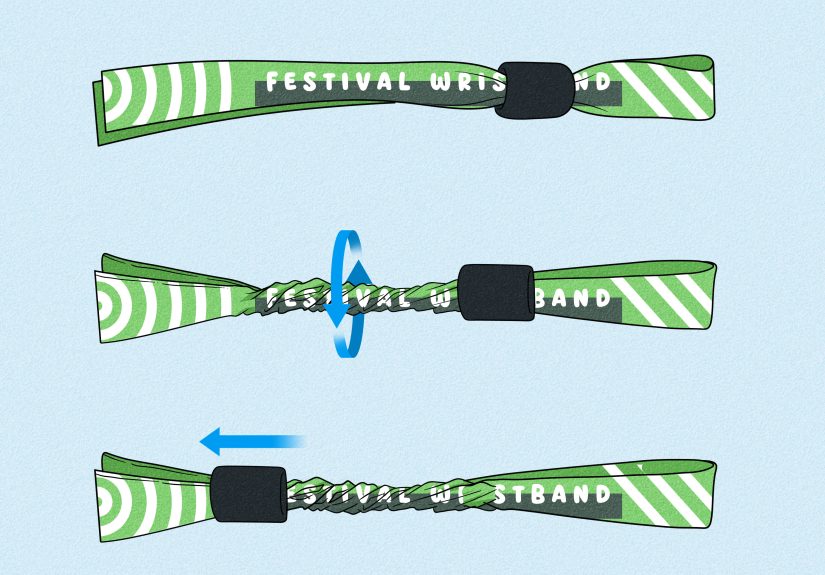
This is the classic trick for fabric festival wristbands with plastic sliding locks. Twist the loose ends of the cloth together until they become a tight rope. That tighter shape can sometimes help the fabric slip backward through the lock’s internal teeth.
Once the fabric is tightly twisted, gently work the plastic lock backward. Don’t jerk it. Don’t try to win with violence. Slow pressure is the whole game here. If it moves even a little, keep going in small increments until you have enough slack to slide the band off or at least make it comfortable.
This method is best for cloth bands that still have a bit of flexibility. If the fabric is wet, stiff, or badly frayed, it may be more stubborn.
2. Use the straw method when the lock has teeth
If the wristband has a plastic lock with tiny internal teeth, a straw can sometimes help lift or bypass that grip. Cut a small section of a drinking straw and slit it lengthwise so you can open it slightly. Then twist the loose tail ends of the wristband and carefully guide the straw between the fabric and the lock.
The goal is to give the fabric a smoother path and reduce the lock’s bite long enough to slide it back. This takes patience and a little finger dexterity. In other words, this is not the task to attempt after four hours of sleep and two iced coffees.
If the straw buckles immediately, try a sturdier one. If the lock refuses to budge, stop before you shred the band or scrape your skin.
3. Try the plastic bag method to reduce friction
This is one of the gentlest removal methods, especially if the wristband isn’t overly tight but just won’t slide over your hand. Put your hand inside a thin plastic bag, then pull part of the bag under the wristband. The slick surface reduces friction between your skin and the band.
Now gently pull the bag while easing the wristband toward your knuckles. Sometimes the band will roll over the bag and come right off. This works well for plastic, vinyl, and even some cloth wristbands. It’s surprisingly effective for a method that sounds like something invented in a grocery store parking lot.
4. Add a little lubrication
When friction is the real enemy, lubrication can help. A small amount of liquid soap, lotion, or gentle oil around the wrist and clasp can make the band easier to slide. Use a light hand here. You want “helpful glide,” not “wristband buttered like toast.”
This method is especially useful when the band can technically fit over your hand but gets stuck around the thumb or knuckles. After applying the lubricant, twist and wiggle the band slowly as you pull. Wipe everything down afterward so you don’t end up dropping your phone five seconds later.
5. Ask for another set of hands
Some wristbands are hard to loosen simply because the angle is awkward. A friend can stabilize the clasp while you twist the band, or vice versa. This is one of those rare life moments when saying “Can you help me get this bracelet off?” is both practical and not remotely romantic.
Just make sure your helper understands the mission: gentle, careful, and patient. Not “Let’s see what happens if I pull really hard.”
How to Remove a Festival Wristband Without Destroying It
If you want to save the wristband as a souvenir, work from most reversible to least reversible.
- Try the twist method first.
- Move to the straw method if there’s a toothed plastic lock.
- Use the plastic bag method if the issue is friction.
- Add a bit of soap or lotion if the band almost fits over your hand.
- Take breaks so you don’t tighten it further out of frustration.
What you shouldn’t do is jam a knife, pin, screwdriver, or random metal gadget into the clasp while it’s still on your wrist. The internet is full of brave-looking hacks that quietly assume nobody minds a trip to urgent care. Be smarter than the thumbnail.
When Cutting the Wristband Is the Right Call
Sometimes the cleanest solution is also the least dramatic: cut it off. If the wristband is painfully tight, the clasp won’t move, or the material is clearly designed for one-time use, cutting is often the safest option.
How to cut it safely
- Slide a spoon, butter knife handle, cardboard strip, or folded paper between the band and your skin as a barrier.
- Use blunt-tip scissors if possible.
- Cut away from your wrist, not toward it.
- Snip the fabric or material first rather than fighting the clasp.
- Stop if you can’t see clearly or the band is pulled too tightly against the skin.
For Tyvek or adhesive wristbands, cutting or tearing may be the only realistic removal method. These bands are often intentionally made to show visible damage if someone tries to remove and reuse them.
What Festivals Usually Say About Wristband Tampering
Festival organizers are not being dramatic when they warn people not to mess with wristbands. Many events state that wristbands are non-transferable, must be worn securely, and may be void if stretched, tampered with, or removed during a multi-day event. That means a successful DIY removal can still become a failed entry attempt later.
In plain English: if the festival isn’t over, don’t treat your wristband like a friendship bracelet from summer camp. Treat it like your ticket, because it probably is.
If you accidentally tightened it too much before the event, check your festival’s wristband assistance or box office policy. In many cases, there is an official replacement path if you bring the damaged or tightened band, your order confirmation, and ID.
How to Avoid This Problem Next Time
The best festival wristband removal trick is prevention. Revolutionary, I know.
Leave a little room
When putting on a cloth festival wristband, tighten it snugly enough to stay secure, but not so tight that it hugs your pulse like it pays rent there.
Register it before tightening
If your event requires wristband registration, do that first. Once some bands are tightened, reversing the decision is about as easy as un-toasting bread.
Don’t “test fit” a one-way lock days early
Many festival help centers explicitly warn people not to put wristbands on before the event because the clasp may lock permanently into place. Curiosity is understandable. Regret is predictable.
Know the material
Cloth bands are usually the best candidates for keepsake removal. Tyvek and other adhesive bands are generally not sentimental objects; they are tiny security devices dressed as accessories.
Common Mistakes People Make
- Pulling harder when the band gets tighter: this usually makes the clasp grip more.
- Using sharp metal tools: dangerous and unnecessary.
- Ignoring numbness or swelling: comfort and circulation come first.
- Trying to preserve every band at all costs: sometimes the memory survives just fine without the bracelet.
- Forgetting the festival is still active: removing a valid band can cause bigger problems than the tightness itself.
Final Thoughts
If you need to loosen and remove a festival wristband, start by identifying the band type and deciding whether you actually should remove it yet. Cloth wristbands with plastic locks respond best to the twist and straw methods. Plastic and vinyl bands often do well with the plastic bag method. Tight-but-removable bands may slide off more easily with a touch of soap or lotion. And adhesive or tamper-evident bands are often best handled with scissors and a calm attitude.
The big lesson is that festival wristbands are built to stay put. That is literally their job. So patience matters, safety matters more, and preserving the band matters least if your wrist is uncomfortable or your circulation looks questionable. No souvenir is worth turning your hand into a tomato.
And if all else fails, cut the band, keep the story, and tell everyone it came off after an epic weekend rather than a 27-minute struggle in your kitchen. Nobody needs the full documentary.
Festival Wristband Experiences: The Funny, the Annoying, and the Very Real
Anyone who has worn a festival wristband for more than a day knows that the experience gets weirdly personal. At first, it feels exciting. You get the band in the mail, hold it like a golden ticket, and suddenly the festival feels real. You imagine the music, the crowds, the overpriced lemonade, and the friend who will absolutely say, “We’re leaving in five minutes,” then still be looking for glitter an hour later.
Then the wristband goes on, and everything changes. During the event, it feels cool in a low-stakes “I belong here” kind of way. It gets scanned at the gate, survives sunscreen, sweat, spilled drinks, and one suspiciously aggressive hand wash in a portable restroom. By day two, it starts to feel less like an accessory and more like a tiny roommate.
For some people, the band becomes a badge of honor. They wear it for days after the festival ends because taking it off feels like admitting real life has returned. You go back to emails, grocery lists, and laundry, but the wristband says, “Actually, last weekend I was dancing under lights and pretending sleep was optional.” That’s why so many people try to remove cloth bands without cutting them. They’re not just saving fabric. They’re saving the feeling.
Other people have the opposite experience. Somewhere around the trip home, the wristband becomes unbearably annoying. It catches on hoodie sleeves, rubs during sleep, and somehow gets wetter after the festival than during it. You start noticing it while typing, cooking, or shampooing your hair. Suddenly, this little symbol of freedom feels like it’s running a tiny dictatorship on your wrist.
Then comes the removal drama. Everyone has a story. Someone used a straw. Someone used a plastic bag. Someone enlisted two roommates, a lamp, and the concentration of a bomb squad. Someone gave up after ten minutes and cut it off while muttering, “The memory still counts.” All of these are normal. Festival wristbands have an uncanny ability to turn otherwise reasonable adults into amateur escape artists.
And honestly, that’s part of the charm. The wristband starts as a ticket, becomes part of the experience, and ends as either a souvenir or a lesson in patience. If you save it, it might end up in a memory box, on a bulletin board, or looped around a mirror with old passes and backstage stickers. If you cut it off, you still keep the best part: the story behind it.
That’s why people care so much about how to loosen and remove a festival wristband. It’s never just about the band. It’s about holding onto a weekend that felt bigger, louder, and brighter than normal life. The little strip of fabric or plastic is proof that, for a few days, your biggest problem was whether to catch the next set or buy fries first. And frankly, that’s a beautiful problem to remember.