Table of Contents >> Show >> Hide
- Who Are the Frecce Tricolori?
- The Magic of a Frecce Tricolori Flyover
- Preparing to Photograph the Flyover
- What It Felt Like When the Formation Arrived
- Why the Frecce Tricolori Are So Photogenic
- Common Mistakes When Photographing a Flyover
- Editing the Frecce Tricolori Photos
- What I Learned From Photographing the Frecce Tricolori
- Extra Experience: My Personal Takeaway From the Frecce Tricolori Flyover
- Conclusion
Some aviation moments politely ask for your attention. Others roar across the sky in a ten-jet formation, paint the clouds green, white, and red, and make every camera in the crowd suddenly feel underqualified. Photographing the Frecce Tricolori flyover was very much the second kind.
The Frecce Tricolori, Italy’s national aerobatic team, are not just another group of fast jets making dramatic noise for the benefit of people with folding chairs and sunscreen. Officially known as the Pattuglia Acrobatica Nazionale, or 313th Acrobatic Training Group, they represent the Italian Air Force with a style that feels equal parts precision engineering, national pride, and aerial theater. Their signature smoke trails are instantly recognizable, and when they appear overhead, the sky stops being background and becomes the main event.
This article is part photography story, part aviation appreciation, and part practical guide for anyone who has ever pointed a camera at a flyover and discovered that jets move faster than human optimism. If you are interested in Frecce Tricolori photography, airshow photography tips, aviation flyover experiences, or simply want to know what it feels like to capture the Italian tricolor in the sky, welcome aboard. Seat belts are optional, but a fast shutter speed is strongly recommended.
Who Are the Frecce Tricolori?
The name “Frecce Tricolori” translates to “Tricolor Arrows,” and it fits beautifully. The team is famous for performing in large, graceful formations while releasing smoke in the colors of the Italian flag. Based at Rivolto Air Base in northeastern Italy, the team has become one of the most recognizable aerobatic units in the world.
Unlike many military demonstration teams that use six aircraft, the Frecce Tricolori are known for flying a larger formation, traditionally using nine aircraft plus a solo pilot. That “9+1” structure gives their display a distinctive rhythm: broad, elegant formation passes followed by a solo aircraft slicing through the air with the confidence of someone who has never once lost a lens cap.
The aircraft most commonly associated with the team is the Aermacchi MB-339PAN, a two-seat jet trainer adapted for aerobatic display work. It is not the newest or loudest jet in the world, but that is part of its charm. The MB-339PAN gives the Frecce Tricolori a graceful visual character. The aircraft look sleek in formation, respond beautifully to coordinated maneuvers, and produce the long, flowing smoke lines that make photographers reach for continuous burst mode like it is a life raft.
The Magic of a Frecce Tricolori Flyover
A flyover is different from a full airshow performance. It is shorter, more compressed, and often more dependent on timing, location, and luck. You may have only a few seconds to frame the shot, track the aircraft, expose correctly, and avoid accidentally photographing a confused pigeon instead of ten Italian jets.
But that briefness is exactly what makes a flyover thrilling. There is a build-up: distant engine noise, heads turning, phones rising, and then the formation appears. With the Frecce Tricolori, the arrival is especially cinematic. The aircraft move as one shape, and then the smoke blooms behind them like a national flag being drawn across the sky in real time.
During their North American appearances in 2024, the team drew attention across major U.S. and Canadian locations, including flyovers and airshow stops connected with cultural events, aviation celebrations, and public displays. For many American spectators, it was a rare chance to see Italy’s famed aerobatic team in person. For photographers, it was a chance to test whether their autofocus system was truly a trusted friend or merely someone they once met at a camera store.
Preparing to Photograph the Flyover
The first rule of photographing any flyover is simple: know where the aircraft are expected to appear. The second rule is more painful: they will still somehow surprise you.
Before heading out, I checked the planned route, watched the sky direction, noted the sun position, and tried to choose a spot that gave me both an open view and a recognizable foreground. A flyover photo can be technically sharp but emotionally flat if it shows only aircraft against empty blue sky. Adding a bridge, skyline, monument, waterfront, or crowd reaction gives the image context. The jets tell the story, but the setting gives it a home address.
Camera Gear That Helps
You do not need the most expensive camera in the universe to photograph the Frecce Tricolori, though owning one may give you the confidence of a wildlife photographer stalking a very aerodynamic bird. A camera with reliable autofocus, a fast burst rate, and a telephoto lens is ideal. A zoom lens in the range of 100-400mm or 150-600mm can be excellent for tight aircraft shots, while a 70-200mm lens works well when the formation is large or when you want to include landscape.
For a flyover, flexibility matters. Jets may appear closer or farther away than expected, and if your lens is too long, you may end up with a beautiful, sharp photo of one aircraft’s tail while the rest of the formation escapes your frame like unpaid interns. A zoom lens gives you a fighting chance.
Suggested Camera Settings
For jets, a fast shutter speed is usually your best friend. I prefer starting around 1/1600 or 1/2000 second for sharp formation shots, especially when the aircraft are crossing the frame quickly. Aperture can sit around f/5.6 to f/8, depending on available light. Auto ISO is useful because the brightness can change quickly when you pan from open sky toward buildings, water, or haze.
Continuous autofocus is essential. Use a tracking mode that can follow moving subjects, and set your camera to high-speed continuous shooting. This is not the time for single-shot photography unless you enjoy gambling with your own happiness.
What It Felt Like When the Formation Arrived
The first thing I noticed was the sound. It did not explode into the scene all at once. It grew, low and layered, until everyone around me seemed to realize the same thing at the same time: they were coming.
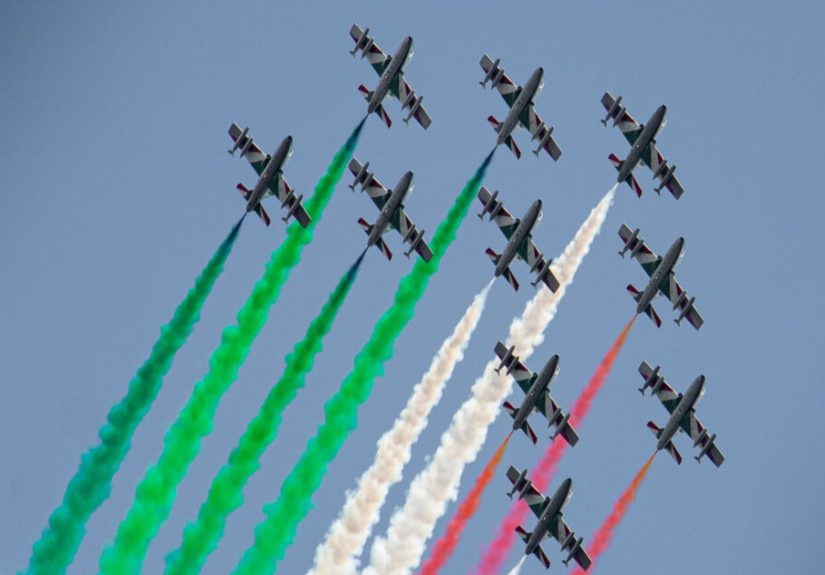
Then the formation appeared, clean and tight, with the aircraft arranged like a flying signature. The smoke started to stretch behind them, and the colors separated clearly against the sky. Green on one side, red on the other, white in the middlethe Italian flag translated into motion.
Photographing that moment was strangely physical. My shoulders tightened, my left hand locked under the lens, and my right index finger suddenly developed the work ethic of a caffeinated woodpecker. I tracked the formation through the viewfinder, trying not to overthink. With aviation photography, hesitation is expensive. The aircraft do not circle back because you were checking your histogram.
The best frame came when the smoke had fully developed but had not yet begun to dissolve. That is the sweet spot. Too early, and the smoke looks thin. Too late, and it becomes a soft cloud of patriotic spaghetti. When everything lines upthe formation, the light, the smoke, the backgroundyou feel it immediately. Even before reviewing the image, you know you caught something worth keeping.
Why the Frecce Tricolori Are So Photogenic
Some aircraft demonstrations are about power. Others are about speed. The Frecce Tricolori are about composition. Their performances naturally create lines, symmetry, curves, and color fields. For photographers, that means every pass offers a different visual problem to solve.
The smoke is the obvious gift. It gives motion a visible trail, allowing the viewer to see where the aircraft have been, not just where they are. That turns a still image into a record of movement. In a strong Frecce Tricolori photo, the aircraft are only part of the subject. The real subject is the path they carve through the air.
The formation size also matters. Ten aircraft create scale. A single jet can look dramatic, but a large formation looks ceremonial. It feels like an event, not just a pass. When photographed well, the Frecce Tricolori can make a city skyline look like a stage and the sky look freshly decorated for a national holiday.
Common Mistakes When Photographing a Flyover
The most common mistake is zooming in too tightly too soon. It is tempting to fill the frame with aircraft, but a flyover often works best when the viewer can understand where it happened. Leave room for smoke, movement, and environment.
Another mistake is forgetting exposure compensation. Bright sky can trick your camera meter, especially when white smoke is involved. If the aircraft look too dark, add a little positive exposure compensation. If the smoke is blown out, pull it back slightly. The goal is to protect detail without making the jets vanish into silhouette.
Finally, do not spend the entire flyover looking at the back of the camera. This is the classic rookie trap. You take one photo, review it, feel proud, and then miss the best pass while admiring your own genius. Shoot first. Celebrate later.
Editing the Frecce Tricolori Photos
Post-processing aviation photos should enhance the moment, not turn it into a science fiction poster unless that is the assignment. For my Frecce Tricolori flyover images, I focused on clarity, contrast, highlight recovery, and color balance. The goal was to keep the smoke vivid while preserving a natural sky.
A small crop helped strengthen the composition, especially in frames where the formation sat too close to the center. I also cleaned up minor distractions, such as tiny dust spots and distant birds. Birds are charming in real life; in aviation photos, they often look like sensor dirt with wings.
The key is restraint. The Frecce Tricolori already bring the drama. Oversaturating the smoke or over-sharpening the aircraft can make the image feel artificial. A good edit should make the viewer feel closer to the moment, not suspicious of it.
What I Learned From Photographing the Frecce Tricolori
Photographing the Frecce Tricolori taught me that aviation photography rewards preparation but still leaves room for surprise. You can know the route, set the camera perfectly, and plan your composition, yet the final image depends on timing, weather, light, and that tiny human ability to react quickly when the sky suddenly becomes interesting.
It also reminded me that great aviation photography is not only about aircraft. It is about atmosphere. The crowd looking up, the sound arriving before the jets, the smoke hanging over buildings, the brief silence after the formation disappearsthose details matter. They are what turn a technically good image into a memory.
Extra Experience: My Personal Takeaway From the Frecce Tricolori Flyover
After the flyover ended, I did what every photographer does after an intense shoot: I pretended to calmly review my images while internally negotiating with the photography gods. Some frames were too wide. Some were too tight. In one image, I had achieved perfect focus on absolutely nothing of importance, which is a humbling genre of art.
But a few shots worked. One frame showed the formation moving diagonally across the sky, smoke trailing in clean color bands. Another caught the jets just as the smoke began to curve and soften, giving the whole image a sense of motion. My favorite photo was not the sharpest one. It was the one that felt most alive.
That is an important lesson. When photographing a rare flyover like the Frecce Tricolori, technical perfection is wonderful, but emotional accuracy matters too. A slightly imperfect photo can still carry the feeling of the day: the noise, the excitement, the crowd reaction, the split-second shock of seeing ten aircraft draw a flag across the clouds.
If I could do it again, I would arrive earlier, scout two backup locations, and bring a second camera body with a wider lens. I would also take more photos of the crowd before and after the flyover. At the time, I was focused almost entirely on the aircraft, which is understandable. They were, after all, the very loud Italian stars of the show. But the human side of the event deserves attention too.
People react beautifully to flyovers. Some point. Some cheer. Some simply stand still, smiling upward. Children often notice the smoke before they fully understand the aircraft. Adults suddenly become aviation experts for approximately forty-five seconds. Someone nearby will always say, “Here they come,” even after everyone has already heard them. These small moments add warmth to the story.
The Frecce Tricolori flyover also made me appreciate the difference between watching and photographing. Watching lets you absorb the whole scene. Photographing forces you to make choices. You choose a focal length, a shutter speed, a frame, a moment. You miss some things in order to capture others. That trade-off is both frustrating and beautiful.
When I finally put the camera down, the smoke was already spreading into soft pastel streaks. The jets were gone, but the sky still held the memory of their path. That lingering smoke may be my favorite part of the entire experience. It is the visual echo after the sound fades, the final brushstroke after the aircraft leave the canvas.
Photographing the Frecce Tricolori flyover was not just about getting a good aviation image. It was about witnessing a rare combination of discipline, culture, engineering, and spectacle. It was about trying to freeze a moment designed to disappear. And yes, it was also about discovering that my camera buffer fills up much faster when ten Italian jets are involved.
Conclusion
Photographing the Frecce Tricolori flyover was one of those experiences that reminds you why photography matters. A flyover lasts only moments, but a strong photograph can hold the sound, color, and excitement long after the sky clears.
The Frecce Tricolori are uniquely rewarding subjects because they combine precision formation flying with unmistakable visual beauty. Their red, white, and green smoke trails are more than decoration; they are part of the story. For aviation photographers, they offer movement, symmetry, scale, and emotion in one breathtaking package.
Whether you are an experienced aviation photographer or someone preparing for your first airshow, the lesson is simple: plan carefully, shoot generously, stay flexible, and do not forget to actually enjoy the moment. The best Frecce Tricolori photo is not always the one with the longest lens or the sharpest pixels. Sometimes it is the image that makes you hear the engines again.
Note: This article is based on real public information about the Frecce Tricolori, their aircraft, their aerobatic identity, their North American appearances, and practical aviation photography guidance. It is written as an original, web-ready SEO article without copied source text.