Table of Contents >> Show >> Hide
- What This Post Is (and Isn’t)
- How I Made the Street Fighter-Style AI Portraits
- The 14 Pics: World Leaders Reimagined as Street Fighter Fighters
- Pic #1: “The Deal Maker” (Donald T.)
- Pic #2: “The Steady Counter” (Joe B.)
- Pic #3: “Hope Shoto” (Barack O.)
- Pic #4: “The Red Dragon Strategist” (Xi J.)
- Pic #5: “The Iron Clincher” (Vladimir P.)
- Pic #6: “The Unbreakable Rushdown” (Volodymyr Z.)
- Pic #7: “The Iron Will Anchor” (Narendra M.)
- Pic #8: “The Velvet Fencer” (Emmanuel M.)
- Pic #9: “Northern Guard” (Justin T.)
- Pic #10: “The Chancellor of Counters” (Angela M.)
- Pic #11: “The Iron Premier” (Giorgia M.)
- Pic #12: “The Calm Technician” (Rishi S.)
- Pic #13: “The Commission Commander” (Ursula V.)
- Pic #14: “The Wild Card Libertador” (Javier M.)
- Why Street Fighter Is the Perfect Style for Political Parody
- AI Ethics: How to Keep This Kind of Content Fun (Not Harmful)
- Prompt Engineering Tips That Actually Help (Without Turning You Into a Robot)
- Conclusion
- My AI Street Fighter Portrait Experiment: 10 Things I Learned the Hard Way (Experience Notes)
Somewhere between my third cup of coffee and my seventh “why did it give him three elbows” render, I had a realization: global politics is basically a fighting game already. Everyone has a signature stance, a rival, a dramatic entrance, and that one move they spam even when it’s clearly punishable.
So I did what any responsible adult would doI turned a roster of world leaders into Street Fighter-style characters using AI. Not as “realistic deepfakes,” not as misinformation, and definitely not as a serious attempt at diplomacy (please don’t @ the UN). Think of it as a playful crossover episode: big personalities reimagined as bold silhouettes, comic-book shading, and dramatic special moves.
The goal was simple: capture the energy of classic Street Fighter character designiconic poses, readable shapes, and just enough exaggeration to make you say, “Yep, I’d main that character,” even if you have no idea what their actual policy platform is.
What This Post Is (and Isn’t)
It is: AI-generated parody art inspired by fighting game aesthetics, with a focus on style consistency, character archetypes, and responsible sharing.
It isn’t: an attempt to mislead anyone into thinking these are real photos, official posters, or leaked game assets. Each image is a stylized illustration, and the write-ups are intentionally tongue-in-cheek.
How I Made the Street Fighter-Style AI Portraits
To keep this project grounded in real design ideas (and not just “AI, please make it cool”), I studied a mix of U.S.-based sources across three buckets: fighting game design commentary, generative AI practices, and synthetic media safety/labeling discussions. For the game side, I leaned on Capcom USA’s own explanations of Street Fighter 6 systems plus major U.S. reviews and features that break down why the game feels modern, readable, and approachable. For the AI side, I referenced U.S. discussions and standards around provenance and deepfakesespecially the ongoing push for metadata, watermarking, and “nutrition-label” style disclosures for synthetic media.
The Workflow (No Sorcery, Just Iteration)
- Pick a fighter archetype first. In Street Fighter terms: shoto, grappler, zoner, rushdown, charge character, tricky setplay gremlin, or final-boss energy. This decides pose, silhouette, and “move vocabulary.”
- Lock the visual language. Consistent lighting, bold outlines, painterly shading, high-contrast color blocking, subtle halftone/grain, and “arena-ready” costumes that look like they come with an absurd backstory.
- Prompt for design rules, not vibes. Instead of “make it badass,” I wrote constraints: camera angle, line weight, cloth texture, emblem placement, glove style, and how the character’s stance should communicate their gameplan.
- Do an “identity check.” If the face drifted into generic-anime-protagonist territory, I dialed it back. If it became too photoreal, I pushed it back toward illustration.
- Label and share responsibly. The internet is already swimming in synthetic media; it costs nothing to add clarity.
SEO Note (Yes, I’m That Person)
If you found this post by searching things like “AI Street Fighter characters,” “world leaders AI art,” “Street Fighter style portraits,” or “generative AI parody illustrations”welcome. You’re among friends. Slightly chaotic friends, but still.
The 14 Pics: World Leaders Reimagined as Street Fighter Fighters
Below is the gallery. Each “pic” includes a quick fighter concept: archetype, signature moves, and the kind of personality that would absolutely get a dramatic announcer intro.
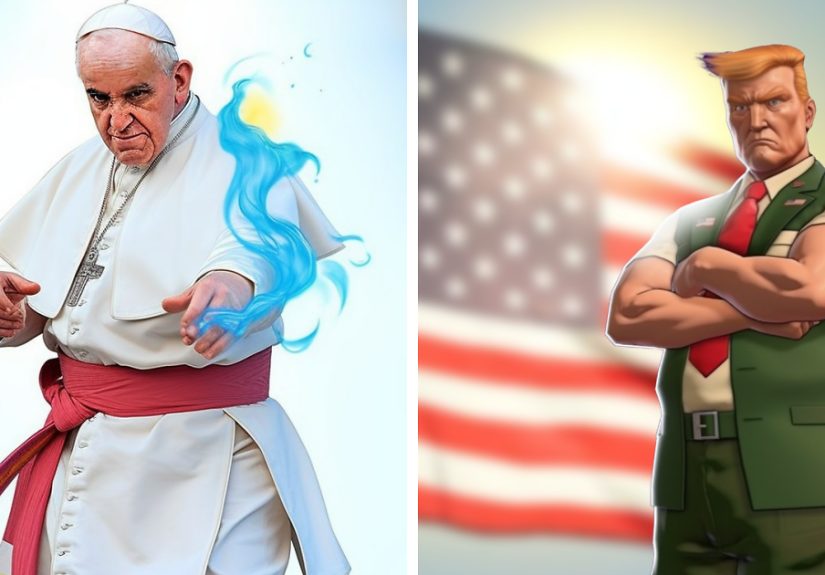
Pic #1: “The Deal Maker” (Donald T.)

Archetype: Zoner with gimmicks (wins neutral, loses friendships).
Signature Moves: Press Conference Palm, Gold-Plated Projectile, Spin Cycle Rebuttal.
The visual trick here was balancing satire with readability. Street Fighter designs are loud on purposebig shapes, strong “read” from a distance. So I leaned into the performer vibe: a stance that says “I’m center stage,” plus effects that look like they were invented in a marketing meeting.
Pic #2: “The Steady Counter” (Joe B.)

Archetype: Defensive counter-puncher.
Signature Moves: Union Upper, Incumbent Interrupt, Oval Office Overhead.
This one was all about timing. Counter characters in fighting games feel patient, almost boring… until you blink, press a button, and explode. So the design had to look “safe” while still reading as dangerous.
Pic #3: “Hope Shoto” (Barack O.)

Archetype: Shoto (the honest fundamentals character everyone respects… and still complains about).
Signature Moves: Rhetoric Hadoken, Pivot Shoryuken, Bipartisan Dash.
Shotos are the Street Fighter comfort food: simple tools, high skill ceiling, and eternal online discourse. The design focuses on a heroic profile, readable gloves, and that “I can do everything if I’m played well” energy.
Pic #4: “The Red Dragon Strategist” (Xi J.)

Archetype: Methodical midrange controller.
Signature Moves: Banner Barrage, Directive Palm, Firewall Feint.
This character concept was about “pressure without speed.” In Street Fighter terms: you feel cornered even in the middle of the stage, because every step forward costs you a resource you didn’t know you had.
Pic #5: “The Iron Clincher” (Vladimir P.)

Archetype: Grappler / bruiser.
Signature Moves: Cold Grip Command Throw, Bear Trap Backbreaker, Sanction Slam.
Grapplers need exaggerated proportionsbig shoulders, thick forearms, boots that look like they weigh as much as a small refrigerator. That’s how you communicate “don’t get close” without a single word.
Pic #6: “The Unbreakable Rushdown” (Volodymyr Z.)

Archetype: Rushdown with morale buffs.
Signature Moves: Frontline Flurry, Resolve Rekka, Stand Tall Super.
Rushdown characters should look like they’re already moving. The pose does half the work: hips forward, heels light, hands up. If the silhouette doesn’t feel fast, the character doesn’t feel fastno matter how many particle effects you throw at it.
Pic #7: “The Iron Will Anchor” (Narendra M.)

Archetype: Stance-based anchor (slow start, huge payoff).
Signature Moves: Mandate Mantle, Iron Stance Shift, Coalition Crush.
This concept uses the “anchored” visual language: feet planted, weight low, shoulders relaxed. In fighting games, that’s the body language of someone who isn’t reactingeveryone else is reacting to them.
Pic #8: “The Velvet Fencer” (Emmanuel M.)

Archetype: Footsies specialist.
Signature Moves: Debate Thrust, Euro Step Kick, Protocol Parry.
Some characters win by being annoying in the most refined way possible. The costume sells the idea: crisp lines, minimal clutter, and a stance that says, “I’ve already read your input.”
Pic #9: “Northern Guard” (Justin T.)

Archetype: Balanced all-rounder with safe specials.
Signature Moves: Snowline Strike, Apology Cancel, Maple Leaf Launcher.
All-rounders should look like they have answers. Not necessarily the best answersjust enough to keep you honest. The vibe is “solid fundamentals, decent hair physics.”
Pic #10: “The Chancellor of Counters” (Angela M.)

Archetype: Defensive whiff-punisher.
Signature Moves: Coalition Counter, Budget Block, Stability Super.
Not every fighter needs fireworks. Some fighters win by not losing. This design intentionally avoids excessive flair so that the animations (and the imagined frame data) do the flexing.
Pic #11: “The Iron Premier” (Giorgia M.)

Archetype: Pressure character with plus frames (in spirit).
Signature Moves: Capitol Crescent, Policy Pressure String, Iron Resolve V-Trigger.
Street Fighter characters often telegraph their gameplan through shapes. This one uses strong diagonals and a “step-in” pose, so you can feel the offense before the first punch lands.
Pic #12: “The Calm Technician” (Rishi S.)

Archetype: Technical, resource-managed fighter.
Signature Moves: Fiscal Feint, Ledger Low Kick, Cabinet Combo Route.
Some characters are “honest.” Some are “broken.” This one is “optimized.” The pose is small, tight, and efficientlike a fighter whose special move is reading patch notes before you do.
Pic #13: “The Commission Commander” (Ursula V.)

Archetype: Summoner / setplay planner.
Signature Moves: Directive Drone, Regulation Ring Trap, Summit Super.
Setplay characters are the chess players of the roster. The costume leans “command” rather than “chaos,” but the kit idea is pure gremlin: place a thing, move you into it, profit.
Pic #14: “The Wild Card Libertador” (Javier M.)

Archetype: High-risk, high-reward wildcard.
Signature Moves: Volatility Vortex, Shock Therapy Strike, Anarcho Upper.
Every fighting game roster has a character that feels like a dare. This is that character. You either dominate and look like a genius, or you explode and your opponent posts a clip titled “THIS IS WHY YOU DON’T MAIN HIM.”
Why Street Fighter Is the Perfect Style for Political Parody
Street Fighter has always been about readability: strong silhouettes, instantly recognizable personalities, and moves that broadcast intent. That’s why it’s such a good canvas for satire. You can communicate “the showman,” “the strategist,” “the bulldozer,” or “the technician” in one framebefore you even invent the fake move names.
Modern Street Fighter design also leans into bold, contemporary visual culturespray-paint energy, graphic shapes, and larger-than-life swagger. It’s a style that naturally supports modern internet humor: posters, memes, character-select screens, and “leaked roster” jokes that everybody knows are fake… but still wants to believe.
AI Ethics: How to Keep This Kind of Content Fun (Not Harmful)
If you’re making AI-generated portraits of public figures, there’s a line between parody art and misleading synthetic media. The internet doesn’t need more confusion. So here’s the playbook I followed:
1) Make the Style Obviously Illustrated
Photoreal is where things get messy. I pushed these toward “video game key art” on purpose: painterly shading, bold outlines, stylized proportions, and effects that scream “fiction.” If it could be mistaken for a real photo, it’s not a joke anymoreit’s a problem.
2) Label It Like a Grown-Up
A simple caption“AI-generated parody illustration”goes a long way. There’s a broader industry conversation about provenance metadata and content labeling (including “digital nutrition label” approaches). But even without fancy tools, plain language still works.
3) Don’t Put Words in People’s Mouths
The safest satire is visual exaggeration, not fabricated quotes. I avoided anything that looked like a real endorsement, fake news screenshot, or “caught on camera” moment. These are fighters, not “evidence.”
4) Respect the Difference Between Comedy and Harassment
The punchline should be the concept (leaders as fighting game characters), not cruelty. No dehumanizing edits, no attacks on protected traits, no “look how hideous” framing. Street Fighter is about charismaeven the villains have stage presence.
Prompt Engineering Tips That Actually Help (Without Turning You Into a Robot)
If you want consistent Street Fighter-style AI art, stop prompting like you’re ordering at a drive-thru. Give the model rules: lighting, composition, line weight, and texture. Here are a few examples of the kinds of constraints that improved my results:
Example Prompt Pattern
Style block: “stylized fighting game key art, bold ink linework, painterly shading, high contrast, subtle halftone grain”
Character block: “iconic stance, readable silhouette, costume with strong shapes, tournament-ready gloves and boots”
Camera block: “3/4 view, waist-up hero framing, dramatic rim light, background: abstract arena lights”
Safety block: “illustration, not photoreal, no text overlays, no real logos”
The secret is that you’re not “telling the AI what to do,” you’re building a tiny art director inside the prompt. A picky art director. The kind who would absolutely say, “This is great, but can we make the shoulders 12% more ‘final boss’?”
Conclusion
Turning world leaders into Street Fighter characters is sillyand that’s the point. It’s a reminder that style, symbolism, and storytelling shape how we interpret public figures, whether we’re watching a debate, doomscrolling a meme, or yelling “THAT WAS PLUS!” at a fictional politician on a fictional stage.
If you share this kind of AI art, keep it clearly illustrated, clearly labeled, and clearly meant for humor. The internet already has enough confusion. Let your “fake roster leak” be the harmless kindthe kind that makes someone smile, not panic-text their group chat.
My AI Street Fighter Portrait Experiment: 10 Things I Learned the Hard Way (Experience Notes)
I promised myself this would be a quick weekend project. Fourteen images, a few punchy captions, maybe a victory lap. That was adorable. What I actually did was enter a time loop where the only units of measurement were “renders,” “re-rolls,” and “why is the neck doing that?”
First lesson: consistency is harder than creativity. Getting one cool image is easy. Getting fourteen images that look like they belong in the same game? That’s where you start acting like an exhausted art director. I ended up keeping a “style contract” for myself: same lighting angle, same outline thickness, same kind of painterly shading, and a strict “no accidental photorealism” rule. Anytime an image started looking like a real photo wearing a cosplay budget, I pushed it back into illustration with stronger linework and bolder shapes.
Second lesson: silhouette is everything. Street Fighter characters are readable from across the room. Even if you don’t know their name, you know who the grappler is and who the speed demon is. When a design felt bland, I didn’t add more detailsI changed the pose. A forward lean makes a rushdown character feel fast. A wide stance makes a grappler feel heavy. A relaxed posture with hands ready makes a counter character feel patient and terrifying. Once the pose worked, the costume fell into place instead of fighting me like an unpaid intern.
Third lesson: AI loves “generic cool” unless you stop it. If you don’t specify design constraints, it will happily hand you the same handsome-face, symmetrical-jacket, vague-hero-energy character fourteen timeslike a fighting game roster designed by a committee afraid of opinions. So I forced variety with archetype rules: one elegant footsies specialist, one bruiser, one trickster, one setplay planner, one “honest shoto,” one chaos pick. The archetype decision made the rest of the prompt smarter.
Fourth lesson: the funniest part is naming the moves. The images are the hook, but move names are where the joke lands. I found it worked best when the move name sounded like it could be real Street Fighter terminologytwo or three punchy words, a little dramatic, and just specific enough to be ridiculous. “Protocol Parry” feels like an actual mechanic. “Maple Leaf Launcher” feels like a DLC move that would absolutely get nerfed. If the name made me snort-laugh, I kept it.
Fifth lesson: responsible sharing is not optional anymore. It’s easy to treat AI images as “just jokes,” but it takes almost zero extra effort to label them clearly and keep the style obviously illustrated. I avoided fake headlines, avoided “caught on camera” realism, and avoided putting text in anyone’s mouth. The point was character design parody, not confusion. If someone had to squint to understand it was fiction, I considered that a design failurenot a clever trick.
Finally, the most surprising lesson: this whole experiment made me appreciate why Street Fighter design is so iconic. It’s not just muscles and fireballs. It’s storytelling through shape, posture, and attitude. When the AI got it right, the character felt like they had a gameplay plan before I even wrote the move list. And when it got it wrong, no amount of sparks, smoke, or dramatic lighting could save it. Which, honestly, is also true of real politicsminus the health bar. Usually.