Table of Contents >> Show >> Hide
- What Is the Odderon?
- Why the Discovery Matters
- How Scientists Found Evidence of the Odderon
- Why It Took Nearly 50 Years
- Is the Odderon a New Particle?
- What This Tells Us About the Strong Force
- Specific Example: The “Dip and Bump” Clue
- What the Discovery Does Not Mean
- What Comes Next for Odderon Research?
- Why Ordinary Readers Should Care
- Experience-Based Reflections: What This Discovery Feels Like in the Real World
- Conclusion
- SEO Tags
Particle physics has a talent for making humans wait. Some discoveries arrive like fireworks. Others take nearly half a century, several generations of scientists, a circular machine the size of a small city, and enough data to make your laptop quietly leave the room. The odderon belongs firmly in the second category.
For decades, physicists suspected that a strange, elusive object made from gluonsthe particles that carry the strong forceshould exist. It was proposed in the early 1970s, when quantum chromodynamics, or QCD, was becoming the language scientists use to describe how quarks and gluons behave inside protons and neutrons. But proposing a particle-like state in theory is one thing. Catching its fingerprints inside high-energy collisions is another. That is where the Large Hadron Collider, better known as the LHC, comes in.
Scientists working with the TOTEM experiment at CERN’s LHC reported evidence for the odderon by studying some of the cleanest and most delicate collisions in particle physics: elastic proton-proton scattering. Later, the TOTEM collaboration and the DØ collaboration at Fermilab strengthened the case by comparing proton-proton collisions with proton-antiproton collisions. The result gave physicists what they had been chasing for nearly 50 years: convincing evidence that the odderon is real.
What Is the Odderon?
The odderon is not a particle in the familiar “tiny billiard ball” sense. It is better understood as a short-lived exchange state involving an odd number of gluons, most commonly described as a color-neutral three-gluon compound. If that sounds like physics trying to win a Scrabble tournament, here is the simpler version: the odderon is a subtle signature of how the strong force behaves when protons skim past one another at extremely high energy.
Gluons are the carriers of the strong force, the force that binds quarks together inside protons and neutrons. Unlike photons, which carry the electromagnetic force but do not carry electric charge themselves, gluons carry the “color charge” of the strong interaction. That means gluons can interact with other gluons. In the particle world, this is like glue that can glue itself, which is both scientifically profound and a little rude to anyone trying to make the math easy.
The odderon was predicted in 1973 by theorists Leszek Łukaszuk and Basarab Nicolescu. It was expected to appear as a difference between proton-proton and proton-antiproton scattering at high energies. For years, experiments hinted at something unusual, but the evidence was not strong enough to call it a discovery. The LHC changed the game by producing proton collisions at energies and precision levels earlier physicists could only dream about.
Why the Discovery Matters
The discovery of evidence for the odderon matters because it tests quantum chromodynamics, one of the most important parts of the Standard Model of particle physics. The Standard Model explains the known elementary particles and three of the four fundamental forces: electromagnetism, the weak force, and the strong force. Gravity, as usual, did not RSVP to the party.
QCD is especially difficult because the strong force gets complicated fast. Quarks and gluons are confined inside larger particles, meaning scientists cannot simply pull out a gluon, set it on a table, and say, “There it is.” Instead, physicists must infer what gluons are doing from collision patterns, scattering angles, energy distributions, and mathematical comparisons between different types of particle interactions.
The odderon provides a rare window into the deeper behavior of gluons. It supports the idea that gluons can combine into colorless states without quarks. That is a big deal because ordinary matter is built from quarks bound by gluons, but the odderon suggests that the strong force has its own rich internal architecture. In other words, the glue has a life of its own.
How Scientists Found Evidence of the Odderon
The Role of the LHC and TOTEM
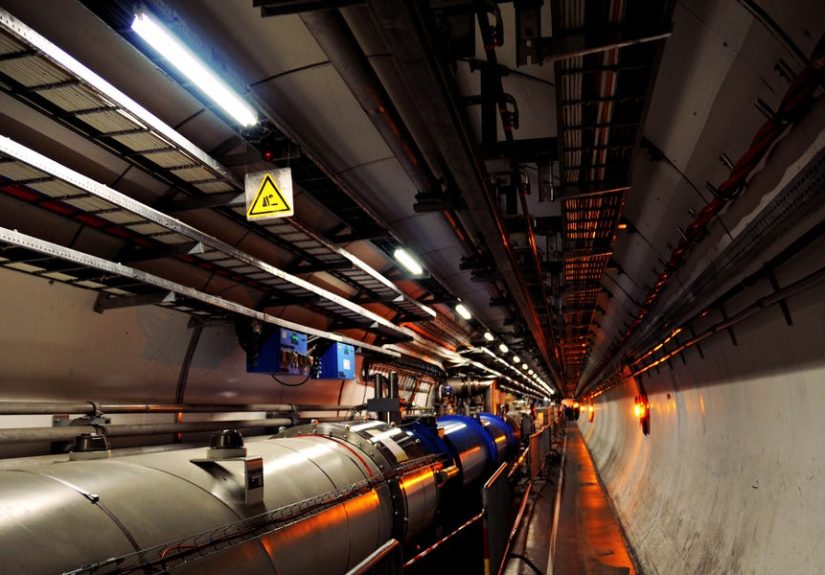
The Large Hadron Collider is the world’s largest and most powerful particle accelerator. It sits in a circular tunnel about 17 miles long beneath the border of France and Switzerland. Inside, beams of protons are accelerated to nearly the speed of light before being smashed together. Most LHC headlines focus on dramatic particle creation, such as the Higgs boson. But the odderon hunt depended on something quieter: protons that survive the encounter.
The TOTEM experiment was designed to study total cross sections, elastic scattering, and diffraction at the LHC. In elastic scattering, two protons interact but remain intact after the collision. They do not explode into sprays of new particles. Instead, they glance off each other, exchanging momentum and revealing information about the forces between them.
To detect these near-miss events, TOTEM uses special detectors called Roman pots. These devices can move extremely close to the LHC beamline to catch protons that have scattered at tiny angles. Think of them as scientific butterfly nets placed next to one of the most energetic proton highways on Earth. Very expensive butterfly nets, naturally.
Proton-Proton vs. Proton-Antiproton Collisions
The strongest evidence came from comparing two kinds of elastic scattering. TOTEM measured proton-proton collisions at the LHC, while the DØ experiment at Fermilab’s former Tevatron collider measured proton-antiproton collisions. If only the traditional even-gluon exchange, often associated with the pomeron, were involved, the patterns should have looked more similar after careful energy adjustments.
But they did not. Scientists saw meaningful differences in the differential cross sections, especially around the “dip” and “bump” regions of the scattering pattern. Those differences are exactly the kind of behavior expected from the odderon, which contributes an odd-gluon exchange. By combining LHC and Tevatron data, researchers could compare the behavior of matter-matter and matter-antimatter scattering in a way that was not possible with one collider alone.
Why It Took Nearly 50 Years
The odderon was not hiding because physicists forgot to look. It was hiding because the signal is extremely subtle. The effect appears in precise differences between scattering patterns, not as a bright new particle track announcing itself like a celebrity entering a restaurant.
There were three major challenges. First, scientists needed very high collision energies where secondary effects would fade and the odderon signal could stand out. Second, they needed detectors capable of measuring protons scattered at extremely small angles. Third, they needed enough data and statistical confidence to show the pattern was not a fluke, a modeling artifact, or the universe playing one of its less charming practical jokes.
The LHC supplied the energy and precision. Fermilab’s DØ experiment supplied crucial proton-antiproton comparison data. Together, the two experiments turned a long-standing theoretical prediction into an experimental milestone.
Is the Odderon a New Particle?
Calling the odderon a “particle” is useful for headlines, but it needs a little care. The odderon is not like an electron, which is a stable elementary particle. It is not like the Higgs boson either, which is a particle associated with the Higgs field. The odderon is better described as a compound gluonic exchange or a quasiparticle-like state that appears in high-energy scattering.
Still, the excitement is justified. The odderon is a long-predicted object in the theory of the strong force. Its observation confirms that odd-numbered gluon exchanges can leave measurable marks in real experiments. That gives scientists another tool for probing QCD, the internal structure of protons, and the behavior of matter at the smallest accessible scales.
What This Tells Us About the Strong Force
The strong force is the most powerful of the fundamental forces at subatomic distances. It binds quarks into protons and neutrons, then helps bind those particles into atomic nuclei. Without it, atoms would not exist, chemistry would not exist, and coffee would not exist. Clearly, this force deserves respect.
But the strong force is also famously difficult to calculate. At short distances, quarks and gluons can behave in ways that are easier to describe mathematically. At larger subatomic distances, the force becomes so intense that quarks and gluons remain confined inside composite particles. This is why physicists rely heavily on experiments like TOTEM to test the theory.
The odderon matters because it confirms that QCD allows more than simple quark-and-gluon binding inside familiar particles. It shows that gluons can create complex exchange structures that affect how protons scatter. That may not change your morning commute, but it deepens our understanding of why matter behaves the way it does.
Specific Example: The “Dip and Bump” Clue
One of the clearest ways to understand the odderon evidence is through the shape of elastic scattering data. When scientists plot how often protons scatter at different momentum transfers, the graph has features known as dips and bumps. These are not decorative. They are fingerprints of the forces and quantum exchanges involved in the collision.
In proton-proton scattering at LHC energies, TOTEM observed a pattern that differed from proton-antiproton scattering measured by DØ at Fermilab. After researchers adjusted the data for comparison, the mismatch remained significant. That difference pointed toward an exchange that behaves differently for matter-matter and matter-antimatter interactions. The odderon fits that role.
In everyday terms, imagine rolling two identical balls toward each other and then rolling a ball toward its mirror-image opposite. If the bounce patterns differ in a precise, repeatable way, you learn something about the invisible interaction between them. Particle physicists do the same thing, except their “balls” are protons, their “bounce patterns” are differential cross sections, and their equipment costs more than a luxury yacht fleet.
What the Discovery Does Not Mean
The odderon discovery does not mean the Standard Model has been overthrown. It does not prove time travel, open a portal, or explain why printer ink costs so much. Instead, it strengthens part of the Standard Model by confirming a difficult prediction of QCD.
That is important because not every major physics discovery needs to break the existing theory. Some of the most valuable discoveries show that a theory works in places where it had not been fully tested. The odderon is one of those discoveries. It tells scientists that the strong force behaves in a richer and more subtle way than many people outside the field ever imagined.
What Comes Next for Odderon Research?
Future studies may refine the odderon measurement, test competing models, and explore whether other gluon-rich states can be observed. Physicists are also interested in glueballs, hypothetical particles made entirely of gluons. The odderon does not automatically prove every gluonic state exists, but it makes the search more exciting.
As the LHC continues to collect data and future collider plans evolve, researchers will keep testing the strong force with higher precision. Better measurements may reveal how often odderon exchange occurs, how it changes with energy, and how it fits into the larger map of QCD phenomena.
Why Ordinary Readers Should Care
It is fair to ask why anyone outside particle physics should care about a three-gluon exchange state discovered through elastic scattering data. The answer is that fundamental science expands the boundary of human knowledge. The same curiosity that leads scientists to understand protons also leads to technologies in medicine, computing, imaging, materials science, and data analysis.
Particle physics has a long history of producing tools that later become useful in unexpected ways. The World Wide Web itself was developed at CERN to help scientists share information. Particle detectors have influenced medical imaging. Accelerator technologies support cancer treatment and materials research. The odderon may not become a household gadget, but the scientific ecosystem that found it has already changed the world.
Experience-Based Reflections: What This Discovery Feels Like in the Real World
For anyone who has followed science news for years, the odderon discovery feels different from the instant thrill of a headline like “new planet found” or “new dinosaur had weird elbows.” It is slower, quieter, and more deeply satisfying. It is the kind of discovery that rewards patience. Nearly 50 years passed between prediction and compelling experimental evidence, which makes the story feel less like a lightning bolt and more like a long detective case where every clue had to survive cross-examination.
One experience many science writers and readers share is the challenge of explaining why “evidence” and “discovery” are not always the same thing. In everyday conversation, evidence often means “good enough for me.” In particle physics, evidence has a stricter meaning. Researchers work with statistical significance, systematic uncertainties, model comparisons, detector performance, and independent confirmation. That careful language can seem cautious, but it is one of science’s greatest strengths. It prevents excitement from outrunning reality.
The odderon story is also a reminder that modern science is collaborative. No single genius walked into a lab, pushed a shiny red button, and found the odderon before lunch. The work involved international teams, decades of theoretical development, highly specialized detectors, and data from more than one accelerator. The LHC’s TOTEM experiment and Fermilab’s DØ experiment each supplied essential pieces of the puzzle. That kind of cooperation is not always glamorous, but it is how big discoveries usually happen.
There is also a human lesson here: some ideas need the right technology before they can be tested. In 1973, theorists could describe the odderon mathematically, but the experimental tools were not yet powerful enough to reveal it clearly. That gap between imagination and measurement appears throughout science. People dream up possibilities, then engineers and experimentalists spend years building machines precise enough to ask nature whether the dream was correct. Sometimes nature says no. Sometimes, as with the odderon, it gives a subtle but thrilling yes.
For students, this discovery can be especially encouraging. Physics often appears finished in textbooks, as if every important fact has already been polished and placed neatly into chapters. The odderon shows the opposite. Even inside the Standard Model, one of the most tested scientific frameworks ever created, there are still difficult corners to explore. A person learning about quarks, gluons, and scattering today is not merely studying old knowledge; they are stepping into a field that continues to evolve.
For the general public, the odderon is a useful reminder that not every discovery needs to have an immediate consumer application to be valuable. We live in a world that often asks, “But what does it do?” Fundamental physics sometimes answers, “It helps us understand what everything is.” That may not fit neatly on a product label, but it is one of humanity’s oldest and most meaningful goals.
Finally, the odderon story has a wonderfully humbling quality. The matter around us feels solid and familiar. Tables, phones, trees, and coffee mugs seem straightforward. Yet inside every atom is a wild quantum world of fields, forces, particles, and interactions so subtle that it can take half a century to confirm one predicted feature. The next time everyday life feels ordinary, remember: the universe is running advanced particle physics under the hood. And yes, apparently even the glue has secrets.
Conclusion
The first strong evidence for the odderon marks a major achievement in high-energy physics. Proposed nearly 50 years earlier, this elusive three-gluon exchange state helps confirm a subtle prediction of quantum chromodynamics and deepens our understanding of the strong force. By comparing proton-proton data from the LHC’s TOTEM experiment with proton-antiproton data from Fermilab’s DØ experiment, scientists found patterns that point to the odderon’s long-awaited presence.
The discovery is not just a triumph for one experiment or one theory. It is a celebration of patience, precision, and the global scientific effort required to study nature at its smallest scales. The odderon may be odd by name, but in the story of particle physics, it fits beautifully.