Table of Contents >> Show >> Hide
- Why This Story Is Not Just Sci-Fi With a Flag on It
- First, Let’s Fix the Terminology Before It Escapes the Room
- What Russia Would Actually Be Building
- Why the Idea Keeps Coming Back
- The Giant Problems Standing in the Way
- So Is Russia Bluffing, Dreaming, or Building?
- Why the Rest of the World Should Care
- The Experience of Watching a Nuclear Rocket Story Become Real
- Conclusion
For years, the phrase nuclear-powered rocket has lived in the same neighborhood as moon bases, robot butlers, and suspiciously confident PowerPoint slides. It sounds half brilliant, half bananas. But here is the part that makes the story worth taking seriously: Russia has continued talking publicly about nuclear space energy even as its broader space program has stumbled, and the underlying propulsion science is very real. That does not mean a glowing atomic rocket is about to leap off a launch pad next Tuesday. It does mean the idea has moved beyond pure science fiction and into the messier, more believable world of long timelines, engineering trade-offs, and geopolitical ambition.
So, could Russia actually build one? Maybe. But the smartest way to read that question is not, “Will Russia launch a reactor-powered mega-rocket from Earth tomorrow?” It is, “Could Russia eventually field an in-space vehicle that uses a nuclear reactor for propulsion or onboard power?” That version of the question is far more plausible. It is also far more interesting.
Why This Story Is Not Just Sci-Fi With a Flag on It
Russia has not abandoned big talk in space. In recent years, officials have publicly discussed nuclear space energy, future lunar infrastructure, and long-range ambitions that go well beyond routine launches. In 2024, Russian officials said Russia and China were considering a nuclear power unit for a future lunar project, and later reporting said Russia had begun developing a nuclear power unit for that effort. That matters because it shows Moscow is still willing to treat nuclear technology in space as a strategic capability rather than a museum exhibit with Soviet dust on it.
At the same time, the caveats are impossible to ignore. Russia’s Luna-25 mission crashed into the moon in 2023, a painful reminder that space ambition and space execution are not the same thing. The Russian space program has also dealt with delays, industrial strain, and leadership turbulence. In plain English, the country is still pitching giant future plans while occasionally tripping over the present. That tension is exactly why the nuclear rocket story feels so dramatic: the aspiration is enormous, but the record sheet has coffee stains on it.
Still, ambitious governments do not keep using the same theme unless they believe it serves a larger purpose. For Russia, nuclear propulsion and nuclear power in space are about more than engineering flair. They signal prestige, deep-space relevance, and the ability to say, “We are still in this race, thank you very much.”
First, Let’s Fix the Terminology Before It Escapes the Room
When people hear “nuclear rocket,” they often imagine one thing: a standard rocket, but with extra uranium and significantly worse public relations. Real space propulsion is more nuanced. There are two major concepts that dominate serious discussion.
Nuclear Thermal Propulsion
This is the high-thrust option. A reactor heats a propellant, usually hydrogen, and that superheated propellant is pushed out a nozzle to create thrust. The appeal is straightforward: it can offer much higher performance than conventional chemical propulsion, especially for deep-space missions where every kilogram and every day matter. NASA has described nuclear thermal propulsion as providing roughly double the propellant efficiency of top chemical systems. In other words, it is not magic. It is better math.
Nuclear Electric Propulsion
This is the patient genius of the family. Instead of directly heating propellant for big bursts of thrust, a reactor generates electricity. That electricity powers electric thrusters, which produce much lower thrust but can do so very efficiently for long periods. The result is the kind of system that makes mission planners start talking faster and drawing arrows toward Mars, asteroids, and cargo routes around the moon.
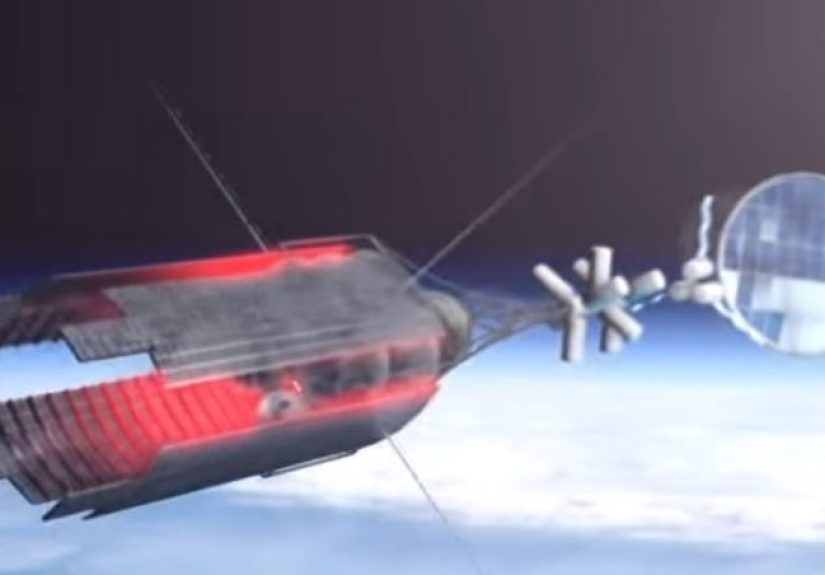
That distinction matters because when Russia is discussed as potentially building a nuclear-powered “rocket,” many analysts think the realistic version looks less like a dramatic launch vehicle and more like an in-space tug, transfer vehicle, or deep-space transport module. In other words, not a hot rod for liftoff, but a long-haul truck for the solar system. Less drag race, more atomic freight train.
What Russia Would Actually Be Building
If Russia ever gets this concept off the drawing board in a serious way, the likely vehicle would be designed for missions that are too demanding for ordinary chemical propulsion to handle elegantly. Think cargo hauling in cislunar space, deep-space repositioning, long-duration exploration support, or moving heavy systems where efficiency matters more than brute-force launch theatrics.
That kind of vehicle would probably not replace the normal rockets that leave Earth. Traditional launch systems are still the practical way to get hardware off the ground. A nuclear-powered spacecraft would more likely be assembled, deployed, or activated in space, where its reactor could provide the energy needed for long missions. This is one reason the idea keeps surviving: it fills a real gap. Chemical rockets are great sprinters. Nuclear systems could become excellent marathoners.
Russia’s interest makes strategic sense in that context. A nuclear-powered transfer vehicle could, in theory, support lunar logistics, heavier science missions, robotic expeditions to the outer solar system, or future crewed architectures that need more flexibility than chemical stages can easily provide. That is the kind of capability states chase when they want influence beyond low Earth orbit.
Why the Idea Keeps Coming Back
Nuclear propulsion never really dies. It just gets rebranded, studied again, budgeted badly, and rediscovered by a new generation of engineers who look at Mars travel times and say, “Surely we can do better than this.” The United States has been through this cycle too. NASA, DARPA, and multiple advisory bodies have spent years evaluating nuclear propulsion because the benefits are not imaginary. Faster missions can reduce crew exposure to radiation and microgravity. Higher efficiency can mean more payload, more flexibility, and fewer painful trade-offs.
That is why Russia’s interest deserves attention even if the timeline remains fuzzy. You do not keep flirting with nuclear propulsion unless the mission cases are compelling. And they are. Space is not just far. It is offensively far. Any technology that promises to move useful mass more efficiently over long distances will keep getting invited back to the table.
There is also a geopolitical reason the idea keeps resurfacing. Space is moving from flags-and-footprints symbolism toward infrastructure. Whoever can move cargo, power habitats, service spacecraft, and support long-duration missions will have an advantage. Nuclear systems are attractive because they touch all of those categories. They are not just engines. They are enablers.
The Giant Problems Standing in the Way
Now for the less glamorous part: this is brutally hard.
Building a nuclear-powered spacecraft means solving a stack of unpleasant engineering problems all at once. You need a reactor that is small enough for spaceflight but robust enough to run reliably. You need fuel and materials that can tolerate extreme temperatures. You need shielding, but not so much shielding that the spacecraft turns into a flying apartment complex made of tungsten. You need heat rejection systems, because in space you cannot just point a radiator at the void and expect miracles. And you need a testing and safety framework that does not make regulators, launch providers, and nearby populations immediately reach for aspirin.
Then comes the programmatic misery. Nuclear propulsion is expensive. It is politically sensitive. It requires long development cycles and a stable industrial base. Even in the United States, where the technical ecosystem is stronger and the documentation tends to arrive in better English, these programs have had stop-start histories. The now-canceled DRACO effort in the U.S. is a useful reminder that even serious programs with serious institutions can hit financial or strategic walls. If Washington struggles, Moscow does not get a free pass from physics or budgets.
That is the real reason skepticism remains healthy. The question is not whether nuclear propulsion works in theory. It does. The question is whether Russia can turn theory, hardware, testing, money, safety, and national will into an operational spacecraft before the schedule slides into the next decade and politely pretends that was always the plan.
So Is Russia Bluffing, Dreaming, or Building?
The honest answer is: a little of all three.
There is clearly an element of strategic messaging in Russia’s repeated emphasis on nuclear space capabilities. Major powers like to project competence, especially in fields with symbolic power. A nuclear-powered space vehicle sounds advanced, intimidating, and future-proof. It is catnip for headlines and a useful reminder that Russia still sees itself as a major space player.
But reducing it all to propaganda would be too simple. The technical logic behind nuclear propulsion is legitimate. Russia also has deep institutional experience in both nuclear technology and space engineering, even if its modern space efforts have been uneven. Countries do not talk this consistently about a concept unless some combination of engineers, planners, and political leaders believes it could eventually pay off.
That means the most realistic position is neither “absolutely happening soon” nor “pure fantasy.” Russia might actually build a nuclear-powered rocket in the sense that it could eventually produce a reactor-powered in-space propulsion vehicle. That is plausible. What is not yet plausible is the breathless version of the story where a fully operational atomic super-rocket appears on a near-term schedule and casually rewrites the space race by the end of the week.
Why the Rest of the World Should Care
This story is not interesting only because Russia is involved. It is interesting because it points toward the next real argument in space policy: who gets to build the transportation layer of deep space? Launching payloads to orbit is no longer the whole game. The next era is about what happens after arrival. How do you move cargo between Earth orbit and lunar orbit? How do you power distant operations? How do you make Mars missions faster, safer, and less absurdly fragile?
Nuclear propulsion sits right in the middle of those questions. If Russia, the United States, China, or anyone else can make it practical, the effect will be bigger than one flashy vehicle. It will change mission design, strategy, logistics, and possibly the political balance of who can operate effectively beyond Earth orbit.
That is why this story keeps resurfacing. It is not really about one machine. It is about the shape of future space power.
The Experience of Watching a Nuclear Rocket Story Become Real
There is something uniquely strange about living through a moment when an idea that once belonged to retro-futurist posters starts sounding practical. A nuclear-powered rocket does that to people. You hear the phrase and your brain splits into two departments. One side says, “That is awesome.” The other side says, “That is probably a terrible meeting with safety regulators.” Both sides are correct.
For space fans, the experience is half thrill and half whiplash. One minute you are reading about reactor designs, electric thrusters, and deep-space cargo transfer. The next minute you are remembering that this is the same world where launch schedules slip, moon missions crash, budgets vanish, and impressive concepts can spend ten years aging quietly in conference presentations. The emotional rhythm of the subject is almost comedic. You move from wonder to caution to optimism to eyebrow raise in a single paragraph.
For engineers, the experience is probably even weirder. Nuclear propulsion is one of those fields where the promise is obvious enough to be motivating and the obstacles are severe enough to ruin your weekend. Every advantage comes with a technical bill attached. Higher efficiency? Wonderful. Now solve materials, reactor control, heat rejection, shielding, mission safety, and public acceptance without blowing the program into fiscal dust. It is the kind of challenge that attracts people who enjoy impossible problems and probably own several notebooks full of alarming diagrams.
For the broader public, the topic taps into a familiar tension in the modern age. We want bold technology, but we also want reassurance. We like moonshots, but preferably moonshots with careful oversight, clear logic, and zero accidental headlines that begin with the phrase “unexpected release.” A nuclear rocket concentrates all of those anxieties into one shiny object. It sounds like progress with a dramatic soundtrack.
And yet, that is exactly why the story matters. Big advances rarely arrive looking cozy. They arrive looking complicated, expensive, controversial, and slightly ahead of the public’s comfort level. The experience of following this topic is really the experience of watching the future negotiate with reality. Ambition says, “We can cut travel times, move heavier cargo, and build a deeper space economy.” Reality says, “Great. Show your work.”
Russia’s role in that story adds another layer. Because the country’s recent space record has been uneven, every ambitious claim lands with a double reaction: intrigue and skepticism. But skepticism is not dismissal. In fact, it is what makes the story compelling. If Russia were obviously capable of deploying a nuclear-powered spacecraft in the near term, the mystery would disappear. If Russia were obviously incapable, the story would collapse into easy mockery. Instead, we are left in the most interesting territory of all: maybe.
And “maybe” is where many important technologies begin. Not with certainty. Not with failure. Just with enough evidence, enough logic, and enough stubborn ambition to keep the idea alive. That is the real experience of a story like this. You are not just reading about a machine. You are watching a civilization decide whether one of its wildest tools is finally worth building.
Conclusion
Russia might actually build a nuclear-powered rocket, but only if we define that phrase correctly and keep our feet on the launchpad of reality. The strongest case is not a conventional launch rocket with atomic swagger. It is an in-space vehicle powered by a reactor, likely aimed at deep-space transport, cargo movement, or long-duration exploration support. That concept is technically credible, strategically meaningful, and still painfully difficult.
So the cleanest verdict is this: the idea is real, the science is real, the ambition is real, and the obstacles are also very, very real. Which means this story deserves neither a laugh nor blind belief. It deserves attention. In space history, that is often how the future starts: as a concept everyone argues about before somebody finally builds the thing.