Table of Contents >> Show >> Hide
- What Defines a Schoolhouse-Inspired Christmas Porch?
- Start With the Architecture, Not the Ornament Bin
- The Best Color Palette for a Vintage Schoolhouse Look
- Layer Greenery Like a Pro
- Essential Decorative Pieces That Nail the Look
- How to Style the Porch in Layers
- Decorating Ideas for Different Porch Sizes
- Common Mistakes to Avoid
- A Sample Porch Formula You Can Copy
- The Experience of a Schoolhouse-Inspired Christmas Porch
- Conclusion
If Christmas had a favorite classroom, it would probably be heated by a crackly stove, trimmed in evergreen, and supervised by a very stylish teacher who believed in neat penmanship and even neater wreath placement. That, in a nutshell, is the charm of schoolhouse inspired vintage Christmas porch decorations. The look feels nostalgic without becoming dusty, festive without becoming loud, and polished without making your porch look like it is trying out for a holiday pageant against its will.
This decorating style borrows from old-school Americana: practical shapes, honest materials, classic symmetry, weathered wood, plaid textiles, iron or brass accents, and greenery that looks like it belongs there instead of like it arrived by freight truck from the North Pole’s trend department. Think lanterns with warm light, sturdy planters filled with winter branches, bells tied with velvet ribbon, a wreath that looks collected rather than fussy, and just enough red to wink at tradition.
The beauty of this style is that it works on almost any porch. A tiny stoop can wear it well. A farmhouse porch can absolutely run with it. A suburban front entry with one lonely doormat and a dream? Also yes. The trick is not to buy every vaguely festive object within a five-mile radius. The trick is to create a porch that looks timeless, welcoming, and a little storybooklike the kind of place where someone might hand you hot cider and ask whether you’ve finished your Christmas cards yet.
What Defines a Schoolhouse-Inspired Christmas Porch?
A schoolhouse-inspired holiday porch is rooted in simplicity and structure. Instead of flashy excess, it leans into pieces that feel useful, collected, and familiar. The overall look should feel grounded, balanced, and warm. If modern holiday décor can sometimes feel like it came with a ring light and a social media manager, this look feels like it came with a stack of old readers, a brass bell, and a pie cooling on the windowsill.
The core design ingredients
- Symmetry: matching urns, paired lanterns, twin mini trees, or balanced swags around a doorway.
- Natural greenery: pine, cedar, magnolia, cypress, eucalyptus, berries, and bare branches.
- Vintage character: old sleds, wooden crates, galvanized buckets, antique-style bells, schoolhouse lights, and worn finishes.
- Classic color: evergreen, deep red, cream, black, warm white, muted gold, and touches of tobacco brown.
- Cozy texture: plaid scarves, grain-sack ribbons, velvet bows, chunky knit throws, and weathered wood.
- Soft lighting: lanterns, candles, window lights, and warm white strands used with restraint.
If you keep those six ingredients in mind, you can build a porch that feels beautifully old-fashioned without drifting into “holiday storage closet exploded at the front door.” That is an important distinction. History is charming. Chaos is just chaos wearing a bow.
Start With the Architecture, Not the Ornament Bin
The smartest vintage Christmas porches look like an extension of the house, not like a seasonal costume. Before you hang anything, stand across the street and actually look at your home. Is it formal and symmetrical? Cozy and cottage-like? Wide and farmhouse-friendly? Narrow and urban? The answer should guide your decorating choices.
A traditional entry with columns begs for balanced décor: matching wreaths, paired lanterns, and structured planters. A cottage porch can handle looser garlands, handmade details, and a more collected feel. A long farmhouse porch has room for layered vignettes, benches, rocking chairs, and clusters of old-fashioned accessories. A small stoop benefits most from one excellent focal point instead of six tiny decorations fighting for attention like cousins at a cookie swap.
In practical terms, this means choosing fewer, larger elements. Oversized wreaths tend to look more intentional than undersized ones. Full planters have more presence than skimpy stems. Lanterns grouped in twos or threes anchor a doorway better than one sad little lantern trying to carry the whole production.
The Best Color Palette for a Vintage Schoolhouse Look
The easiest way to make your porch feel vintage is through color discipline. Schoolhouse style does not need a rainbow of ornaments. It needs a palette that feels rooted in old American interiors and winter landscapes.
A foolproof palette
Start with a base of green, cream, and brown. Then layer in one or two accents such as candy-apple red, black, or muted gold. This creates richness without clutter. A black front door looks especially handsome with magnolia wreaths, brass bells, and red plaid ribbon. A white or cream house pairs beautifully with cedar garlands, weathered wood, and deep green urns. Brick homes look wonderful with velvet ribbon, lantern light, and warm metallic touches.
If you love plaid, this is its moment. Tartan, buffalo check, and wool-inspired patterns instantly add that collected, old-school warmth associated with classic American holiday decorating. Use them sparingly: a scarf around a planter, a ribbon on a wreath, or a throw over a bench. One plaid accent says “timeless.” Eight plaid accents say “the porch is now a lumberjack convention.”
Layer Greenery Like a Pro
Greenery is the backbone of vintage Christmas porch décor. It softens hard edges, connects the house to the winter landscape, and instantly signals that the season has arrived. Best of all, it makes everything else look more expensive, including the lantern you bought on sale and have emotionally upgraded in your mind to “heirloom adjacent.”
Where greenery works best
On the front door: Hang a wreath with classic form and subtle detail. Magnolia leaves, pine, cedar, boxwood, or mixed evergreen all work beautifully. Add a velvet ribbon, jingle bells, dried orange slices, or berry stems for an old-fashioned touch.
Around the door frame: A garland framing the entry creates the strongest visual impact. Keep it full and textural. Add ribbon only in a few intentional spots rather than every twelve inches.
Along railings: If your porch has rails, swag them with greenery instead of tightly wrapping them. That looser, draped look feels older and more graceful.
In planters and urns: Fill containers with evergreen boughs, magnolia leaves, red berries, pinecones, and tall birch branches. This is where the porch starts to feel architectural and complete.
On benches and tables: A simple bundle of cut greens in a crock, old pitcher, or wooden crate adds life without fuss.
The key is variety. Mix broad leaves with feathery branches. Pair glossy magnolia with draping cedar. Add twiggy branches for height. Vintage style is rarely flat. It is layered, tactile, and pleasantly imperfect.
Essential Decorative Pieces That Nail the Look
1. Lanterns with warm light
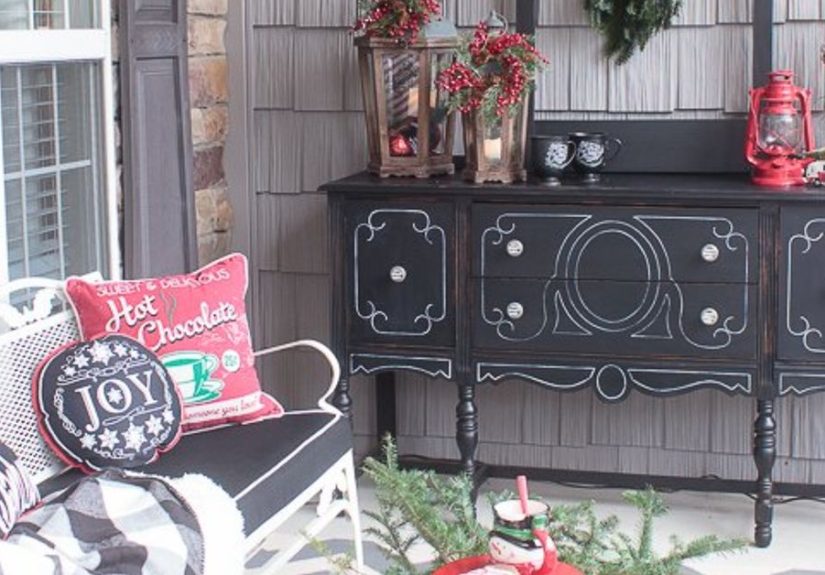
Nothing says “come on in” like lanterns flanking the front door. Black metal lanterns, antique brass finishes, or weathered zinc styles all fit the schoolhouse mood. Use flameless candles for convenience, then tuck in pinecones, bells, or clipped greenery around the base. Grouping lanterns in different heights also works beautifully beside a bench or near steps.
2. Vintage-style bells and ribbons
Oversized bells tied with velvet, ticking stripe, or grain-sack ribbon bring in that antique-school charm. Hang them from the door, a wreath center, the porch light, or even from a hook beside the entry. They feel festive, but also architectural.
3. Old sleds, skates, and wooden crates
If you want obvious vintage personality, add one truly character-filled piece. A weathered sled leaned against the wall, an old crate filled with birch logs, or a pair of old skates tied with ribbon instantly adds story. The rule here is one or two statement pieces, not a historical reenactment of every winter object ever invented.
4. Potted mini trees
Small pines or firs in baskets, crocks, or galvanized pails are perfect for creating that “small-town holiday” feeling. Wrap the bases in burlap, plaid scarves, or old grain sacks for a softer look. On a large porch, use a matching pair. On a small stoop, one great little tree might be all you need.
5. Window candles or soft porch lights
Warm light matters. Skip icy blue bulbs unless your decorating goal is “municipal parking lot in December.” Warm white lights, candlelight glow, and softly lit lanterns all support the nostalgic mood far better. A porch should shimmer, not interrogate.
How to Style the Porch in Layers
Professional-looking porches usually come down to layers. You do not need more stuff. You need better order.
Layer one: the anchor
Choose your strongest focal point. This might be the front door with a bold wreath, a framed garland entry, or a pair of planters. Everything else should support that main feature.
Layer two: the structural pieces
Add lanterns, urns, mini trees, or a bench. These create weight and visual balance. They also keep the porch from feeling like everything is floating at eye level.
Layer three: the personality
Now bring in the fun stuff: a plaid blanket over a rocker, a crate of pinecones, an old sled, a mailbox for Santa letters, a basket of logs, or bells tied with ribbon. These are the details that make the porch feel lived in and memorable.
Layer four: the glow
Add string lights to greenery, lantern candles, or soft window lights. Hide cords carefully and keep the effect subtle. The prettiest porches look magical at dusk, not like they are trying to guide aircraft.
Decorating Ideas for Different Porch Sizes
For a small porch or stoop
Use one large wreath, two lanterns, and one planter or basket tree. Add a neat coir doormat and one ribbon accent. Small spaces do best when every item earns its keep.
For a medium-size porch
Frame the door with garland, add matching urns, and place a bench or rocker on one side with a folded plaid throw. Finish with lanterns and one vintage accent like a sled or crate.
For a large farmhouse-style porch
Create zones. One area might feature the front door and formal greenery. Another could hold a seating vignette with rocking chairs, a wool blanket, and a lantern cluster. A third might include an old sled, mini trees, or a basket of birch logs. Repeating materials keeps the porch cohesive even when the footprint is generous.
Common Mistakes to Avoid
- Using decorations that are too small for the scale of the porch.
- Mixing too many competing themes, such as glam gold, rustic farmhouse, candy cane whimsy, and woodland creatures all at once.
- Overloading the color palette with too many bright tones.
- Ignoring the architecture of the house.
- Using too much ribbon or too many bows.
- Letting cords show everywhere.
- Forgetting that texture often matters more than quantity.
Vintage-inspired decorating works best when it feels collected, not crowded. Leave a little breathing room. Your porch does not need to prove it owns Christmas. It just needs to welcome it beautifully.
A Sample Porch Formula You Can Copy
Want a simple formula that always works? Try this:
- One oversized magnolia or mixed evergreen wreath with a velvet ribbon.
- Two matching urns filled with cedar, pine, birch branches, and berries.
- Two lanterns in different heights with flameless candles.
- One vintage accent, such as a weathered sled or wooden crate.
- One plaid or grain-sack textile detail.
- Warm white string lights tucked into greenery.
That combination feels classic, balanced, and photograph-ready without becoming stiff. It is festive enough for the season, restrained enough to stay elegant, and nostalgic enough to make even the mail carrier pause for a second and think, “Well, this is delightful.”
The Experience of a Schoolhouse-Inspired Christmas Porch
What really makes schoolhouse inspired vintage Christmas porch decorations special is not the wreath itself or the lantern or even the little tree tucked into a basket by the steps. It is the feeling the whole arrangement creates. A good porch does more than look pretty in daylight. It changes the mood of arriving home.
Picture coming back in the late afternoon when the winter sky is already turning blue-gray. The porch light is on, but softly. The lantern candles are flickering. The wreath on the door looks deep and full instead of flashy, and the ribbon has that slightly old-fashioned feel that makes you think of holiday concerts, paper snowflakes, and classroom windows fogged by warm breath. The planters on either side of the door feel sturdy and generous, packed with greens and branches that move just a little when the wind picks up. Nothing is screaming for attention, yet everything feels noticed.
That is the emotional power of this decorating style. It does not rely on spectacle. It relies on memory. It calls up the kinds of holiday moments people tend to treasure most: boots drying by the door, wool coats on hooks, a bell ringing somewhere inside, cinnamon in the air, and the happy chaos of family arriving five minutes early while you are still adjusting the bow on the wreath.
There is also something deeply comforting about the schoolhouse angle specifically. It reminds people of old buildings made to last, of simple craftsmanship, of practical beauty. A porch decorated in this style feels dependable. It looks like the house knows what season it is and is very pleased about it. It says that Christmas does not have to be brand-new to be beautiful. In fact, it is often better when it looks a little worn in, a little loved, and a little rooted in tradition.
Some of the most charming details are the least expensive. A stack of old books on a bench table. A pair of skates found at an antique store. A plaid scarf wrapped around a pot. Bells tied with ribbon that is slightly imperfect because you tied it with cold fingers while balancing on the top step. Those details tell the story. They make the porch feel personal rather than purchased.
And then there is the quiet joy of seeing it at night. A vintage-style Christmas porch has a different rhythm after dark. The greenery becomes shadowy and rich. The warm lights soften the edges of the house. The old sled leaning by the wall looks almost cinematic. Suddenly the whole entry feels less like decoration and more like hospitality. Even if nobody comes over, the porch still does its job. It welcomes you. It turns the ordinary act of getting home into a tiny seasonal ritual.
That may be why so many people return to this look year after year. It is beautiful, yes, but it is also familiar in the best possible way. It feels like a holiday tradition you can step into. Not precious. Not trendy. Just warm, steady, and a little magical. The kind of porch that makes you want to stay outside another minute, listen to the wind in the trees, and admire your handiwork before going in for cocoa and the annual debate over who forgot to buy more tape for wrapping presents.
In the end, that is the goal: not perfection, but presence. A porch that glows. A doorway that feels generous. A decorating style with enough vintage soul to feel meaningful and enough schoolhouse structure to stay crisp. When you get that balance right, your Christmas porch does more than look festive. It feels like home with extra punctuation.
Conclusion
Creating a schoolhouse-inspired vintage Christmas porch is really about editing with heart. Choose decorations that suit your home’s architecture, build around greenery and texture, use warm light generously but carefully, and bring in a handful of nostalgic accents that tell a story. Keep the color palette classic, the scale appropriate, and the mood welcoming. When done well, this style feels timeless because it is built on things that never really go out of season: symmetry, natural materials, warm light, and the irresistible charm of old-fashioned holiday hospitality.
If your porch ends up looking like the front entrance to a charming winter schoolhouse where the teacher definitely kept peppermints in her desk drawer, congratulations. You nailed it.