Table of Contents >> Show >> Hide
- The Viral Coffee Shop Meltdown, In Plain English
- Why This Story Hit Such a Nerve
- The Bigger Problem Was Not the Coffee, It Was the Parenting
- What the Mom Should Have Done Instead
- Why Her Regret Was Basically Guaranteed
- What Everyone Else Can Learn From This Mess
- Related Experiences That Make This Story Feel So Familiar
Some viral stories are funny because they are absurd. Others are funny because they are painfully believable. This coffee-shop tale lands squarely in the middle, wearing sneakers, carrying a sticky toddler handprint, and shouting at the barista while everyone else silently rethinks humanity.
The headline sounds like internet exaggeration, but the reason the story spread so fast is simple: it taps into a very modern nightmare. You order ahead. You pay. You arrive at the handoff counter ready to grab your drink and get on with your day. Then, out of nowhere, a stranger decides your order is apparently a free tasting flight for her children. Suddenly your cold brew is no longer a beverage. It is a social experiment.
At first glance, this is just another “entitled mom” story, the kind that thrives online because it delivers outrage with a side of iced espresso. But there is more going on here than one rude customer and one regrettable gulp of someone else’s drink. The story is really about public boundaries, parenting in plain view, the strange collapse of line etiquette, and the expensive lesson that happens when convenience turns into entitlement.
And yes, there is a little instant karma too. Because sometimes the universe does not send thunderbolts. Sometimes it sends eight shots of espresso in a cup that definitely was not meant for a child.
The Viral Coffee Shop Meltdown, In Plain English
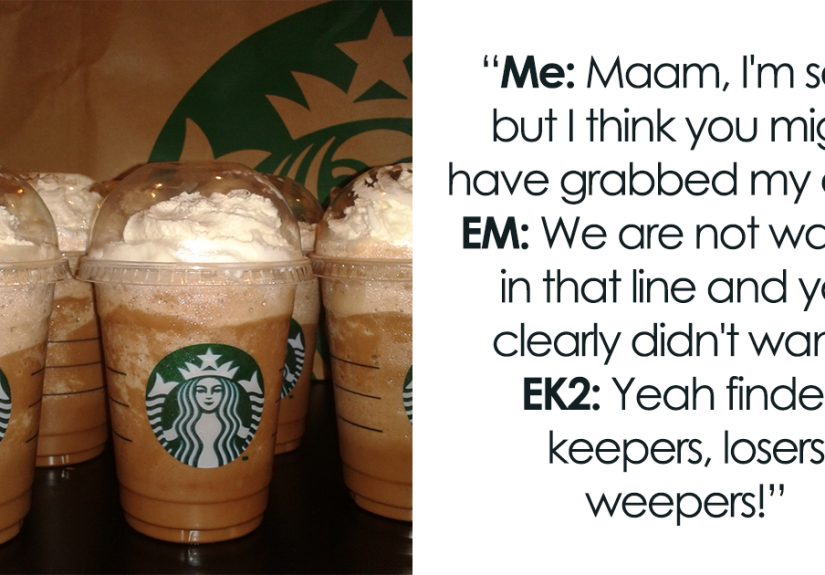
In the now-circulating story, a customer went to pick up a mobile coffee order for coworkers at a Starbucks that was packed and running behind. After waiting, she stepped away briefly, only to return and see another woman carrying off the exact drink tray she knew belonged to her group. The details matched. The names on the cups matched. The audacity, unfortunately, also matched.
When confronted, the mother reportedly argued that the drinks had been “just sitting there,” which in her mind translated to “abandoned” and therefore available for her daughters to sample. She had not even placed an order yet. Her logic was breathtaking in the way only entitlement can be: the line was too long, the kids were thirsty, and they needed to try someone else’s fully paid drinks before deciding what they wanted. In other words, patience had left the building, and it took basic decency with it.
Then came the twist. One of the drinks the children wanted to “taste” looked chocolatey enough to seem kid-friendly, but it was actually a heavy espresso order. The original customer, realizing the mom was committed to bad decisions, stopped arguing and let the lesson unfold. One child took a big gulp, hated it instantly, spilled the drink all over the mother, and triggered the kind of public chaos that makes strangers suddenly become very interested in the ceiling.
The mother then allegedly accused the other customer of trying to poison her child, which is a remarkable accusation to make after demanding access to a stranger’s order in the first place. The barista remade the drink. The mess got cleaned up. The entitled parent stormed off. And the internet, naturally, dined out on the story for years.
Why This Story Hit Such a Nerve
Because line-cutting is civilization’s tiny stress test
Few things make ordinary people feel more instantly united than someone trying to skip a line. Waiting your turn is one of the most boring rules in public life, which is exactly why it matters. It is the small, unglamorous agreement that keeps crowded places from turning into caffeine-fueled jungle law.
Most people can handle a delay. What they hate is watching someone decide that their time matters more than everyone else’s. The mother in this story did not just avoid the line. She tried to outsource the inconvenience of decision-making onto another paying customer. That is elite-level public selfishness. It is not merely rude. It announces, with stunning confidence, that fairness is for other people.
Because the “Karen” label exists for a reason
The internet did not invent rude customers, but it did finally give them a mascot. The “Karen” stereotype has become shorthand for a person who treats service workers and strangers like supporting actors in a one-woman drama titled My Needs Are Urgent and Therefore Sacred. The term can be overused, sure, but stories like this explain why it stuck. The behavior pattern is instantly recognizable: loud demands, invented logic, boundary violations, and a heroic refusal to feel embarrassed until the consequences arrive in a paper cup.
What makes this case especially memorable is that the mother attempted to dress up theft as parenting. She was not stealing, she implied. She was merely helping her children explore beverage options. That is some championship-grade rationalization right there.
Because kids copy the behavior adults normalize
The most uncomfortable part of the story is not the spilled drink. It is the lesson being taught in real time. Children learn from what adults do, not just from what adults say. If a parent models grabbing first, arguing later, children absorb that script with terrifying efficiency.
When kids see a grown-up ignore boundaries, bully workers, and claim other people’s stuff as temporary community property, they do not walk away thinking, “Mother is violating social norms.” They think, “This must be how you get what you want.” That is how entitlement grows legs. First it borrows your fries. Then it steals your latte.
The Bigger Problem Was Not the Coffee, It Was the Parenting
Let’s be fair about one thing: children get restless. Kids get thirsty, impatient, loud, dramatic, and occasionally possessed by the spirit of a raccoon in a snack aisle. None of that is shocking. What matters is how the adult handles it.
A calm parent can turn a long line into a tiny life lesson. “We wait our turn.” “We do not touch things that belong to other people.” “If you are unsure what to order, we can ask nicely.” “No, that is not ours.” These are not revolutionary teachings. They are the plain oatmeal of good parenting: not flashy, but deeply useful.
The mother in this story chose the opposite route. Instead of helping her children tolerate a little uncertainty, she made the uncertainty everyone else’s problem. Instead of teaching respect, she performed entitlement. Instead of modeling self-control, she turned a coffee pickup area into a community theater production of Boundaries Are Optional.
That matters because public parenting is public messaging. Every child nearby, every worker behind the counter, and every tired adult waiting for their order gets a front-row seat to the values on display. Kids notice who says “please.” They notice who grabs. They notice whether frustration becomes a conversation or a tantrum with eyeliner.
There is also the health angle, which makes the whole thing even more ridiculous. Letting children sip a stranger’s mystery drink is not just rude. It is reckless. You do not know what is in the cup. It could contain strong coffee, an allergen, a sugar bomb, or simply ingredients your child hates. Even in the best-case version, you are letting your kid drink from a stranger’s order in a public place. Germs are not exactly famous for minding their own business.
What the Mom Should Have Done Instead
There were about six normal, functional, civilized options available to this woman before she chose chaos. She could have waited in line like everyone else. She could have asked the barista for kid-friendly recommendations. She could have bought one simple drink to split. She could have shown her children the menu and narrowed down choices together. She could have said, “I know you’re thirsty, but we wait our turn.” She could even have left and come back later.
Notice what is missing from that list: stealing other people’s drinks for a live-action taste test.
Customer-service experts say complaints and requests are far more effective when they are clear, calm, and specific. That principle applies here too. If the line is long, you ask for help politely. If your child is overwhelmed, you manage the child. If you are frustrated, you do not convert a stranger’s purchase into a sample platter and then act shocked when reality snaps back.
The most functional parents are not the ones who eliminate every inconvenience. They are the ones who help children survive small inconveniences without becoming tiny dictators. Waiting is a skill. Choosing is a skill. Hearing “no” without collapsing into melodrama is absolutely a skill. Coffee shops are not just places to buy drinks. On a good day, they are accidental classrooms for basic social behavior.
Why Her Regret Was Basically Guaranteed
This story was always headed for disaster because it rested on three bad assumptions. First, the mother assumed that public objects and private purchases are the same thing. Second, she assumed that if she sounded confident enough, other people would surrender to the nonsense. Third, she assumed there would be no cost to crossing a boundary.
That last assumption is where the whole scheme fell apart. Entitlement often survives because people around it are too tired, too busy, or too polite to challenge it. But when reality pushes back, the collapse can be instant. In this case, it came in the form of a child discovering that not every brown drink is chocolate milk in a party outfit.
Her regret was not just about the spill. It was about the public humiliation of being forced to confront the obvious. The drinks were not hers. The line still existed. Her children still needed guidance. And the entire logic chain she used to justify taking someone else’s order turned out to be as sturdy as a wet napkin.
There is also a broader moral here: people who bulldoze boundaries often mistake other people’s restraint for weakness. Then they are stunned when the world refuses to cooperate. Manners may look soft, but they are actually load-bearing. They keep ordinary life from becoming exhausting.
What Everyone Else Can Learn From This Mess
For parents
Teach kids that wanting something does not make it theirs. Teach them that other people’s time matters. Teach them that workers are not obstacles. Teach them that “please,” “thank you,” and “that belongs to someone else” are not old-fashioned phrases. They are social duct tape.
For baristas and service workers
Support matters. One reason this story works so well is that the employee calmly stepped in, identified the rightful order, and refused to let nonsense become policy. Public-facing jobs often require Olympic-level patience, and workers should never be expected to absorb someone else’s parenting failure as part of the beverage experience.
For bystanders
You do not need to escalate every rude moment into a courtroom drama. But there is something deeply useful about staying calm, stating facts, and refusing to be bullied by somebody else’s volume. A lot of entitlement depends on other people folding. When no one folds, the performance gets much less fun for the star.
Related Experiences That Make This Story Feel So Familiar
If this coffee-shop disaster feels oddly believable, that is because versions of it keep popping up anywhere public patience is required. Mobile-order counters, grocery checkout lanes, self-serve snack areas, office refrigerators, school pickup zones, buffet tables, and even neighborhood gatherings all seem to attract the same type of mini-drama: someone decides that rules are suggestions, property is negotiable, and their urgency outranks everybody else’s boundaries.
One common example involves mobile orders getting grabbed by the wrong person. It happens because modern pickup systems depend on a simple idea that should work beautifully in theory: if your name is not on the order, maybe do not take it. Yet customer stories and barista discussions online keep describing drinks being snatched, remade, or mysteriously disappearing from the handoff counter. That does not mean society is collapsing. It does mean honesty is still doing a lot of unpaid labor.
Retail workers also tell remarkably similar stories involving kids opening food before it is paid for while exhausted or inattentive parents act like the laws of ownership have taken the afternoon off. The details change, but the pattern does not. A child bites into something, squeezes a snack pouch, licks a cookie, or grabs candy from the impulse rack. Then the parent, instead of taking responsibility, tries to return the now-contaminated item to the worker as if spit has a refund policy.
And then there are the stories that are less dramatic but maybe more important: parents who handle the exact same situations well. The mom who tells her child, “Nope, that drink belongs to someone else.” The dad who says, “We can wait five minutes.” The caregiver who asks the barista, “What is something caffeine-free for a kid?” The adult who turns an impatient moment into a lesson instead of a scene. Those stories do not usually go viral because good behavior is less flashy than public nonsense. But they are the reason public life remains even slightly manageable.
That is the part worth remembering. The opposite of entitlement is not misery. It is consideration. It is the boring, beautiful habit of recognizing that other people are real. They have paid for things, waited for things, planned things, and would like to leave the coffee shop without watching a stranger turn their drink order into an unscheduled parenting experiment. Frankly, that is not too much to ask.
So yes, the espresso spill makes the story memorable. But the real takeaway is simpler: if your children need a sip, buy them a sip. If your children need help choosing, help them choose. If your children need a model for how to behave in public, try not to make that model a woman shouting that someone else’s latte was obviously community property. That lesson is way too expensive, and apparently, it comes with almond milk.