Table of Contents >> Show >> Hide
- Why a Classic Leica Is Such a Tempting Platform
- How the Leica MPi Digital Back Works
- The Parts Behind the Magic
- Why Non-Destructive Design Matters
- The Post-Digital Appeal
- Digital Back Versus Modern Digital Leica
- How New Digital Film Projects Compare
- The Biggest Technical Challenge: Sensor Size
- What Photographers Can Learn From the Leica MPi
- Practical Experiences With a Classic Leica Digital Back
- Conclusion
- SEO Tags
There are two kinds of people in the photography world: those who believe a classic Leica should be preserved like a museum artifact, and those who look at a perfectly good Leica M2 and think, “What if this had a Raspberry Pi inside?” Somewhere between those two camps lives one of the most interesting camera ideas of the modern maker era: a non-destructive digital back for a classic Leica.
The concept is simple, at least in the way building a tiny ship inside a bottle is “simple.” Instead of gutting a vintage Leica, drilling holes into its body, or committing crimes against German brass, the digital back replaces the removable rear door and pressure plate. The original camera stays intact. The Leica still focuses like a Leica, fires like a Leica, and feels like a Leica. The difference is that light no longer lands on 35mm film. It lands on a digital sensor.
This is the charm of the Leica MPi, a project by Michael Suguitan that turned a Leica M2 rangefinder into a digital camera using a Raspberry Pi Zero W, a Raspberry Pi High Quality Camera module, a small display board, wiring, and a custom 3D-printed back. It is not a commercial Leica product, and it is not pretending to beat a modern Leica M11. Instead, it asks a more playful question: can we enjoy the ritual of a classic mechanical camera while recording images digitally?
Why a Classic Leica Is Such a Tempting Platform
The Leica M2 is not just another old film camera pulled from a drawer next to expired batteries and mysterious keys. Produced from 1957 to 1968, it is a purely mechanical 35mm rangefinder and one of the most respected members of the Leica M family. It has a clean design, a bright optical viewfinder, framelines for 35mm, 50mm, and 90mm lenses, and the famous Leica M mount. It is compact, quiet, and wonderfully direct.
Classic Leica cameras also have something that modern technology struggles to manufacture: trust. Their shutters, rangefinders, brass bodies, and simple controls were built for decades of use. A well-maintained Leica M2 can still be a daily camera more than half a century after it left the factory. That makes it a dream object for photographers and a terrifying object for tinkerers. Modify it badly, and you have not just broken a camera. You may have angered an entire online forum.
That is why the phrase “non-destructive” matters so much. A digital conversion that requires permanent changes to a classic Leica is a hard sell. Collectors hate it. Repair technicians sigh deeply. Future owners wonder what happened. But a reversible digital back respects the camera’s history. The original film door can be reinstalled, and the Leica can return to shooting film. No tragedy. No tiny violin. No angry ghost of Oskar Barnack hovering over the workbench.
How the Leica MPi Digital Back Works
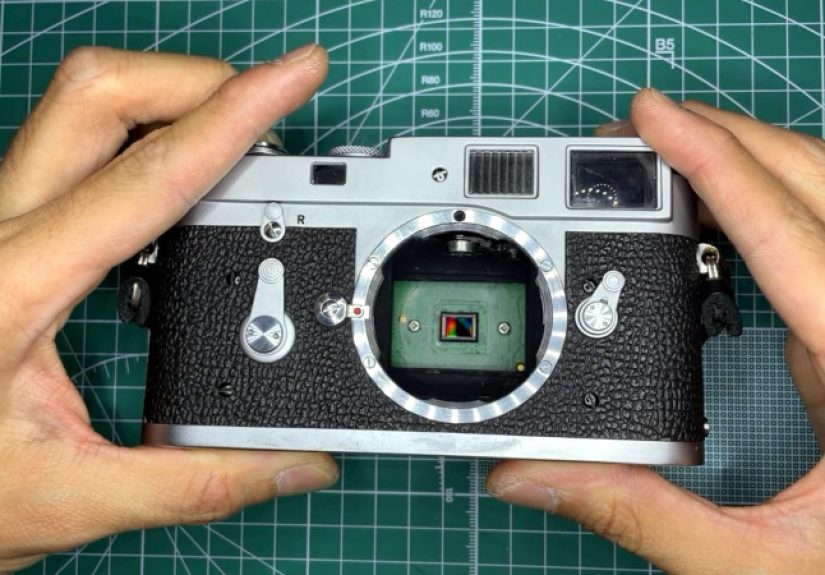
The Leica MPi build replaces the camera’s removable back with a 3D-printed digital module. Inside that module are the Raspberry Pi Zero W, the Raspberry Pi High Quality Camera sensor board, and supporting electronics. The sensor is positioned where the film plane would normally sit, allowing the camera’s lens and rangefinder focusing system to remain meaningful.
That last point is important. Many retro digital conversions simply use a film camera body as a stylish shell. The old lens, shutter, and focusing system become decorations. In the Leica MPi, the project tries to preserve the key actions that make a rangefinder enjoyable. You still focus manually through the optical rangefinder. You still press the original shutter button. You still handle the camera like a mechanical tool rather than a touchscreen with a lens attached.
The shutter synchronization is especially clever. The Leica’s mechanical shutter is connected through the flash sync terminal to a GPIO pin on the Raspberry Pi. When the shutter fires, the circuit signals the Pi to begin an electronic exposure. Because software introduces a slight delay, the mechanical shutter is typically used in Bulb mode while the digital sensor controls the effective exposure time. It is not exactly the same timing experience as film, but it is an elegant way to make old mechanics and modern electronics shake hands without needing a mediator.
The Parts Behind the Magic
The digital heart of the build is the Raspberry Pi High Quality Camera, which uses a 12.3-megapixel Sony IMX477 sensor. This sensor is much smaller than a 35mm film frame, with a 7.9mm diagonal compared with the 36mm by 24mm frame of traditional full-frame photography. That means the Leica lenses produce a heavy crop. A 35mm lens no longer behaves like the classic wide-angle storytelling lens Leica shooters love. It becomes much tighter, more like a telephoto view.
That crop factor is the main compromise. The digital back preserves the Leica’s focusing feel and mechanical soul, but it does not preserve the full optical character of the lens in the same way a full-frame digital Leica would. Wide-angle photography becomes difficult. Framing changes. Depth of field behavior changes. If you are expecting a homemade Leica M11 for the price of a dinner and two emotionally irresponsible coffees, reality will politely tap you on the shoulder.
Still, the project is impressive because it works within severe physical constraints. A Leica M body was designed for film, not circuit boards, cables, sensors, screens, batteries, and software. Placing a sensor at the correct plane, avoiding interference with the shutter curtain, and building a back that fits securely are all difficult tasks. In the MPi, even small details matter, such as sensor alignment and mechanical clearance. This is where the project becomes more than a novelty. It becomes a serious exercise in respectful engineering.
Why Non-Destructive Design Matters
Non-destructive design is not just about resale value, although Leica owners do tend to hear cash register sounds whenever someone says “rare condition.” It is about stewardship. Classic cameras are physical artifacts of photographic history. They represent a design philosophy built around repairability, mechanical precision, and long-term use. A reversible digital back continues that philosophy instead of replacing it.
Modern consumer electronics often age poorly. Batteries swell, apps disappear, ports change, and software support vanishes faster than a lens cap at a wedding. Mechanical Leicas, by contrast, can often be serviced and returned to use. A non-destructive digital back allows the digital portion to be upgraded, removed, repaired, or replaced without sacrificing the camera body. In theory, the sensor module could evolve while the camera remains the same. That is a very Leica-friendly idea: the body endures, the medium changes.
This approach also aligns with the maker movement and the right-to-repair mindset. The user is not merely consuming a sealed product. The user understands the tool, adapts it, and keeps it alive. A digital back for a classic Leica is not just a photography accessory. It is a small rebellion against disposable technology, wearing a very stylish leatherette jacket.
The Post-Digital Appeal
The Leica MPi belongs to what some people call the post-digital movement. That does not mean digital photography is over. Digital photography is very much alive and currently eating everyone’s phone storage. Instead, post-digital photography recognizes that perfect sharpness, instant review, and infinite shooting are not always emotionally satisfying. Sometimes limitations make the process more meaningful.
Film cameras create friction. You must choose your exposure carefully. You must focus manually. You do not get to inspect every image immediately. You live with uncertainty. Digital cameras remove much of that friction, which is useful, but it can also make photography feel too easy, too fast, and too disposable. A digital back inside a classic Leica creates a hybrid experience. You get digital files, but you still interact with a slow, tactile, mechanical camera.
That is the real appeal. The Leica MPi is not about maximum image quality. It is about maximum involvement. Every photo feels intentional. The camera asks you to participate. It makes you slow down, look harder, and accept a little weirdness. In a world where phones can identify your dog, brighten the sky, smooth your face, and possibly judge your lunch, a handmade digital Leica feels refreshingly human.
Digital Back Versus Modern Digital Leica
A modern Leica M11 is a spectacular digital rangefinder with a full-frame 60-megapixel sensor, refined electronics, and compatibility with Leica M lenses. It delivers the real digital Leica experience: full-frame rendering, modern metering, high resolution, and professional reliability. It also costs enough to make many photographers suddenly develop a deep appreciation for “the camera they already own.”
The Leica MPi is not competing with that. It is a maker project, a proof of concept, and a conversation starter. It costs dramatically less in parts if the user already owns the camera, but it demands technical skill, patience, calibration, and a willingness to accept limitations. It is closer to building a custom instrument than buying a finished product.
That difference matters for SEO readers searching for “digital back for Leica,” “Leica M2 digital conversion,” or “Raspberry Pi camera conversion.” Some people want a polished commercial solution. Others want inspiration for a DIY camera project. The Leica MPi sits firmly in the second category. It is not the easy route. It is the interesting route.
How New Digital Film Projects Compare
The dream of turning old film cameras into digital cameras is not new. Over the years, companies and inventors have tried to create digital film cartridges, sensor backs, and hybrid systems for 35mm bodies. Many failed because the engineering challenge is brutal. A 35mm camera leaves very little room for electronics, and sensor placement must be extremely precise.
Newer projects such as I’m Back Roll APS-C show how much interest still exists in this idea. Instead of replacing the entire back of a camera, that concept places a digital sensor, storage, battery, and electronics into a film-roll-style insert. The appeal is obvious: load a digital “roll,” use the analog camera normally, and transfer files later. Some versions are designed with Leica and rangefinder users in mind, including framing aids to account for crop factor.
These commercial concepts are exciting, but they come with their own questions. Compatibility, sensor alignment, battery life, shutter synchronization, delivery timelines, and real-world image quality all matter. Crowdfunding projects should always be approached with healthy skepticism. A working prototype is one thing; a reliable product that fits many different vintage cameras is another. Still, the direction is clear. Photographers want old cameras to stay useful, and they want digital convenience without erasing analog character.
The Biggest Technical Challenge: Sensor Size
The elephant in the darkroom is sensor size. A classic Leica was designed around a 36mm by 24mm film frame. Leica M lenses project an image circle intended for that area. When a much smaller sensor is placed behind the lens, only the center portion of the image is captured. This creates a crop factor, changing the field of view dramatically.
For some photography, this is not fatal. Street details, portraits, textures, signs, hands, windows, and compressed urban scenes can all work beautifully with a tighter crop. But classic Leica photography is often associated with 35mm and 50mm lenses used in environmental, documentary, and street contexts. A tiny sensor makes that harder. The camera may still feel like a Leica, but the pictures no longer frame like one.
A larger APS-C sensor helps. A full-frame sensor would be ideal. But larger sensors create bigger engineering problems: heat, power, cost, board size, shutter clearance, and alignment. This is why a DIY Raspberry Pi Leica back is both brilliant and limited. It proves the concept, but it also shows why no simple universal solution has conquered the market yet.
What Photographers Can Learn From the Leica MPi
The most useful lesson is not “everyone should put a Raspberry Pi in a Leica.” Please do not sprint toward your camera cabinet with a screwdriver unless you know what you are doing. The better lesson is that camera design is about experience, not just specifications.
The Leica MPi reminds us that photography is not only the final file. It is the way the camera sits in the hand, the way the shutter button feels, the way focusing forces attention, and the way limitations shape decisions. A technically imperfect camera can still be creatively rich. In fact, imperfection may be the point.
For makers, the project is a masterclass in restraint. The temptation in any conversion is to add more: bigger screen, more buttons, more features, more menus, more everything. But the strongest part of the Leica MPi is what it refuses to destroy. It does not turn the Leica into a generic digital camera. It lets the old machine remain itself.
Practical Experiences With a Classic Leica Digital Back
Using a non-destructive digital back on a classic Leica would feel different from both film photography and normal digital photography. The first experience would likely be physical: the camera still has weight, balance, and metal confidence. Unlike a modern mirrorless body that wakes up with menus and icons, a Leica M2 starts with mechanical silence. You lift it, focus through the rangefinder patch, set aperture on the lens, and press the shutter. The digital back is present, but it is not the star of the show.
The second experience would be patience. With a Raspberry Pi-based build, you do not shoot like a sports photographer holding down burst mode. You shoot one frame at a time. You wait for the electronics. You respect the delay. At first, that may feel awkward. After a while, it could become part of the rhythm. You stop spraying images and start composing them. The camera becomes less like a machine gun and more like a fountain pen: slower, fussier, and somehow more satisfying.
Framing would require adjustment. Because the sensor is smaller than the original film frame, the viewfinder no longer matches the captured image perfectly. A photographer accustomed to a 35mm Leica lens would need to think in tighter compositions. This could be frustrating for classic street scenes, but surprisingly useful for isolating small details. A bicycle handlebar, a coffee cup on a windowsill, a face in strong afternoon light, or the geometry of a fire escape could become stronger subjects.
Focusing would remain one of the most enjoyable parts. The Leica rangefinder patch encourages deliberate manual focus. Even if the sensor crop changes the final frame, the act of aligning the rangefinder image connects the photographer to the subject. There is no autofocus box jumping around, no face detection deciding that a poster in the background is more interesting than your friend, and no algorithm trying to be helpful in the way only algorithms can be aggressively helpful.
The files themselves would probably not look like modern full-frame Leica images. They may be monochrome, cropped, imperfect, and a little eccentric. But that can be part of the pleasure. The output might feel closer to experimental photography than commercial perfection. Grain is replaced by sensor noise. Film stock personality is replaced by lens character, digital processing, and the quirks of the build. The result is not “better than film” or “better than digital.” It is its own category.
In day-to-day use, the best subjects would likely be slow and graphic: architecture, street corners, still life, portraits in controlled light, workshop scenes, and documentary details. Fast action would be less ideal because of shutter lag and workflow friction. Low light would depend heavily on sensor performance, exposure settings, and how the system handles noise. This is not the camera to bring when a client says, “We need 2,000 perfectly sharp event photos by midnight.” This is the camera to bring when you want to enjoy making ten strange, thoughtful frames and remember every one of them.
The emotional experience may be the strongest reason to care. A non-destructive digital back lets a beloved camera return to active use without consuming film on every outing. Film is wonderful, but it is increasingly expensive and sometimes inconvenient to develop. Digital capture lowers the cost of experimentation. You can test lenses, practice focusing, and enjoy the Leica body more often. Then, when you want the full analog ritual, remove the digital back and load a real roll of film. That flexibility is powerful.
There is also a deeper satisfaction in using technology that does not erase the past. Many upgrades replace old tools. This kind of upgrade collaborates with them. The camera is not treated as obsolete. It is treated as unfinished in the best possible way. A classic Leica with a reversible digital back becomes a bridge between eras: brass and silicon, rangefinder patch and sensor board, mechanical shutter and software exposure. It is a little impractical, a little nerdy, and completely delightful.
Conclusion
A non-destructive digital back for a classic Leica is more than a clever camera hack. It is a thoughtful answer to a question many photographers quietly ask: how can we keep using the tools we love without pretending the digital world never happened? The Leica MPi shows one possible answer. It keeps the mechanical camera intact, respects the original rangefinder experience, and adds digital capture in a reversible way.
It is not perfect. The small sensor creates a major crop. The workflow is slower than a modern digital camera. The build requires technical skill. But those limitations do not ruin the idea. They define it. This is photography as craft, experiment, and conversation. It is for people who love cameras not only as image-making devices, but as objects with history, personality, and a little mechanical theater.
The future of classic camera digital backs may come from polished commercial products, open-source maker projects, or some glorious combination of both. Either way, the principle behind the best versions should remain the same: do not destroy the camera. Let the Leica stay a Leica. Give it a new way to see.
SEO Tags
Note: This article is prepared as clean, publish-ready HTML body content with no source-link blocks, citation artifacts, or unnecessary publishing elements.