Table of Contents >> Show >> Hide
- Why Bad Design Feels So Instantly Wrong
- 50 Structures And Designs That Deserve Side-Eye
- Entrances, Doors, and Stairs From the School of Chaos
- Sidewalks, Streets, and Parking Lots That Clearly Hate Feet
- Bathrooms and Wayfinding Systems Built on Pure Nerve
- Public Spaces, Offices, Schools, and Stores With Main Character Delusion
- Homes and Apartments That Were Clearly Approved During a Group Delirium
- What These Design Fails Actually Teach Us
- The Shared Human Experience of Terrible Design
- Final Thoughts
Every once in a while, you walk into a building, parking lot, bathroom, or stairwell and immediately know a crime has occurred. Not a legal crime, necessarily. More like a crime against logic, knees, patience, and basic human dignity. The sign points left, the door swings right, the ramp launches you into a shrub, and the sink sensor only works if you perform a rain dance. At that moment, one thought arrives with the force of a dropped ceiling tile: who approved this?
That feeling is what makes bad design so memorable. We do not talk lovingly about the hallway that worked perfectly, the curb ramp that lined up with the crosswalk, or the restroom sign we found on the first try. We remember the disasters. The spaces that feel like they were sketched at 4:58 p.m. on a Friday by a committee armed with caffeine, overconfidence, and no user testing.
This article keeps the internet-style headline you requested, but let’s be fair: the real villain is not cartoon evil. It is careless design. When designers ignore accessibility, safety, ergonomics, visibility, comfort, and actual human behavior, the result is not edgy. It is exhausting. Below are 50 structures and design fails that look absurd, feel worse, and teach a surprisingly useful lesson about what good design should do instead.
Why Bad Design Feels So Instantly Wrong
The best design is boring in the best possible way. It is legible, comfortable, safe, and easy to understand. It does not ask you to guess whether a panel is a door, whether a ramp is decorative, or whether the restroom sign is hidden behind a ficus tree for spiritual growth. Good design quietly supports the body and the brain. Bad design turns ordinary tasks into puzzle levels.
That is why terrible structures go viral. People are excellent at noticing friction. A stair with uneven risers feels wrong before you can explain why. A plaza with nowhere to sit feels hostile before you know the planning term. A bathroom with mystery controls feels ridiculous because it ignores the most basic rule of usability: if people cannot tell what to do, the design has failed, not the user.
In other words, the funniest design fails are also the most revealing. They show what happens when looks beat function, when cost-cutting beats common sense, and when nobody bothers to ask the radical question, “How will a real person use this?”
50 Structures And Designs That Deserve Side-Eye
Entrances, Doors, and Stairs From the School of Chaos
- The push door with a giant pull handle. Nothing says “welcome” like a daily trust exercise with a misleading handle. If the hardware invites the wrong action, the door is not mysterious; it is badly designed.
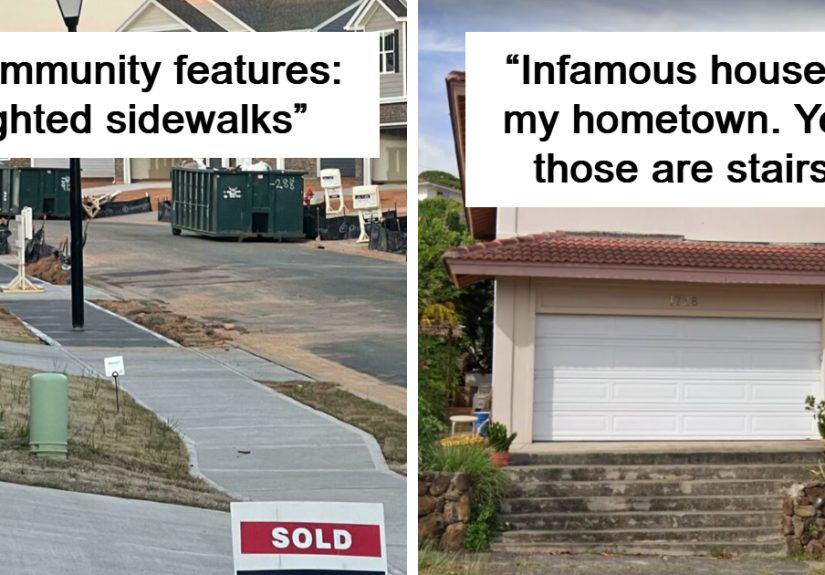
- The door that opens directly onto a stair. Congratulations, your entrance doubles as a surprise athletic event. This kind of layout turns a simple exit into a slapstick hazard.
- The stair tucked under a low beam. A staircase should not require the posture of a medieval peasant. If tall people have to duck mid-step, the structure is picking fights.
- Steps with inconsistent heights. The human body loves rhythm, and bad stairs love betrayal. One odd riser is enough to make everyone look like they forgot how legs work.
- All-gray stairs with no visual contrast. When every tread blends into one giant concrete blur, depth perception packs its bags and leaves. Stylish? Maybe. Helpful? Absolutely not.
- The decorative ramp that is steeper than a ski warm-up. Calling something a ramp does not make it usable. Sometimes it is just a slide for invoices and regret.
- The hidden accessible entrance around the back. Ah yes, the classic “everyone is welcome, but some of you must take the scenic route past the dumpsters.”
- The revolving door as the main event. Revolving doors can be elegant. They can also feel like a carnival ride for people who were just trying to enter a pharmacy.
- The fake door panel that looks more real than the actual door. We have all pushed the wall. The wall did not deserve it, and neither did we.
- The emergency exit disguised like minimalist art. In a crisis, nobody wants a scavenger hunt. If escape requires interpretation, the design has missed the point entirely.
Sidewalks, Streets, and Parking Lots That Clearly Hate Feet
- The crosswalk to nowhere. It begins with hope and ends in grass, gravel, or a guardrail. It is less a pedestrian path and more a dare.
- The curb ramp aimed into traffic instead of the crosswalk. This is the urban design version of pointing someone toward a cliff and saying, “Close enough.”
- The pedestrian button placed miles from the curb. If you have to leave the crossing to request the crossing, somebody has mistaken inconvenience for innovation.
- The sidewalk with a utility pole in the center. A classic. Nothing says “people were considered” like forcing strollers, wheelchairs, and groups to perform single-file maneuvers.
- The bike lane that disappears at the scary part. Smooth, smooth, smooth, and then suddenly: good luck, brave soul. Design should not ghost users at the intersection.
- The giant parking lot with no safe walking route. Cars get geometry, lanes, arrows, and hierarchy. Humans get vibes and a prayer.
- The plaza with no shade, no trees, and enough reflected heat to fry optimism. It photographs beautifully at 8 a.m. and becomes a solar experiment by noon.
- The bench placed six inches from speeding traffic. Yes, technically it is seating. Emotionally, it is an anxiety simulator.
- The sign installed after the decision point. Thanks for telling us where to turn after we have already missed it. Very cinematic. Extremely useless.
- The loading dock that functions as the main pedestrian route. Nothing spices up a morning walk like forklifts and reverse beeps.
Bathrooms and Wayfinding Systems Built on Pure Nerve
- The restroom sign in eight-point gray text on a gray wall. A sign that cannot be found is wall decor with delusions of grandeur.
- The toilet paper dispenser designed like a bank vault. The paper is in there. Probably. Accessing it requires finger strength, patience, and a minor engineering degree.
- The hidden flush control. The toilet has one job, yet its button is concealed like a national secret.
- The motion-sensor faucet with trust issues. You wave. It ignores you. You give up. It suddenly activates after your hands are gone. Performance art, really.
- The mirror mounted for very tall basketball ghosts. Average-height users get forehead. Children get existential confusion.
- The stall door with a gap wide enough to host eye contact. Privacy should not feel like a pilot program.
- The restroom with no hooks, no shelf, and nowhere to place a bag. Wonderful. Now the handbag is hanging off an elbow like a tired parrot.
- Arrows pointing in different directions for the same destination. When wayfinding becomes choose-your-own-adventure, everyone loses.
- The elevator panel that hides the open-door button among twelve identical circles. This is how elevators become stress tests instead of machines.
- The floor numbering system that skips logic entirely. Lobby, Mezzanine, 1, 3, 3A, Sky, 8. Fantastic. Even the building seems unsure where it is.
Public Spaces, Offices, Schools, and Stores With Main Character Delusion
- The gorgeous lobby with nowhere to sit. It looks like a rendering come to life, which is unfortunate because renderings do not get tired feet.
- The bench that prevents conversation. Sometimes seating is arranged so awkwardly that it feels less like hospitality and more like a social experiment.
- The atrium with cathedral-level echo. Stunning acoustics, if your dream is to hear one dropped spoon discussed by the entire building.
- The open office with zero acoustic control. Collaboration is great until you learn seventeen coworkers’ snack preferences and one man’s entire divorce timeline.
- The classroom with glare so strong the whiteboard becomes a light source. When students cannot see the board, the room is not inspiring; it is squint-based learning.
- The thermostat that is visible but untouchable. Few symbols capture modern despair like a thermostat encased in plastic, taunting everyone equally.
- The store checkout line with no beginning, no end, and no mercy. Customers should not need crowd-reading skills to buy toothpaste.
- The product display blocking the aisle. Retail loves drama, but the wheelchair, stroller, and cart traffic did not consent to this obstacle course.
- The building facade that presents a blank wall to the sidewalk. A dead edge kills street life fast. If the exterior says “keep moving,” people will.
- The public square designed to discourage lingering. No shade, no movable chairs, no food, no reason to stay. It is technically a public space and spiritually a screensaver.
Homes and Apartments That Were Clearly Approved During a Group Delirium
- The bathroom door that collides with the toilet. Ah yes, the space-saving layout that saves nothing except the builder a second draft.
- The shower controls directly under the showerhead. Every morning begins with an icy punishment for wanting clean hair.
- The kitchen island that blocks every drawer. It looks expensive, which is helpful because you will need to admire it instead of using the cabinets.
- The light switches assigned by horoscope. One controls the porch, one controls a closet in another timezone, and one appears to summon thunder.
- The bedroom window facing an interior hallway. Privacy? We do not know her. But we do know everyone walking past at 6 a.m.
- The laundry nook you can only reach sideways. The washer fits. The dryer fits. A human performing maintenance does not.
- The closet door that opens into a stair landing. Fashion storage meets gravity in an arrangement nobody needed.
- The outlet hidden behind fixed cabinetry or a bed wall. Power exists in theory, like good intentions and affordable rent.
- The balcony with a tall threshold trip point. Indoor-outdoor living sounds dreamy until every step outside feels like a trap set by your own condo.
- The rooftop amenity deck with no shade, no restroom, and metal seating in direct sun. Luxury, apparently, means being beautifully uncomfortable with a skyline view.
What These Design Fails Actually Teach Us
Behind every ridiculous structure is the same lesson: design is not just about appearance. It is about movement, comprehension, comfort, and dignity. A good entrance tells you where to go. A good sign can be read quickly. A good sidewalk connects to something useful. A good stair is consistent enough that your body trusts it. A good public space gives people reasons to stay instead of reasons to leave.
That is why accessibility, wayfinding, ergonomics, and pedestrian comfort are not side quests. They are the main plot. When a place works for parents with strollers, older adults, wheelchair users, delivery workers, distracted commuters, tired shoppers, and the random person carrying two iced coffees and a laptop, it usually works better for everybody else too. Human-centered design is not a boring constraint. It is the difference between a place people love and a place people roast online forever.
The Shared Human Experience of Terrible Design
What makes bad design such a reliable source of humor is that almost everyone has lived through it. You do not need to be an architect, planner, engineer, or usability specialist to know when a place feels absurd. You just need to exist in a body and try to move through the world without being mildly insulted by it. We have all done the awkward dance in front of a confusing glass door, pretending we meant to inspect the handle. We have all walked confidently toward a sign, only to discover it was pointing to a restroom on another floor, in another wing, possibly in another era.
There is also something uniquely bonding about collective design suffering. A whole crowd can be united by one terrible airport bathroom layout. Office workers can form lifelong alliances over a thermostat that serves no purpose except decorative gaslighting. Apartment renters can spot a fake “luxury” renovation from ten feet away: gray vinyl plank flooring, a sink crammed into a corner, and a shower that practically files a complaint every time you turn it on. Bad design creates community, although admittedly not in the way the designer hoped.
The funniest part is how often people adapt. They learn the trick to make the faucet work. They figure out which hallway actually leads to the exit. They memorize the one stair tread that is slightly taller than the others. They discover the exact angle needed to close the bathroom door without bruising a knee. Humans are astonishingly flexible, and bad spaces rely on that flexibility like a bad group project relies on one responsible person.
But adaptation should not be the benchmark. Nobody should earn a black belt in using a public restroom. Nobody should need insider knowledge to cross a street, find a classroom, use a bench, or plug in a phone. The best spaces remove friction before people feel it. They respect time, energy, and attention. They account for the fact that users are often tired, carrying things, rushing somewhere, aging, distracted, or simply unfamiliar with the space. That is not weakness. That is reality.
And maybe that is why this topic keeps resonating. Terrible structures and ridiculous designs are funny, yes, but they are also revealing. They show how often environments are built around abstract drawings instead of real bodies. They expose the gap between what looks impressive in a concept image and what feels humane on an ordinary Tuesday. Most of all, they remind us that design is never neutral. It either smooths out life or adds one more tiny obstacle to it.
So the next time you find yourself staring at a sign that vanishes into the wallpaper, a crosswalk that delivers you into a hedge, or a sink that only recognizes your existence after you leave, take heart. You are not overreacting. You are simply encountering the built environment at its most unserious. Laugh, take the photo, send it to your friends, and then hope the next generation of designers keeps one humble principle in mind: if normal people cannot use it without improvising, it is not clever. It is just bad.
Final Thoughts
Bad design fails are funny because they are preventable. Most of these disasters are not the result of impossible engineering challenges. They come from skipped feedback, ignored standards, weak user empathy, and the eternal temptation to prioritize appearance over function. The good news is that the fix is usually simple: observe people, test the space, listen earlier, and design for actual human behavior instead of fantasy behavior. A beautiful place that works is memorable. A beautiful place that does not work becomes a meme. And honestly, the meme usually deserves it.