Table of Contents >> Show >> Hide
- 1. Friends “I’ll Be There for You”
- 2. Cheers “Where Everybody Knows Your Name”
- 3. The Fresh Prince of Bel-Air “Yo Home to Bel-Air”
- 4. The Jeffersons “Movin’ On Up”
- 5. Gilligan’s Island “The Ballad of Gilligan’s Isle”
- 6. The Addams Family “The Addams Family Theme”
- Why These Iconic Sitcom Theme Songs Still Matter
- Experience: What Listening to These Sitcom Themes Teaches Us Today
- Conclusion
Note: This article synthesizes verified entertainment reporting, music-history references, songwriter archives, and television-industry sources into original, web-ready content.
Some TV shows need a season to win your heart. A great sitcom theme song needs about eight seconds, a catchy hook, and, in one famous case, exactly four claps. Sitcom theme songs are the tiny front doors of television: open one, and suddenly you are in a Boston bar, a Manhattan apartment, a Bel-Air mansion, a deluxe apartment in the sky, a shipwreck, or a spooky mansion where finger-snapping counts as percussion.
The best iconic sitcom theme songs do more than introduce characters. They explain the premise, sell the mood, and sneak into your memory like a musical raccoon in the attic. Long before streaming platforms added the “Skip Intro” button, viewers sat through these songs every week because they were part of the ritual. The theme told you, “Relax. Your people are here.”
Below are six beloved sitcom theme songs with behind-the-scenes facts, surprising creative turns, and tiny music-history miracles that helped them become pop-culture furniture.
1. Friends “I’ll Be There for You”
The claps were not the whole plan at first
The Friends theme may be the only song in television history that has caused living-room arguments over clap accuracy. The magic number is four. Not three. Not five. Four. That tiny percussive break became so recognizable that people who cannot remember where they put their keys can still clap it with frightening confidence.
The song was performed by The Rembrandts, but it was not simply a band single that got dropped onto a sitcom. The theme was developed for the show with contributions from Michael Skloff, Allee Willis, David Crane, Marta Kauffman, Danny Wilde, and Phil Solem. Before it became the definitive sound of Central Perk-era adulthood, the production had considered a different musical direction connected to R.E.M.’s bright alternative-pop sound. When that did not work out, the team created a custom theme that captured the anxious, broke, friendship-powered energy of young adulthood.
That is why the song works so well. It is not really about having life figured out. It is about not having life figured out, but having people who will sit with you while everything is on fire and maybe order muffins. The guitars are sunny, the rhythm is snappy, and the lyrics carry just enough chaos to fit six twenty-somethings trying to become adults one questionable decision at a time.
A short TV theme became a full pop hit
The original opening-credit version was short, because television themes had to get in, do their job, and leave before the episode began. But the song became so popular that The Rembrandts expanded it into a full-length track. Radio stations helped turn the theme into a mainstream hit, making it one of the rare sitcom theme songs to escape the TV screen and live a second life as a pop single.
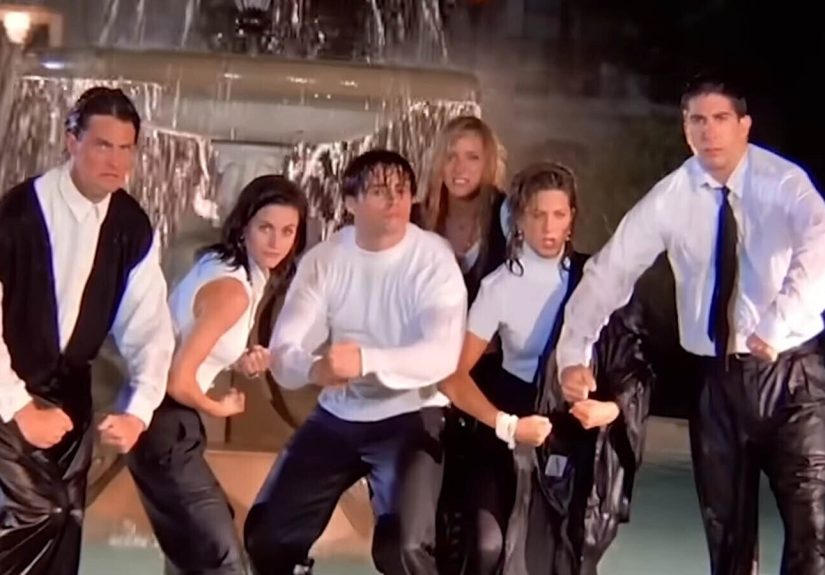
The funny twist? The cast was not necessarily as enchanted by the fountain-dancing opening as fans were. For viewers, the theme feels like pure nostalgia. For the actors, it was work: late-night filming, splashing around, and pretending that dancing in a fountain in formal-ish clothes is a normal group activity. Still, that opening became inseparable from the show’s identity. It is proof that sometimes the thing that feels goofy on set becomes the thing millions of people love forever.
2. Cheers “Where Everybody Knows Your Name”
It took several tries to find the perfect bar song
The Cheers theme is warm, melancholy, and comforting in a way that makes you want to walk into a bar even if you only drink ginger ale and make responsible bedtime choices. Written by Gary Portnoy and Judy Hart Angelo, the song did not arrive fully formed on the first try. The writers went through rejected attempts before landing on the version that became one of the most beloved television theme songs ever.
The origin story begins outside the bar. Portnoy and Hart Angelo had worked on music for a stage project, and one of their earlier songs caught the attention of the people developing Cheers. Because that song could not simply be reused, they wrote new material for the sitcom. After several tries, they found the emotional center of the show: people do not just want a drink; they want a place where they are recognized.
That is the secret sauce. Cheers was not really selling beer. It was selling belonging. The opening credits show old photographs and barroom images, while the song gently tells viewers that the world is exhausting and a familiar place can save your mood. It is basically emotional customer service with piano.
The singer was also one of the writers
Another fun detail: Gary Portnoy himself performed the theme. The production reportedly considered outside singers, but Portnoy’s voice had the intimate, slightly weary quality the song needed. It sounds less like a professional jingle and more like someone at the piano telling you, “Rough day? Pull up a stool.”
That human scale is why the theme has lasted. It is not flashy. It does not shout. It does not announce, “Here comes comedy!” Instead, it creates a feeling. For SEO purposes, yes, we can call it an iconic sitcom theme song. For human purposes, it is a two-minute argument for having a regular place, regular people, and maybe a regular bowl of pretzels.
3. The Fresh Prince of Bel-Air “Yo Home to Bel-Air”
The theme is basically the pilot episode in rap form
Most sitcom themes hint at the premise. The Fresh Prince of Bel-Air theme explains the entire setup so clearly that you could miss the first episode and still know the important stuff. Will Smith’s character starts in West Philadelphia, gets into trouble, and is sent to live with wealthy relatives in Bel-Air. Boom. Premise delivered. No syllabus required.
The song was created by Will Smith and DJ Jazzy Jeff, who were already known as a hip-hop duo before the sitcom turned Smith into a television star. The theme’s genius is its narrative speed. It uses rap storytelling to do what older sitcom themes often did with exposition-heavy lyrics, but with more bounce, personality, and 1990s cool.
There was reportedly an earlier musical idea connected to Quincy Jones, the legendary producer who helped bring the show together. But Smith and DJ Jazzy Jeff created their own version, one that better matched the youth, humor, and hip-hop identity of the series. The result did not merely introduce a sitcom; it became one of the most memorized TV openings ever.
It helped make hip-hop feel at home on network television
By the early 1990s, hip-hop was already a major cultural force, but network sitcoms were still figuring out how to speak to younger audiences without sounding like a guidance counselor in sunglasses. The Fresh Prince theme solved that instantly. It was funny, rhythmic, accessible, and character-driven.
The song also worked because Smith’s delivery was conversational. He was not just performing at the audience; he was talking to them. That “let me tell you what happened” quality made viewers feel included before the first scene. It is a great reminder for writers, musicians, and marketers: if you can explain your story in a way people want to repeat, you have already won half the battle.
4. The Jeffersons “Movin’ On Up”
A theme song with gospel power and sitcom attitude
The Jeffersons theme is not subtle. It enters like a celebration, throws open the curtains, and announces upward mobility with a gospel-flavored grin. “Movin’ On Up” was co-written and performed by Ja’Net DuBois, best known to many viewers as Willona Woods on Good Times, with Jeff Barry, a songwriter connected to major pop hits of the 1960s.
The song’s power comes from how perfectly it captures George and Louise Jefferson’s story. The characters are moving from working-class roots into wealth, and the music makes that transition feel triumphant, funny, and just a little bit sassy. It is not merely “we changed apartments.” It is “we have arrived, please update your mailing address and your attitude.”
The gospel choir sound matters. It gives the theme a communal lift, turning one family’s success into something bigger. The song carries joy, ambition, pride, and comic swagger all at once. In under a minute, it tells us that this sitcom will talk about class, race, money, marriage, ego, and aspiration, but it will do so with rhythm.
The singer was part of Norman Lear’s TV universe
One reason the theme feels so connected to the era is that DuBois was already part of the larger Norman Lear television world. Her work on Good Times and her voice on The Jeffersons linked two major sitcoms through performance, music, and cultural perspective.
The result is one of the most instantly energizing sitcom openings ever made. Some theme songs invite you in. This one kicks the door open, calls the elevator, and makes sure everyone in the lobby knows the Jeffersons are headed up.
5. Gilligan’s Island “The Ballad of Gilligan’s Isle”
It is a sitcom theme, a map, and a disaster report
If The Fresh Prince of Bel-Air theme is a rap pilot, Gilligan’s Island is a sea shanty PowerPoint presentation. The song explains who went sailing, what went wrong, and why everybody is now stuck on an island with alarmingly durable outfits. Written by Sherwood Schwartz and George Wyle, the theme is one of TV’s clearest examples of “premise as song.”
Before the familiar version, the original pilot had a different calypso-style theme. That unaired pilot version had a different flavor, but the final ballad became the one audiences remembered. It gave the show a playful storybook quality, turning a shipwreck into something weirdly cozy. Only television could make maritime disaster feel like appointment viewing.
The theme also changed after the first season. Early lyrics famously grouped the Professor and Mary Ann more vaguely, but later versions named them directly. That change mattered because both characters became fan favorites. The update is a reminder that theme songs are not always frozen on day one. They can evolve as producers learn what viewers love.
The song made the premise impossible to forget
The brilliance of “The Ballad of Gilligan’s Isle” is that it removes confusion. You know the characters. You know the situation. You know the comic engine. Every episode can begin from there without spending time re-explaining why nobody has simply called a boat mechanic and gone home.
That is why the song remains one of the best TV theme songs for storytelling. It is catchy, functional, and slightly ridiculous in the most charming way. It proves that exposition is not the enemy if you can rhyme it, sing it, and make it feel like a campfire tale told by someone wearing a sailor hat.
6. The Addams Family “The Addams Family Theme”
Finger snaps became comedy percussion
Few sitcom themes are as instantly identifiable as The Addams Family. Composer Vic Mizzy created a theme built around a harpsichord-like sound, playful spooky energy, and those unforgettable finger snaps. Before you even see the family, the music tells you exactly what world you are entering: creepy, elegant, silly, and proud of it.
Mizzy did more than write a tune. He helped define the show’s rhythm and visual personality. The opening sequence has the cast snapping along, nearly motionless, like a family portrait that has decided to become a metronome. It is simple, theatrical, and brilliant.
The theme also includes little vocal touches that match the characters’ oddball charm. Ted Cassidy, who played Lurch, added deep-voiced punctuation to the song, giving the opening an extra layer of comic weirdness. The whole thing feels like Halloween learned vaudeville.
The song understood the joke
The reason the Addams Family theme works is that it never treats the family as merely scary. It treats them as delightedly themselves. The music is spooky, yes, but it is also jaunty. It tells the audience not to fear the Addamses, but to enjoy how happily they reject normal suburban behavior.
That balance is difficult. Too creepy, and the sitcom becomes a horror spoof. Too silly, and the gothic elegance disappears. Mizzy found the perfect middle: a theme song that sounds like a haunted house winking at you.
Why These Iconic Sitcom Theme Songs Still Matter
These six songs show that the best sitcom theme songs are not random jingles. They are miniature storytelling machines. Friends captures chosen family. Cheers captures belonging. The Fresh Prince of Bel-Air captures transformation. The Jeffersons captures ambition. Gilligan’s Island captures premise. The Addams Family captures identity.
They also remind us that theme songs used to do serious branding work. Before thumbnails, autoplay trailers, and algorithmic recommendations, the opening song was the handshake. It told viewers what emotional contract they were signing. Are we laughing at workplace loneliness? Are we celebrating social mobility? Are we watching a talking-gothic-family fever dream? The theme answered before the first joke landed.
Modern sitcoms often use shorter intros because platforms want speed and viewers have itchy thumbs. But the cultural power of these classics proves that a memorable opening can make a show larger than itself. A great theme song becomes a shortcut to memory. Hear a few notes, and the whole series walks back into the room.
Experience: What Listening to These Sitcom Themes Teaches Us Today
Spending time with classic sitcom theme songs feels a little like opening an old photo album, except the pictures sing at you. What stands out most is how much emotional information these songs carry. You do not need to be a music professor to feel the difference between the cozy ache of Cheers and the bright chaos of Friends. The songs teach the mood before the scripts begin.
There is also something refreshing about how direct these themes are. Today, many shows prefer moody title cards, abstract images, or a few seconds of atmospheric sound. That can be stylish, but it rarely gives you the same communal thrill as a room full of people clapping along to Friends or reciting the setup to The Fresh Prince of Bel-Air. Classic sitcom themes were built for shared memory. They were not just heard; they were learned.
For anyone who writes content, makes videos, builds brands, or creates entertainment, these songs offer a surprisingly practical lesson: clarity is not boring when it has personality. Gilligan’s Island tells you the whole premise, yet it never feels like homework. The Jeffersons tells you the emotional arc, yet it sounds like a party. The Addams Family tells you the tone, yet it does so with snaps and a smirk. Each one proves that information becomes memorable when it is delivered with rhythm, confidence, and a point of view.
There is another experience hidden in these songs: nostalgia is not only about the past. It is about repetition. Viewers heard these themes again and again until the songs became attached to routines: dinner on a tray, homework half-finished, family members arguing over the remote, Saturday reruns, late-night cable, or streaming marathons years later. The music became a bookmark for comfort.
That may be why these iconic sitcom theme songs still travel so well across generations. Even people who never watched every episode can recognize the openings. The songs escaped their original time slots and became cultural shorthand. Mention the Fresh Prince theme, and someone nearby may start performing it without invitation. Play the Addams Family snaps, and hands respond before brains do. The body remembers what the calendar forgot.
The biggest personal takeaway is that a theme song does not need to be complicated to be brilliant. It needs to be specific. The Cheers theme is specific about loneliness and belonging. The Friends theme is specific about messy adulthood. The Jeffersons theme is specific about arrival. When a song knows exactly what emotional door it is opening, the audience walks through happily.
Conclusion
The most iconic sitcom theme songs are tiny masterpieces hiding in plain sight. They introduce characters, explain worlds, and create emotional muscle memory. Whether it is four claps, two snaps, a barroom piano, a gospel choir, a rap narration, or a shipwreck ballad, each theme proves that television history is not only written in scripts. Sometimes, it is sung before the episode even starts.
So the next time a streaming service offers to skip the intro, think twice. You might be skipping the soul of the show.