Table of Contents >> Show >> Hide
- What Is the Diagonal of a Square?
- Quick Formula Cheat Sheet
- Method 1: Calculate the Diagonal When You Know the Side Length
- Method 2: Calculate the Diagonal When You Know the Perimeter
- Method 3: Calculate the Diagonal When You Know the Area
- Method 4: Calculate the Diagonal Using Coordinates or Direct Measurements
- How to Simplify a Square Diagonal Answer
- Common Examples of Square Diagonal Calculations
- Why the Diagonal Is Longer Than the Side
- Practical Uses for Calculating the Diagonal of a Square
- Experience-Based Tips for Calculating a Diagonal of a Square
- Conclusion
- SEO Tags
A square looks simple: four equal sides, four right angles, no drama. Then someone asks you to calculate its diagonal, and suddenly that tidy little shape starts acting like it has a secret. The good news? The diagonal of a square is not mysterious at all. It is the straight line that runs from one corner of the square to the opposite corner, splitting the square into two equal right triangles.
Whether you are solving homework, checking a construction measurement, designing a tile layout, cutting fabric, planning a garden bed, or trying to figure out whether a large square table will fit through a doorway, knowing how to calculate a diagonal of a square is surprisingly useful. Even better, you do not need advanced math. You only need a few dependable formulas, a little square-root confidence, and perhaps a calculator that has not been hiding in a junk drawer since 2014.
In this guide, you will learn four practical ways to find the diagonal of a square: using the side length, using the perimeter, using the area, and using coordinates or real-world measurements. Each method includes a clear formula, a step-by-step explanation, and examples so you can pick the method that matches the information you already have.
What Is the Diagonal of a Square?
The diagonal of a square is a line segment that connects two opposite corners. Every square has two diagonals, and both are the same length. When you draw one diagonal, the square is divided into two congruent right triangles. Each triangle has two legs equal to the side length of the square, and the diagonal becomes the hypotenuse, which is the longest side of the right triangle.
This is where the Pythagorean theorem enters like the dependable math friend who always brings snacks. The theorem says that in a right triangle:
a² + b² = c²
In a square, both legs of the right triangle are the same length. If each side is s, then the equation becomes:
s² + s² = d²
That simplifies to:
2s² = d²
Take the square root of both sides:
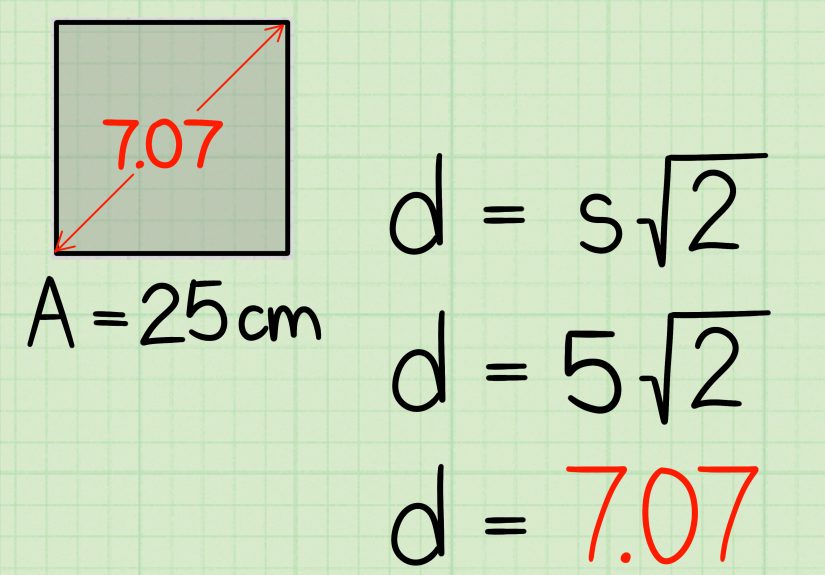
d = s√2
This is the classic diagonal of a square formula. The square root of 2 is approximately 1.414, so the diagonal is always about 1.414 times the side length.
Quick Formula Cheat Sheet
| What You Know | Formula for the Diagonal | Example |
|---|---|---|
| Side length | d = s√2 | If s = 10, d = 10√2 ≈ 14.14 |
| Perimeter | d = (P ÷ 4)√2 | If P = 40, d = 10√2 ≈ 14.14 |
| Area | d = √(2A) | If A = 100, d = √200 ≈ 14.14 |
| Coordinates | d = √((x₂ – x₁)² + (y₂ – y₁)²) | From (0,0) to (10,10), d ≈ 14.14 |
Method 1: Calculate the Diagonal When You Know the Side Length
Formula
d = s√2
This is the fastest and most common way to calculate a diagonal of a square. Use this method when you already know the length of one side. Because all four sides of a square are equal, knowing one side gives you everything you need.
Step-by-Step Example
Imagine you have a square with a side length of 8 inches. To find the diagonal:
- Write the formula: d = s√2
- Substitute the side length: d = 8√2
- Use √2 ≈ 1.414: d ≈ 8 × 1.414
- Calculate: d ≈ 11.31 inches
So, the diagonal of an 8-inch square is about 11.31 inches.
Why This Works
Drawing a diagonal across the square creates a right triangle. The two legs are the sides of the square, and the diagonal is the hypotenuse. Since both legs are equal, the Pythagorean theorem simplifies neatly into d = s√2. In other words, the diagonal is not random; it is geometry doing its job with excellent posture.
When to Use This Method
Use the side-length method when you are measuring a square tile, checking a square picture frame, solving a textbook problem, or working with any square object where one side is known. This is also the easiest method to remember because it uses the most direct information.
Method 2: Calculate the Diagonal When You Know the Perimeter
Formula
d = (P ÷ 4)√2
The perimeter of a square is the total distance around it. Since a square has four equal sides, the perimeter is:
P = 4s
To find one side, divide the perimeter by 4:
s = P ÷ 4
Then plug that side length into the diagonal formula.
Step-by-Step Example
Suppose a square garden has a perimeter of 64 feet. What is the diagonal distance from one corner to the opposite corner?
- Find the side length: s = 64 ÷ 4 = 16 feet
- Use the diagonal formula: d = s√2
- Substitute: d = 16√2
- Approximate: d ≈ 16 × 1.414 = 22.62 feet
The diagonal is about 22.62 feet.
Why This Method Is Useful
Sometimes you do not know the side length directly, but you do know the perimeter. This happens often in real-world projects. For example, you may know how much fencing surrounds a square yard, how much trim goes around a square mirror, or how much edging frames a square patio. Once you divide the perimeter by 4, you are back in familiar territory.
Common Mistake to Avoid
Do not multiply the perimeter by √2. The perimeter is not the side length. First divide by 4, then multiply by √2. Skipping that step is like putting frosting on a cake before baking it: enthusiastic, but mathematically messy.
Method 3: Calculate the Diagonal When You Know the Area
Formula
d = √(2A)
The area of a square is found by multiplying the side length by itself:
A = s²
That means the side length is the square root of the area:
s = √A
Once you know the side length, you can use d = s√2. But there is also a shortcut:
d = √(2A)
Step-by-Step Example
Let’s say the area of a square floor mat is 144 square inches. Find the diagonal.
- Use the formula: d = √(2A)
- Substitute the area: d = √(2 × 144)
- Multiply inside the square root: d = √288
- Simplify or approximate: d ≈ 16.97 inches
The diagonal is about 16.97 inches.
Another Way to Solve It
You can also find the side first:
- s = √144 = 12 inches
- d = 12√2
- d ≈ 16.97 inches
Both approaches give the same result. The shortcut simply saves a step.
When to Use This Method
Use the area method when the problem gives you square units, such as square feet, square inches, square meters, or square centimeters. This is common in flooring, landscaping, classroom geometry, construction planning, and design layouts.
Unit Reminder
Area is measured in square units, but a diagonal is measured in linear units. If the area is given in square feet, the diagonal will be in feet. If the area is given in square centimeters, the diagonal will be in centimeters. Your units should walk out of the problem wearing the correct shoes.
Method 4: Calculate the Diagonal Using Coordinates or Direct Measurements
Formula
d = √((x₂ – x₁)² + (y₂ – y₁)²)
The coordinate method is based on the distance formula, which is really the Pythagorean theorem wearing a slightly fancier jacket. Use this method when the square is placed on a coordinate plane or when you can identify two opposite corners with coordinates.
Step-by-Step Coordinate Example
Suppose one corner of a square is at (2, 3), and the opposite corner is at (8, 9). Find the diagonal.
- Use the distance formula: d = √((x₂ – x₁)² + (y₂ – y₁)²)
- Substitute the coordinates: d = √((8 – 2)² + (9 – 3)²)
- Simplify: d = √(6² + 6²)
- Square the differences: d = √(36 + 36)
- Add: d = √72
- Approximate: d ≈ 8.49 units
The diagonal is about 8.49 units.
Using Real-World Measurements
The same idea works outside the coordinate plane. If you are measuring a square room, a square patio, or a square board, you can check the diagonal directly with a tape measure. This is especially helpful when you want to confirm that something is truly square.
For example, if a square tabletop has sides of 30 inches, the expected diagonal is:
d = 30√2 ≈ 42.43 inches
If your tape measure shows a diagonal close to 42.43 inches from corner to corner, the tabletop is likely square. If the two diagonals are different lengths, something may be out of alignment. Congratulations: you have found geometry’s version of a red flag.
How to Simplify a Square Diagonal Answer
Sometimes your answer will include a square root, such as 10√2. Other times, you may need a decimal approximation, such as 14.14. Both can be correct depending on the situation.
Exact Form
Exact form keeps the square root. For example:
d = 12√2
This is precise and often preferred in math classes.
Decimal Form
Decimal form uses an approximation:
12√2 ≈ 16.97
This is more useful in real-world measuring, building, cutting, shopping, and design work. After all, most tape measures do not have a cheerful little mark labeled “√2.”
Common Examples of Square Diagonal Calculations
Example 1: A Square Tile
A square tile has a side length of 6 inches. Find the diagonal.
d = 6√2 ≈ 8.49 inches
Example 2: A Square Yard
A square yard has a perimeter of 120 feet. Find the diagonal.
First find the side:
s = 120 ÷ 4 = 30 feet
Then calculate the diagonal:
d = 30√2 ≈ 42.43 feet
Example 3: A Square Rug
A square rug has an area of 81 square feet. Find the diagonal.
d = √(2 × 81) = √162 ≈ 12.73 feet
Example 4: A Square on a Coordinate Plane
Opposite corners of a square are located at (1, 1) and (5, 5). Find the diagonal.
d = √((5 – 1)² + (5 – 1)²)
d = √(16 + 16) = √32 ≈ 5.66 units
Why the Diagonal Is Longer Than the Side
A diagonal cuts across the square from corner to corner, so it travels farther than one side. Because it becomes the hypotenuse of a right triangle, it must be longer than either leg. In a square, the diagonal is always √2 times the side length, which means it is about 41.4% longer than the side.
For example, if a square has a side of 100 centimeters, the diagonal is about 141.4 centimeters. This relationship never changes. Tiny square, giant square, square on paper, square patio, square cake panthe diagonal follows the same rule. Geometry is beautifully consistent, even when your cake pan is not.
Practical Uses for Calculating the Diagonal of a Square
Construction and Carpentry
Builders often use diagonal measurements to check whether a frame, room, deck, or foundation is square. If both diagonals are equal, the corners are likely at right angles. If one diagonal is longer than the other, the shape may be slightly skewed.
Interior Design
Diagonal measurements help determine whether furniture, rugs, artwork, or appliances can fit through openings or into rooms. A square coffee table may have a side length that looks manageable, but the diagonal can reveal whether it will rotate through a doorway without causing a comedy scene.
Gardening and Landscaping
If you are laying out a square garden bed, patio, or paving area, diagonal measurements help keep the design even. This is especially useful when stakes, string lines, and measuring tape are involved.
Crafting and Sewing
Quilters, woodworkers, paper crafters, and fabric designers often use diagonals when cutting square pieces, aligning patterns, or creating symmetrical designs. A small measuring error can grow into a large layout problem, so understanding the diagonal is a quiet superpower.
Experience-Based Tips for Calculating a Diagonal of a Square
In real life, calculating the diagonal of a square is often less about memorizing a formula and more about choosing the right shortcut for the job. If you are working on paper, exact form is usually best. If your answer is 7√2, leave it that way unless the problem asks for a decimal. Teachers often like exact answers because they show you understand the relationship, not just how to push calculator buttons with confidence.
If you are measuring something physical, decimal form becomes more helpful. For example, if you are cutting a square board with a 24-inch side, knowing that the diagonal is 24√2 is mathematically elegant, but your saw does not care about elegance. It needs a practical measurement, so 33.94 inches is more useful. In many hands-on projects, rounding to the nearest eighth or sixteenth of an inch may be appropriate, depending on how precise the work needs to be.
One useful habit is to estimate before calculating. Since √2 is about 1.414, the diagonal should be a little less than one and a half times the side length. If a square has a side of 10 inches, the diagonal should be around 14 inches. If your calculator gives you 140 inches, something went wrong. Maybe you added a zero. Maybe the calculator is haunted. Either way, estimation helps you catch errors before they become expensive.
Another helpful tip is to keep your units consistent. Do not mix inches and feet in the same calculation unless you convert first. If one side is measured in feet and another measurement is in inches, convert everything to one unit before using the formula. Unit confusion is one of the most common reasons correct formulas produce incorrect answers.
For construction or layout work, measure both diagonals whenever possible. In a true square, the diagonals are equal. This is one of the simplest ways to check whether a frame, box, room, or garden plot is properly squared. If the diagonals differ, adjust the corners until both diagonal measurements match. This method is widely used because it is simple, visual, and reliable.
When using the area method, remember that area gives you a square measurement, not a side. If the area is 225 square feet, the side is not 225 feet. The side is √225, which equals 15 feet. Then the diagonal is 15√2, or about 21.21 feet. This is a common mistake, especially when people rush through word problems.
Finally, remember that the diagonal of a square is not just a school formula. It is a practical tool for solving everyday problems. It helps you measure across spaces, check alignment, plan materials, and understand how shapes behave. Once you learn the four methodsside length, perimeter, area, and coordinatesyou can handle almost any square diagonal problem without breaking a sweat. A tiny bit of geometry can save you from a lot of guessing, and guessing is rarely a good construction strategy unless your design style is “abstract regret.”
Conclusion
Calculating the diagonal of a square is easier once you understand the relationship between the square and the right triangles created by its diagonal. If you know the side length, use d = s√2. If you know the perimeter, divide by 4 first, then multiply by √2. If you know the area, use d = √(2A). If you are working with coordinates, use the distance formula.
The diagonal of a square appears in math problems, construction projects, design planning, landscaping, crafting, and everyday measuring. Learn the formulas, keep your units consistent, estimate your answers, and you will be able to calculate square diagonals with confidence. The square may look basic, but its diagonal is where the geometry gets interesting.