Table of Contents >> Show >> Hide
- What Is an Outline in Writing?
- Why Writing an Outline Matters
- Before You Start: Set Up Your Outline the Right Way
- Types of Outlines
- How to Write an Outline Step by Step
- Example of a Simple Outline
- Common Outline Mistakes to Avoid
- Use Reverse Outlining to Improve a Draft
- Real-World Experiences With Outlining
- Conclusion
Staring at a blank page can feel a little like being asked to build a house with no blueprint, no tools, and one suspiciously tiny pencil. That is exactly why learning how to write an outline matters. A strong outline turns scattered ideas into a clear writing plan. It helps you organize your thoughts, stay focused, build logical structure, and avoid the classic mid-draft panic of, “Wait… what was my point again?”
Whether you are writing a blog post, essay, research paper, business article, speech, or even a long email that should not have become a novella, outlining gives your content shape before you start drafting. It saves time, improves flow, and makes revision much less painful. In other words, it is not busywork. It is pre-writing with benefits.
In this complete guide, you will learn what an outline is, why it works, the main types of outlines, how to create one step by step, what mistakes to avoid, and how to use outlining as both a planning tool and a revision strategy. You will also see a practical example you can adapt for your own writing projects.
What Is an Outline in Writing?
An outline is a structured plan for a piece of writing. It shows the main idea, the major sections, and the supporting points under each section. Think of it as the skeleton of your content. The muscles, skin, and clever sentences come later.
A good writing outline does not need to be fancy. It just needs to answer a few basic questions:
- What is this piece about?
- What is my central point or thesis?
- What major sections will I include?
- What evidence, examples, or subpoints go under each section?
- What order makes the most sense for the reader?
That is why outlining works for nearly every kind of writing. A student can use it for an academic essay. A marketer can use it for a blog post. A business professional can use it for a report. A novelist can even use it to track plot turns, character arcs, and dramatic reveals. Yes, even the reveal that your hero’s mentor was secretly the villain all along. Outlines do not judge.
Why Writing an Outline Matters
If you have ever written three paragraphs only to delete two of them because they wandered off like unsupervised toddlers, you already understand the value of an outline.
Here is what an effective outline can do:
- Organize ideas clearly: You can see the relationship between your main points and supporting details before drafting.
- Improve logical flow: Outlining helps you arrange information in a sensible order, such as chronological, problem-solution, compare-and-contrast, or cause-and-effect.
- Keep your writing focused: A clear structure reduces tangents and keeps every section tied to your main idea.
- Reveal weak spots early: If one section has no evidence or another seems repetitive, the outline exposes the problem before you waste time writing around it.
- Speed up drafting: Once the structure is in place, drafting becomes easier because you are no longer inventing and organizing at the same time.
- Make revision easier: You can use a reverse outline after drafting to see whether each paragraph still supports the purpose of the piece.
In short, outlining gives you direction. And direction is lovely when the alternative is wandering into paragraph six wondering how you got there.
Before You Start: Set Up Your Outline the Right Way
Before you begin listing Roman numerals or bullet points, slow down for a moment. The best outlines begin before the outline itself.
1. Know Your Purpose
Ask yourself what you are trying to do. Are you informing, persuading, analyzing, comparing, explaining, or telling a story? Your purpose shapes the structure. A persuasive article may need claims and evidence. A how-to guide may need step-by-step sequencing. A personal essay may need reflection and narrative movement.
2. Identify Your Audience
Your audience affects your tone, detail level, examples, and word choice. Writing for college students is different from writing for business executives. Writing for beginners is different from writing for experts. The better you understand your audience, the easier it becomes to decide what belongs in your outline and what should stay in your brain’s junk drawer.
3. Clarify Your Main Idea or Thesis
Your thesis, central idea, or controlling point is the anchor of the outline. Everything in the structure should support it. If your main idea is fuzzy, the outline will wobble. If your thesis is clear, the outline gets much easier.
4. Brainstorm First
Do not force order too early. Start by brainstorming ideas, examples, quotes, facts, questions, and angles. You can use sticky notes, a mind map, a messy list, voice notes, or a document titled “This Will Be Organized Later.” Then group related ideas together and look for patterns. Those clusters usually become your major sections.
Types of Outlines
There is no single perfect outline format. The best one depends on your project, your audience, and how detailed you need to be.
Topic Outline
A topic outline uses short phrases or keywords. It is fast, flexible, and great for blog posts, short essays, and early-stage planning. This is the outline version of wearing sneakers: practical, comfortable, and not trying too hard.
Sentence Outline
A sentence outline uses full sentences for each major point and subpoint. It takes longer to build, but it is especially useful for complex essays, academic writing, and research papers because it forces you to think through your logic more precisely.
Alphanumeric Outline
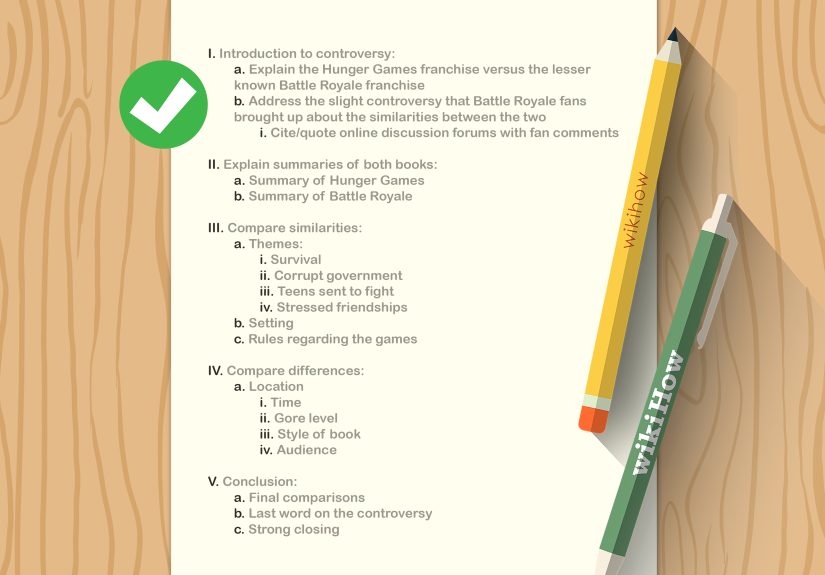
This is the classic formal outline format:
It is commonly used in school and research settings because it clearly shows hierarchy.
Decimal Outline
This format uses numbers like 1.0, 1.1, 1.1.1, and so on. It is especially useful for technical writing, reports, and highly structured documents.
Informal Outline
Not every outline needs Roman numerals dressed like it is attending a formal event. Sometimes a simple bullet list is enough. Informal outlines work well for blog articles, speeches, newsletters, or creative projects where flexibility matters more than strict format.
How to Write an Outline Step by Step
Step 1: Write Your Working Title or Topic
Start with the topic or working title so you know what you are building around. This does not need to be final. A rough title gives your ideas a home.
Step 2: Create a Clear Thesis or Central Goal
Write one sentence that captures the main point of your piece. For example:
A strong outline helps writers organize ideas, improve flow, and draft more efficiently.
That sentence becomes your North Star. Every major section should connect back to it.
Step 3: List the Main Sections
Most outlines begin with three broad parts:
- Introduction
- Body
- Conclusion
Then break the body into major points. For example, if you are writing about how to write an outline, your body sections might be:
- What an outline is
- Why outlines matter
- Types of outlines
- How to create one
- Common mistakes
Step 4: Add Subpoints Under Each Section
Now fill in the support under each main point. This may include examples, research, statistics, stories, questions to answer, or definitions. Keep the subpoints relevant. If something is interesting but unrelated, save it for another piece. Not every shiny idea belongs in this article.
Step 5: Arrange Points in a Logical Order
Sequence matters. The order should feel natural to the reader. Some common organizing patterns include:
- Chronological order: best for process writing and stories
- Problem-solution: best for persuasive or business writing
- Compare-and-contrast: best for analytical content
- General to specific: best for educational and explanatory writing
If a section feels out of place, move it. Outlines are tools, not tattoos.
Step 6: Check for Parallel Structure
Parallel structure means keeping items in the same grammatical form. If one heading starts with a verb, the others should too. If one subpoint is a noun phrase, try to keep the others consistent. This makes the outline easier to scan and understand.
For example:
- Bad: Finding your topic, thesis development, and to gather examples
- Better: Finding your topic, developing your thesis, and gathering examples
Step 7: Revise the Outline Before Drafting
Read through the structure and ask:
- Does every section support the thesis?
- Are any major ideas missing?
- Is anything repetitive?
- Do I have enough support for each point?
- Will this order make sense to my audience?
Once those answers look good, start drafting. Your outline has officially done its noble work.
Example of a Simple Outline
Here is a sample outline for an article called Why Morning Walks Improve Mental Health:
That outline is clear, focused, and ready to become a full draft.
Common Outline Mistakes to Avoid
Making the Outline Too Vague
If your headings are so broad that they could fit ten different articles, your draft may drift. Be specific enough to guide your writing.
Making the Outline Too Detailed
An outline should support the draft, not become a second draft in disguise. If you spend six hours color-coding subpoints for a 900-word article, the outline may have staged a workplace takeover.
Ignoring the Audience
Even the neatest outline fails if it does not match reader needs. A beginner-friendly guide needs definitions and plain language. An expert audience may prefer faster movement and deeper analysis.
Forgetting Evidence
A strong outline does not just list claims. It also hints at what will support those claims, such as examples, data, case studies, or explanations.
Being Too Rigid
Your outline should guide the writing, but it should also evolve. If a better structure appears while drafting, adjust it. Good writers refine their plan as they learn more.
Use Reverse Outlining to Improve a Draft
Here is a smart trick many writers overlook: reverse outlining. Instead of creating an outline before you write, you build one after the draft exists.
To do this, go paragraph by paragraph and write down the main point of each paragraph in a few words. Then ask what job that paragraph is doing. Is it introducing a claim? Giving evidence? Explaining context? Repeating something you already said for the third time because you were tired and your coffee had betrayed you?
Reverse outlining helps you spot:
- Paragraphs that drift off topic
- Missing transitions
- Ideas in the wrong order
- Repetition and weak support
- Places where the draft does not fully support the thesis
If your original outline is the map before the trip, reverse outlining is checking whether you actually ended up where you meant to go.
Real-World Experiences With Outlining
One reason this topic matters so much is that almost every writer eventually has the same experience: they think outlining will slow them down, skip it, and then spend twice as long untangling a chaotic draft. It is a rite of passage. Not a fun one, but a very real one.
Students often discover the value of outlining when they move from short high school assignments to longer college papers. A five-paragraph essay can sometimes survive on sheer determination and last-minute adrenaline. A ten-page research paper usually cannot. Without an outline, it is easy to pile quotations into a document, add a heroic introduction, and then realize the body paragraphs are not actually arranged in a meaningful order. The paper has information, but not direction. Once students start outlining, they usually notice two things: drafting becomes faster, and revision becomes less dramatic.
Blog writers and content marketers have their own version of this lesson. In digital content, structure affects not only readability but also SEO performance. A clear outline helps writers build logical headings, answer search intent, and make sure each section earns its place. It also prevents one of the internet’s favorite bad habits: writing 1,800 words that somehow say 600 words’ worth of useful information. With an outline, writers can see whether they are covering the topic thoroughly or just walking in circles with confidence.
Business writers often describe outlines as sanity-saving. Reports, proposals, presentations, and thought-leadership articles all benefit from clear hierarchy. When several people are involved in a document, an outline becomes even more valuable because it creates alignment before anyone writes full sections. It answers questions like who covers what, what comes first, and how the argument or recommendation will unfold. In collaborative writing, a good outline is not just helpful. It is diplomacy.
Creative writers sometimes resist outlines because they do not want to “ruin the magic.” That concern is understandable, but many discover that outlining does not kill creativity. It protects it. A flexible outline can hold plot beats, emotional turns, scene goals, or character decisions without dictating every sentence. For many writers, the real creative freedom comes from knowing the path well enough to improvise with confidence.
Another common experience is realizing that the first outline is rarely the final outline. Writers often begin with one structure, draft a few sections, and then notice that the piece wants to move differently. That is normal. In fact, it is healthy. The best outlines are working documents. They grow with the project. A rigid outline can feel like a cage, but a living outline feels like support.
Perhaps the most reassuring experience of all is this: even writers who love outlining still make messy drafts. The outline does not make writing perfect. It makes writing manageable. It gives you a starting point, a shape, and a way back when the middle starts to wobble. And honestly, that is plenty. Writing will always involve thinking, revising, and the occasional dramatic sigh. But with a solid outline, it becomes far easier to turn good ideas into clear, organized work.
Conclusion
Learning how to write an outline is one of the most practical writing skills you can build. A strong outline helps you clarify your purpose, understand your audience, organize ideas logically, and draft with more confidence. It can be simple or formal, broad or detailed, but it should always serve the same goal: making your writing clearer and more effective.
If you want better essays, stronger blog posts, cleaner reports, or smoother first drafts, start with an outline. It does not have to be perfect. It just has to be useful. Begin with your central idea, group your main points, add support, and make sure the structure works for the reader. Then draft from there. Your future self, your editor, and probably your blood pressure will appreciate it.